


Cultures Crossing: The Power of Habit in Delaying Gratification
- PMID: 35749259
- PMCID: PMC9437728
- DOI: 10.1177/09567976221074650
Cultures Crossing: The Power of Habit in Delaying Gratification
Abstract
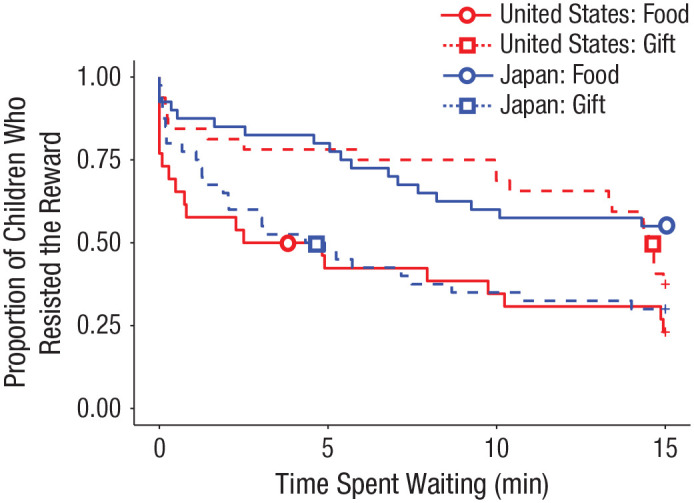
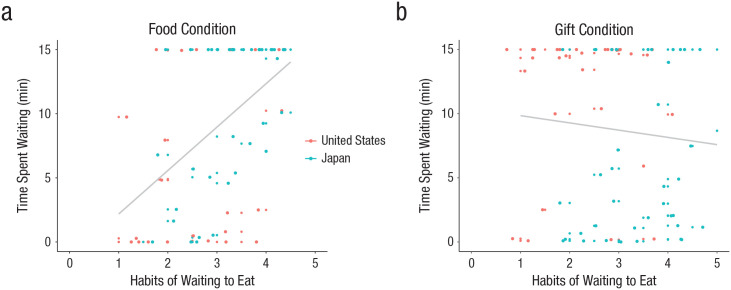
Resisting immediate temptations in favor of larger later rewards predicts academic success, socioemotional competence, and health. These links with delaying gratification appear from early childhood and have been explained by cognitive and social factors that help override tendencies toward immediate gratification. However, some tendencies may actually promote delaying gratification. We assessed children's delaying gratification for different rewards across two cultures that differ in customs around waiting. Consistent with our preregistered prediction, results showed that children in Japan (n = 80) delayed gratification longer for food than for gifts, whereas children in the United States (n = 58) delayed longer for gifts than for food. This interaction may reflect cultural differences: Waiting to eat is emphasized more in Japan than in the United States, whereas waiting to open gifts is emphasized more in the United States than in Japan. These findings suggest that culturally specific habits support delaying gratification, providing a new way to understand why individuals delay gratification and why this behavior predicts life success.
Keywords: children; culture; delay of gratification; habit; open data; open materials; preregistered; self-control.
Conflict of interest statement
Figures
References
-
- Akasawa N., Arao C. (2004). Study on the dietary education for dietary habit of preschool children. The Annual Report of the Faculty of Education, University of Iwate, 63, 135–148. 10.15113/00011400 - DOI
-
- Baldwin A. S., Rothman A. J., Hertel A. W., Linde J. A., Jeffery R. W., Finch E. A., Lando H. A. (2006). Specifying the determinants of the initiation and maintenance of behavior change: An examination of self-efficacy, satisfaction, and smoking cessation. Health Psychology, 25(5), 626–634. 10.1037/0278-6133.25.5.626 - DOI - PubMed
-
- Barbieri M. S., Griguolo M. (1993). Context and quantitative dimension of social conventional transgressions: Is it more serious at home or at school? European Journal of Psychology of Education, 8(2), 105–117. 10.1007/BF03173156 - DOI
-
- Beatty S. E., Kahle L. R., Utsey M., Keown C. F. (1993). Gift-giving behaviors in the United States and Japan: A personal values perspective. Journal of International Consumer Marketing, 6(1), 49–66. 10.1300/J046v06n01_04 - DOI
