


Role of literacy, fear and hesitancy on acceptance of COVID-19 vaccine among village health volunteers in Thailand
- PMID: 35749368
- PMCID: PMC9231694
- DOI: 10.1371/journal.pone.0270023
Role of literacy, fear and hesitancy on acceptance of COVID-19 vaccine among village health volunteers in Thailand
Abstract
Background: The roles of literacy, fear and hesitancy were investigated for acceptance of COVID-19 vaccine (AV) types among village health volunteers (VHVs) in Thailand.
Materials and methods: A cross-sectional study was conducted using an unidentified online questionnaire to assess literacy, fear and hesitancy of COVID-19 vaccine acceptance among Thai VHVs between 1 and 15 October 2021. The questionnaire was developed based on the HLVa-IT (Health Literacy Vaccinale degli adulti in Italiano) for vaccine literacy (VL), using an adult Vaccine Hesitancy Scale (aVHS) for COVID-19 vaccine hesitancy (VH) and Fear of COVID-19 scale (FCoV-19S) for the distress of COVID-19 vaccine. The effects of VL, VH and vaccine fear (VF) on AV were estimated using multivariable logistic regression.
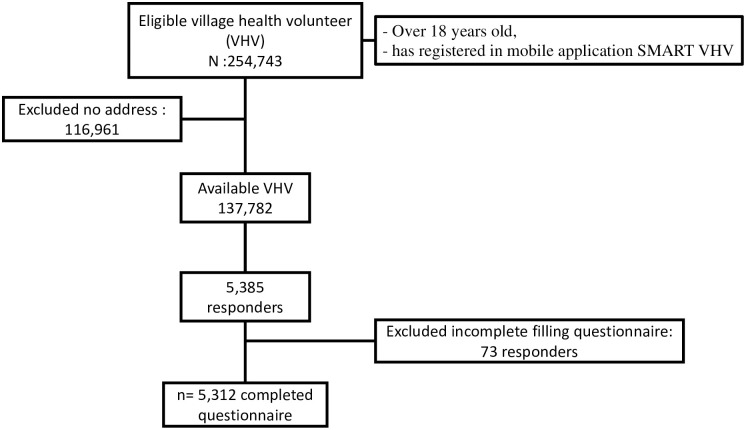
Results: A total of 5,312 VHVs completed the questionnaire. After adjustment with variables in the multivariable analysis, the VL score was insignificantly associated with increased vaccination (aOR = 1.002; (95%CI: 0.994-1.01)), while VF and VH significantly decreased the chance of vaccination, aOR = 0.966 (95%CI: 0.953-0.978) and aOR = 0.969; (95%CI: 0.960-0.979), respectively and VF and VH were negatively associated with AV for all types of vaccine preference, with VL showing a reverse relationship only for mRNA-based vaccines.
Conclusion: VL may not increase AV among VHVs. To increase attitudes toward receiving COVID-19 vaccination in Thailand, the government and health-related organizations should instigate policies to significantly reduce VF and VH among Thai VHVs.
Conflict of interest statement
The authors have declared that no competing interests exist.
References
-
- Ferretti L, Wymant C, Kendall M, Zhao L, Nurtay A, Abeler-Dörner L, et al. Quantifying SARS-CoV-2 transmission suggests epidemic control with digital contact tracing. Science [Internet]. 2020. May 8 [cited 2020 May 21];368(6491). Available from: https://science.sciencemag.org/content/368/6491/eabb6936 doi: 10.1126/science.abb6936 - DOI - PMC - PubMed
-
- WHO Director-General’s opening remarks at the media briefing on COVID-19–11 March 2020 [Internet]. [cited 2021 Jun 2]. https://www.who.int/director-general/speeches/detail/who-director-genera...
-
- WHO Coronavirus (COVID-19) Dashboard [Internet]. [cited 2021 Sep 14]. https://covid19.who.int
-
- Chung H, He S, Nasreen S, Sundaram ME, Buchan SA, Wilson SE, et al. Effectiveness of BNT162b2 and mRNA-1273 covid-19 vaccines against symptomatic SARS-CoV-2 infection and severe covid-19 outcomes in Ontario, Canada: test negative design study. BMJ. 2021. Aug 20;374:n1943. doi: 10.1136/bmj.n1943 - DOI - PMC - PubMed
Publication types
MeSH terms
Substances
LinkOut - more resources
Full Text Sources
Medical
