


Long-term outcome after COVID-19 infection in multiple sclerosis: a nation-wide multicenter matched-control study
- PMID: 35751475
- PMCID: PMC9350009
- DOI: 10.1111/ene.15477
Long-term outcome after COVID-19 infection in multiple sclerosis: a nation-wide multicenter matched-control study
Abstract
Background: Long-term outcome after COVID-19 in patients with multiple sclerosis (pwMS) is scarcely studied and controlled data are lacking.
Objective: To compare long-term outcome after COVID-19 in pwMS to a matched control group of pwMS without COVID-19.
Methods: We included pwMS with PCR-confirmed diagnosis of COVID-19 and ≥6 months of follow-up available and, as a control group, pwMS matched 1:1 for age, sex, disability level and disease-modifying treatment type.
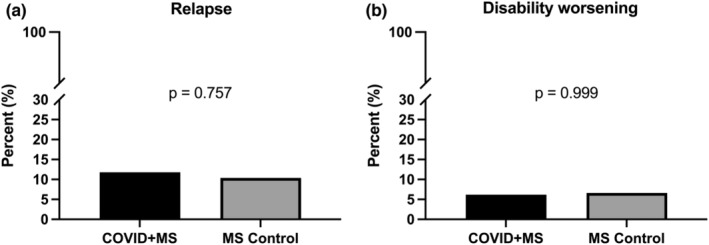
Results: Of 211 pwMS with COVID-19 (mean age 42.6 years [SD 12.2], 69% female, median EDSS 1.5 [range: 0-7.5], 16% antiCD20), 90.5% initially had a mild COVID-19 course. At follow-up, 70% had recovered completely 3 months (M3) after COVID-19, 83% after 6 months (M6) and 94% after 12 months (M12). Mild initial COVID-19 course was the only significant predictor of complete recovery (odds ratio [OR]: 10.5; p<0.001). Most frequent residual symptoms were fatigue (M3: 18.5%, M6: 13.7%, M12: 7.3%), hyposmia (M3: 13.7%, M6: 5.2%, M12: 1.7%) and dyspnea (M3: 7.1%, M6: 6.6%, M12: 2.8%). Compared to matched controls, fatigue, hyposmia and dyspnea were significantly more frequent at M3 and still slightly at M6, while there was no difference at M12. PwMS with COVID-19 had neither a significantly increased risk for relapses (OR 1.1; p=0.70) nor disability worsening (OR 0.96; p=0.60).
Discussion: Long-term outcome of COVID-19 is favourable in a large majority of pwMS with only a small proportion of patients suffering from persistent symptoms usually resolving after 3-6 months. COVID-19 is not associated with increased risk of relapse or disability.
Keywords: COVID-19; Multiple sclerosis; SARS-CoV-2; long term; outcome.
This article is protected by copyright. All rights reserved.
Conflict of interest statement
G.B. has participated in meetings sponsored by and/or received speaker honoraria and/or travel funding from Biogen, Celgene/BMS, Merck, Novartis, Roche, Sanofi‐Genzyme, and Teva, and has received honoraria for consulting from Biogen, Celgene/BMS, Novartis, Roche, Sanofi‐Genzyme, and Teva. He has received research grants from Celgene/BMS and Novartis. H.A. has participated in meetings sponsored by and/or received honoraria (advisory boards, consultations) and/or travel funding from Biogen, Merck, Novartis, Roche, Sanofi‐Genzyme, Celgene/BMS, Janssen‐Cilag, and Teva. C.G. has participated in meetings sponsored by and/or received honoraria (lectures, consultations) and/or travel funding from Biogen, D‐Pharma, Merck, Novartis, Roche, Sanofi‐Genzyme, and Teva. B.H. has received funding for travel or speaker honoraria from Bayer, Biogen, Merck, Novartis, Roche, Sanofi‐Genzyme, and Teva. M.‐S.H. has nothing to disclose. N.K. has participated in meetings sponsored by and/or received speaker honoraria and/or travel funding from Roche, Novartis, and Merck, and held a grant for a Multiple Sclerosis Clinical Training Fellowship Program from ECTRIMS. F.D.P. has participated in meetings sponsored by and/or received honoraria (lectures, advisory boards, consultations) and/or travel funding from Almirall, Bayer, Biogen, Celgene/BMS, Janssen, Merck, Novartis, Sanofi‐Genzyme, Roche, and Teva. Her institution has received research grants from Roche. H.H. has participated in meetings sponsored by and/or received speaker honoraria and/or travel funding from Bayer, Biogen, Merck, Novartis, Roche, Sanofi‐Genzyme, Siemens, and Teva, and has received honoraria for consulting from Biogen, Celgene/BMS, Novartis, and Teva. G.T. has participated in meetings sponsored by and/or received honoraria (lectures, advisory boards, consultations) and/or travel funding from Biogen, Celgene/BMS, Merck, Novartis, Roche, Sanofi‐Genzyme, and Teva. F.L. has participated in meetings sponsored by and/or received honoraria for acting as an advisor/speaker for Bayer, Biogen, Celgene/BMS, MedDay, Merck, Novartis, Roche, Sanofi‐Genzyme, and Teva. P.W. has received funding for travel and honoraria (lectures, advisory boards) from Bayer, Biogen, Celgene/BMS, Janssen‐Cilag, Merck, Novartis, Roche, Sandoz, Sanofi‐Genzyme, and Teva. G.Z. has participated in meetings sponsored by and/or received travel funding or speaker honoraria from Biogen, Merck, Novartis, Roche, Sanofi‐Genzyme, and Teva. M.G. has received support and honoraria for research, consultation, lectures, and education from Almirall, Biogen, Celgene/BMS, Genzyme, Janssen, Merck, Novartis, Roche, Sanofi Aventis, and TEVA Ratiopharm. C.E. has received funding for travel and speaker honoraria from Biogen, Bayer, Merck, Novartis, Roche, Shire, Genzyme, and Teva; has received research support from Biogen, Merck, and Teva; and is serving on scientific advisory boards for Bayer, Biogen, Celgene/BMS, Merck, Novartis, Roche, and Teva. T.B. has participated in meetings sponsored by and received honoraria (lectures, advisory boards, consultations) from pharmaceutical companies marketing treatments for MS: Allergan, Bayer, Biogen, Bionorica, Celgene/BMS, GSK, Janssen‐Cilag, MedDay, Merck, Novartis, Octapharma, Roche, Sandoz, Sanofi‐Genzyme, and Teva. His institution has received financial support in the past 12 months through unrestricted research grants (Bayer, Biogen, Celgene/BMS, Merck, Novartis, Sanofi Aventis, Teva) and for participation in clinical trials in multiple sclerosis sponsored by Alexion, Bayer, Biogen, Celgene/BMS, Merck, Novartis, Octapharma, Roche, Sanofi‐Genzyme, and Teva.
Figures

References
LinkOut - more resources
Full Text Sources
Miscellaneous
