


Long COVID symptoms in SARS-CoV-2-positive children aged 0-14 years and matched controls in Denmark (LongCOVIDKidsDK): a national, cross-sectional study
- PMID: 35752194
- PMCID: PMC9221683
- DOI: 10.1016/S2352-4642(22)00154-7
Long COVID symptoms in SARS-CoV-2-positive children aged 0-14 years and matched controls in Denmark (LongCOVIDKidsDK): a national, cross-sectional study
Abstract
Background: After the acute phase of SARS-CoV-2 infection, children can develop long COVID symptoms. We aimed to investigate the prevalence of long-lasting symptoms, the duration and intensity of symptoms, quality of life, number of sick days and absences from daycare or school, and psychological and social outcomes in children aged 0-14 years who had been infected with SARS-CoV-2 relative to controls with no history of SARS-CoV-2 infection.
Methods: A nationwide cross-sectional study was conducted including children with a confirmed SARS-CoV-2-positive PCR test (cases) and matched controls from Danish national registers. A survey was sent to mothers (proxy reporting) of children aged 0-14 years who had had a positive SARS-CoV-2 test between Jan 1, 2020, and July 12, 2021, and a control group matched (1:4) by age and sex. The survey included the Pediatric Quality of Life Inventory (PedsQL) and the Children's Somatic Symptoms Inventory-24 (CSSI-24) to capture current overall health and wellbeing, and ancillary questions about the 23 most common long COVID symptoms. Descriptive statistics and logistic regression analysis were used. Clinically relevant differences were defined as those with a Hedges'g score greater than 0·2. This study is registered at ClinicalTrials.gov (NCT04786353).
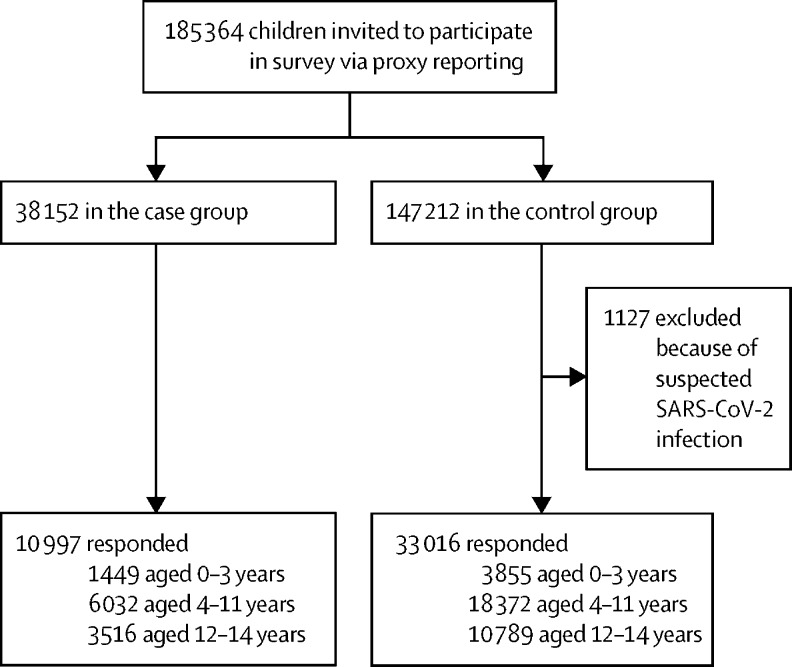
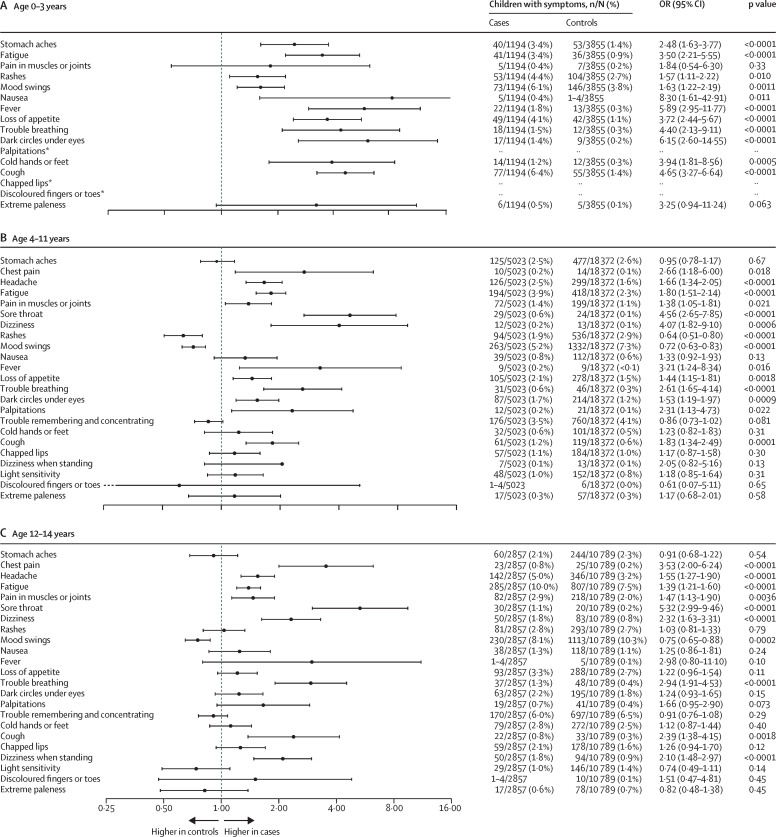
Findings: Responses to the survey were received from 10 997 (28·8%) of 38 152 cases and 33 016 (22·4%) of 147 212 controls between July 20, 2021, and Sept 15, 2021. Median age was 10·2 years (IQR 6·6-12·8) in cases and 10·6 years (6·9-12·9) in controls. 5267 (48·2%) cases and 15 777 (48·3%) controls were female, and 5658 (51·8%) cases and 16 870 (51·7%) controls were male. Cases had higher odds of reporting at least one symptom lasting more than 2 months than did controls in the 0-3 years age group (478 [40·0%] of 1194 vs 1049 [27·2%] of 3855; OR 1·78 [95% CI 1·55-2·04], p<0·0001), 4-11 years age group (1912 [38·1%] of 5023 vs 6189 [33·7%] of 18 372; 1·23 [1·15-1·31], p<0·0001), and 12-14 years age group (1313 [46·0%] of 2857 vs 4454 [41·3%] of 10 789; 1·21 [1·11-1·32], p<0·0001). Differences in CSSI-24 symptom scores between cases and controls were statistically significant but not clinically relevant. Small clinically relevant differences in PedsQL quality-of-life scores related to emotional functioning were found in favour of cases in the children aged 4-11 years (median score 80·0 [IQR 65·0-95·0]) in cases vs 75·0 [60·0-85·0] in controls; p<0·0001) and 12-14 years (90·0 [70·0-100·0] vs (85·0 [65·0-95·0], p<0·0001). PedsQL social functioning scores were also higher in cases (100·0 [90·0-100·0] than controls (95·0 [80·0-100·0]) in the 12-14 years age group (p<0·0001; Hedges g>0·2).
Interpretation: Compared with controls, children aged 0-14 years who had a SARS-CoV-2 infection had more prevalent long-lasting symptoms. There was a tendency towards better quality-of-life scores related to emotional and social functioning in cases than in controls in older children. The burden of symptoms among children in the control group requires attention. Long COVID must be recognised and multi-disciplinary long COVID clinics for children might be beneficial.
Funding: A P Møller and Chastine Mc-Kinney Møller Foundation.
Copyright © 2022 Elsevier Ltd. All rights reserved.
Conflict of interest statement
Declaration of interests SDN declares a research grant from Novo Nordic Foundation, a travel grant from Gilead, and that she is on the Advisory board for Gilead, GlaxoSmithKline, and MSD. All other authors declare no competing interests.
Figures
Comment in
-
Difficult questions about long COVID in children.Lancet Child Adolesc Health. 2022 Sep;6(9):595-597. doi: 10.1016/S2352-4642(22)00167-5. Epub 2022 Jun 23. Lancet Child Adolesc Health. 2022. PMID: 35752193 Free PMC article. No abstract available.
References
-
- Hansen CH, Schelde AB, Moustsen-Helm IR, et al. Vaccine effectiveness against SARS-CoV-2 infection with the Omicron or Delta variants following a two-dose or booster BNT162b2 or mRNA-1273 vaccination series: a Danish cohort study. medRxiv. 2021 doi: 10.1101/2021.12.20.21267966. published online Dec 23. (preprint, version 3). - DOI
-
- Centers for Disease Controls and Prevention Omicron variant: what you need to know. 2022. https://www.cdc.gov/coronavirus/2019-ncov/variants/omicron-variant.html
-
- WHO A clinical case definition of post COVID-19 condition by a Delphi consensus. 6 October 2021. https://www.who.int/publications/i/item/WHO-2019-nCoV-Post_COVID-19_cond... - PMC - PubMed
Publication types
MeSH terms
Associated data
LinkOut - more resources
Full Text Sources
Medical
Miscellaneous
