


Increasing incidence rates of sexually transmitted infections from 2010 to 2019: an analysis of temporal trends by geographical regions and age groups from the 2019 Global Burden of Disease Study
- PMID: 35754034
- PMCID: PMC9233762
- DOI: 10.1186/s12879-022-07544-7
Increasing incidence rates of sexually transmitted infections from 2010 to 2019: an analysis of temporal trends by geographical regions and age groups from the 2019 Global Burden of Disease Study
Abstract
Background: World Health Organization announced its goal of ending sexually transmitted infection (STI) epidemics by 2030. To provide a reference for tailored prevention strategies, we analyzed trends and differences in STIs by geographical regions and age groups from 1990 to 2019.
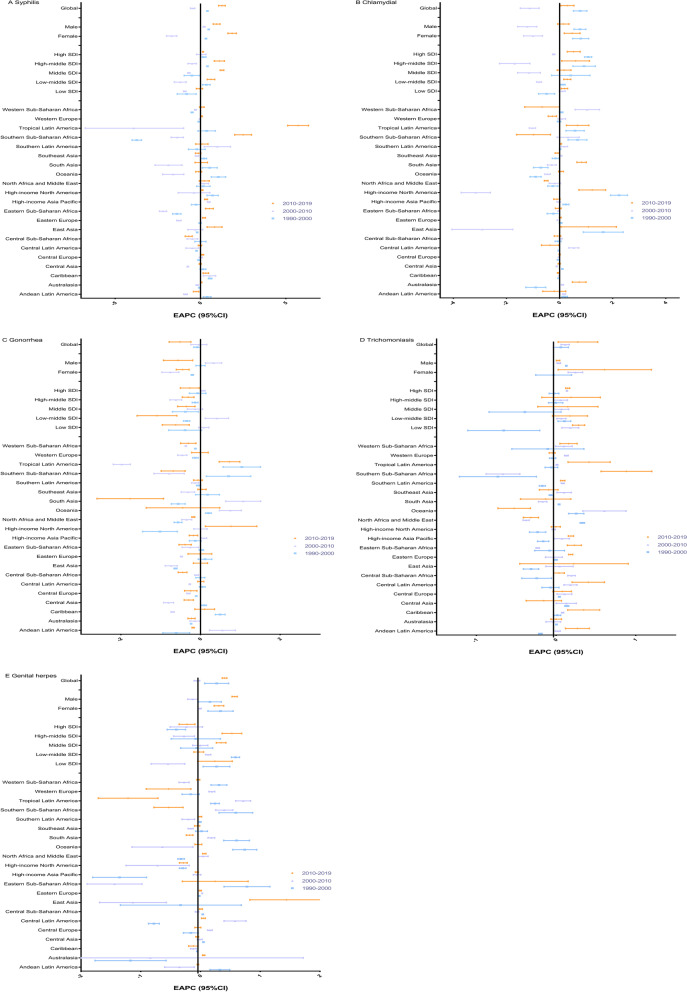
Methods: Annual number of new infections and age-standardized incidence rates (ASRs) of syphilis, chlamydia, gonorrhea, trichomoniasis, and genital herpes were recorded from the 2019 Global Burden of Disease study. We quantified the temporal trends of STIs by calculating changes in new infections and estimated annual percentage changes (EAPCs) of ASR.
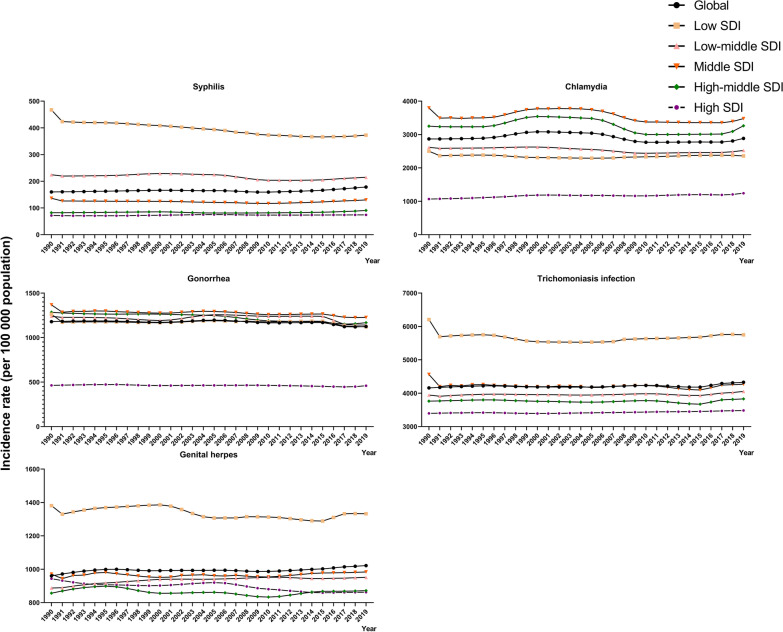
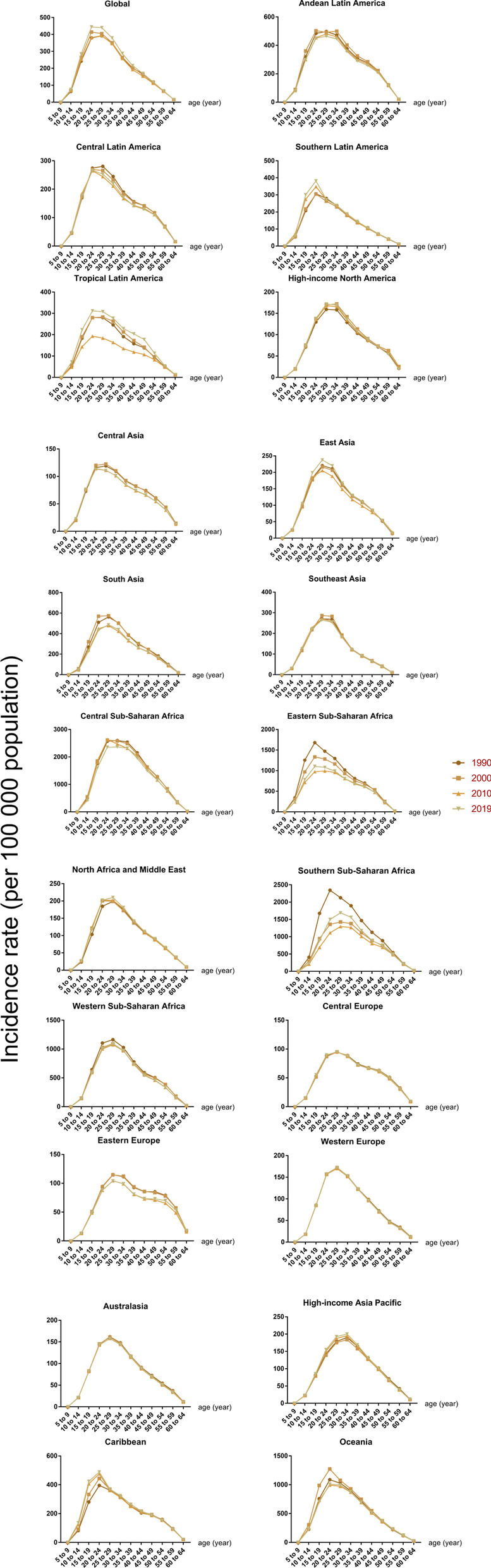
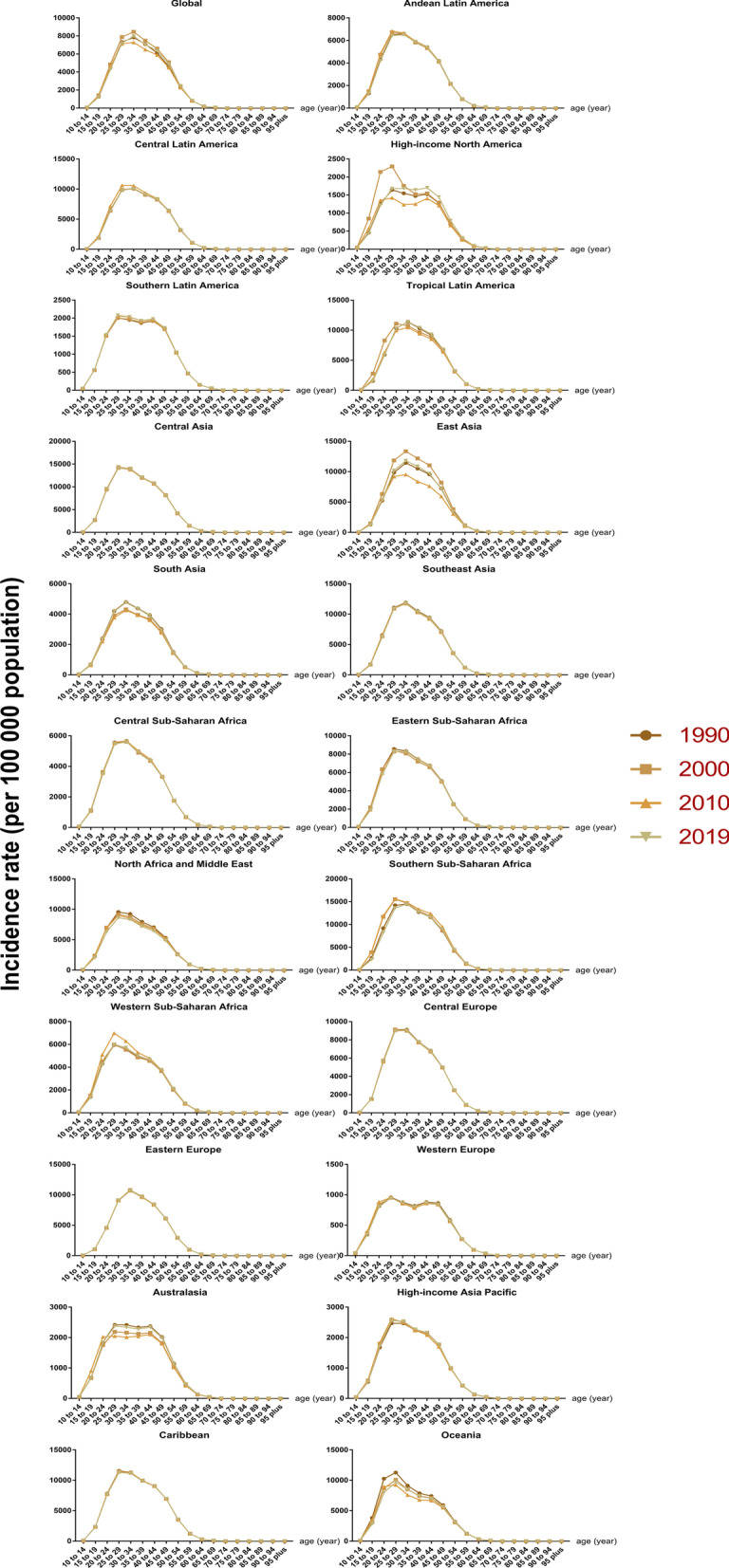
Results: The ASRs of syphilis, chlamydia, trichomoniasis, and genital herpes increased by 1.70% (95% confidence interval [CI], 1.62-1.78%), 0.29% (95% CI 0.04-0.54%), 0.27% (95% CI 0.03-0.52%), and 0.40% (95% CI 0.36-0.44%) per year from 2010 to 2019 worldwide, respectively, while that of gonorrhea did not. The American regions had the greatest increase in ASR for syphilis (tropical Latin America: EAPC, 5.72; 95% CI 5.11-6.33), chlamydia (high-income North America: EAPC, 1.23; 95% CI 0.73-1.73), and gonorrhea (high-income North America: EAPC, 0.77; 95% CI 0.12-1.41). Additionally, southern sub-Saharan Africa and East Asia had the greatest increase in ASR for trichomoniasis (EAPC, 0.88; 95% CI 0.57-1.20) and genital herpes (EAPC, 1.44; 95% CI 0.83-2.06), respectively. In the most recent years, the population with the greatest incidence of syphilis tended to be younger globally (25-29 years in 2010 vs. 20-24 years in 2019) but older in North Africa and Middle East (20-24 year vs. 25-29 years); with chlamydia tended to be older in southern sub-Saharan Africa (25-29 years vs. 30-34 years) but younger in Australasia (40-44 years vs. 25-29 years); with genital herpes tended to be older in high-income North America (20-24 years vs. 25-29 years) and South Asia (25-29 years vs. 30-34 years).
Conclusions: Syphilis, chlamydia, trichomoniasis, and genital herpes showed a trend of increasing ASR from 2010 to 2019. The differences in trends by geographical regions and age groups point to the need for more targeted prevention strategies in key regions and populations.
Keywords: Chlamydia; Genital herpes; Gonorrhea; Syphilis; Trichomoniasis.
© 2022. The Author(s).
Conflict of interest statement
The authors declare that the research was conducted in the absence of any commercial or financial relationships that could be construed as a potential conflict of interest.
Figures
References
-
- Global health sector strategy on sexually transmitted infections. https://www.who.int/reproductivehealth/publications/rtis/ghss-stis/en/.
-
- Report on global sexually transmitted infection surveillance, 2018. Geneva: World Health Organization; 2018. Licence: CC BY-NC-SA 3.0 IGO. https://www.who.int/reproductivehealth/publications/stis-surveillance-20....
MeSH terms
Grants and funding
- 72122001/National Natural Science Foundation of China
- 71934002/National Natural Science Foundation of China
- 2021ZD0114101/National Key Research and Development Program of China
- 2021ZD0114104/National Key Research and Development Program of China
- 2021ZD0114105/National Key Research and Development Program of China
LinkOut - more resources
Full Text Sources
Medical
