Review
. 2022 Jun 27;10(1):28.
doi: 10.1186/s40635-022-00455-6.

Inhaled nitric oxide: role in the pathophysiology of cardio-cerebrovascular and respiratory diseases

Affiliations
Review

Inhaled nitric oxide: role in the pathophysiology of cardio-cerebrovascular and respiratory diseases

Davide Signori et al. Intensive Care Med Exp. .

Abstract

Nitric oxide (NO) is a key molecule in the biology of human life. NO is involved in the physiology of organ viability and in the pathophysiology of organ dysfunction, respectively. In this narrative review, we aimed at elucidating the mechanisms behind the role of NO in the respiratory and cardio-cerebrovascular systems, in the presence of a healthy or dysfunctional endothelium. NO is a key player in maintaining multiorgan viability with adequate organ blood perfusion. We report on its physiological endogenous production and effects in the circulation and within the lungs, as well as the pathophysiological implication of its disturbances related to NO depletion and excess. The review covers from preclinical information about endogenous NO produced by nitric oxide synthase (NOS) to the potential therapeutic role of exogenous NO (inhaled nitric oxide, iNO). Moreover, the importance of NO in several clinical conditions in critically ill patients such as hypoxemia, pulmonary hypertension, hemolysis, cerebrovascular events and ischemia-reperfusion syndrome is evaluated in preclinical and clinical settings. Accordingly, the mechanism behind the beneficial iNO treatment in hypoxemia and pulmonary hypertension is investigated. Furthermore, investigating the pathophysiology of brain injury, cardiopulmonary bypass, and red blood cell and artificial hemoglobin transfusion provides a focus on the potential role of NO as a protective molecule in multiorgan dysfunction. Finally, the preclinical toxicology of iNO and the antimicrobial role of NO-including its recent investigation on its role against the Sars-CoV2 infection during the COVID-19 pandemic-are described.

Keywords: Blood transfusion; Brain disorder; Cardiac arrest; Cardiopulmonary bypass; Endothelial dysfunction; Hemolysis; Ischemia reperfusion; Nitric oxide; Pulmonary hypertension; Shunt; Toxicology.


Conflict of interest statement

The authors have no competing interests to declare.

Figures
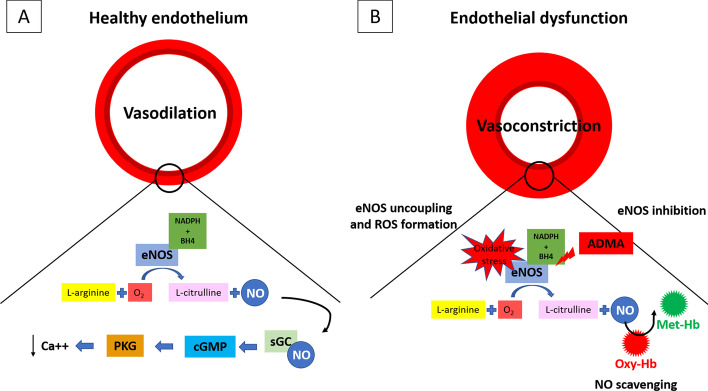
Fig. 1
Fig. 1
NO biosynthesis and eNOS uncoupling. Endogenous NO is produced by NOS by the oxidation of l-arginine to l-citrulline + NO (NADPH and BH4-dependent reaction). NO is one of the end-products of the reaction. Most of the effects of NO in the cardiovascular system are mediated by the activation of sGC, which catalyzes the formation of the second messenger cGMP from GTP. The activation of GMP‐dependent PKG leads to vascular relaxation (A). Several circumstances may alter eNOS activity causing the reduction of NO levels and triggering the production of superoxide instead of NO, a process defined as “eNOS uncoupling”. For example, the depletion of eNOS cofactor BH4, l-arginine deficiency, and increase in endogenous eNOS inhibitor ADMA lead to eNOS uncoupling. This process is largely deleterious and has been linked to endothelial dysfunction, ROS increase and other vascular pathologies. Moreover, NO bioavailability is reduced by free oxy-Hb. B NO: nitric oxide; NOS: nitric oxide synthase; sGC: soluble guanylate cyclase; cGMP: cyclic guanosine monophosphate; GTP: guanosine-5′-triphosphate; PKG: Protein Kinase G; BH4: tetrahydrobiopterin; ADMA: asymmetric dimethylarginine; oxy-Hb: oxyhemoglobin
Fig. 2
Fig. 2
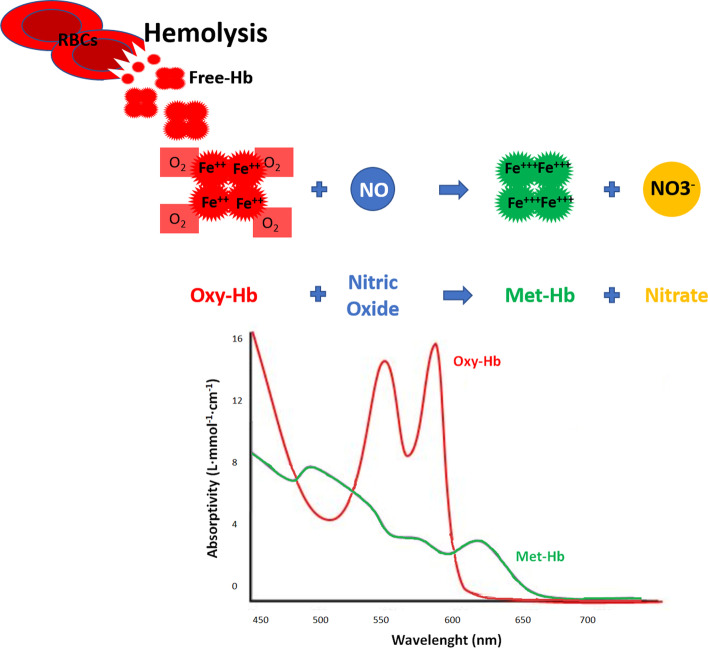
NO scavenging in hemolysis. The di-oxygenation reaction: during intravascular hemolysis in human disease, oxy-Hb (Fe2+) is able to rapidly bind NO, to form bio-inactive NO3 and met-Hb (Fe3+). The NO scavenging causes consequently vasoconstriction. Exogenous NO can prevent this phenomenon by minimizing the scavenging of endogenous NO. The graph represents the different light absorption wavelengths of oxy-Hb and met-Hb. NO: nitric oxide; Hb: hemoglobin; RBC: red blood cell; NO3: nitrate
Fig. 3
Fig. 3
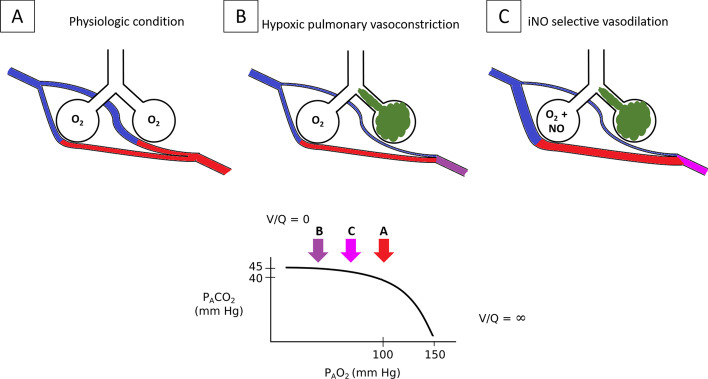
iNO reversal of hypoxemia and pulmonary hypertension during HPV. iNO is a pulmonary selective vasodilator. It diffuses selectively from ventilated alveoli to the adjacent pulmonary capillaries. This reduces PVR and the right ventricle afterload. The selective vasodilation of oxygenated vessels diverges pulmonary blood flow towards the ventilated alveoli. As a consequence, pulmonary shunt is reduced and arterial oxygenation is increased. In physiologic conditions, most of the alveoli are well ventilated and perfused, as low PVR ensures that a wide pulmonary capillary bed is recruited (A). If some of the alveoli are poorly or not ventilated (e.g., atelectasis, pneumonia), the pulmonary capillaries that perfuse those alveoli constrict because of HPV. The increased PVR leads to a consequent reduction of the available pulmonary vascular bed. This limits the blood perfusion of the poorly/not ventilated lung areas then limiting V/Q mismatch and pulmonary shunt (B). The administration of iNO in the presence of HPV increased the vasodilation of pulmonary vessels that are normally ventilated. This condition reduces PVR and reverses hypoxemia by diverging the blood flow to ventilated areas, thus reducing V/Q mismatch and pulmonary shunt (C). The PAO2-PACO2 graph below, represents the partial pressure of the alveolar gases in each of the conditions previously described. In physiologic conditions, the V/Q is optimal (A arrow); when some the alveoli are not ventilated, hypoxemia emerges because of pulmonary shunt despite the compensatory mechanism of HPV (B arrow). This condition may be partially reverted by the administration of iNO (C arrow). The bottom panel was adapted from West JB, Luks AM. West’s Respiratory Physiology. The Essentials. Tenth Edition. Wolters Kluwer, 2015. PAO2: alveolar pressure of O2; PACO2: alveolar pressure of CO2; V/Q: ventilation–perfusion ratio; PVR: pulmonary vascular resistance; HPV: hypoxic pulmonary vasoconstriction

References

    1. Lala P, Chakraborty C. Role of nitric oxide in carcinogenesis and tumour progression. Lancet Oncol. 2001 doi: 10.1016/S1470-2045(00)00256-4. - DOI - PubMed
    1. Culotta E, Koshland DE. NO news is good news. Science. 1992 doi: 10.1126/science.1361684. - DOI - PubMed
    1. (1998) Award ceremony speech. NobelPrize.org. In: https://www.nobelprize.org/prizes/medicine/1998/ceremony-speech/
    1. Fukuto JM. Chemistry of nitric oxide: biologically relevant aspects. Adv Pharmacol. 1995 doi: 10.1016/S1054-3589(08)61078-9. - DOI - PubMed
    1. Mourgeon E, Levesque E, Duveau C, Law-Koune JD, Charbit B, Ternissien E, Coriat P, Rouby JJ. Factors influencing indoor concentrations of nitric oxide in a Parisian intensive care unit. Am J Respir Crit Care Med. 1997 doi: 10.1164/ajrccm.156.5.96-12012. - DOI - PubMed