. 2021 Jan 11:5:100027.
doi: 10.1016/j.cpnec.2021.100027. eCollection 2021 Feb.

Oxytocin and cortisol concentrations in adults with and without autism spectrum disorder in response to physical exercise

Affiliations

Oxytocin and cortisol concentrations in adults with and without autism spectrum disorder in response to physical exercise

L Albantakis et al. Compr Psychoneuroendocrinol. .

Abstract

Autism spectrum disorder (ASD) is a neurodevelopmental disorder, whose core symptoms consist of deficits in social interaction and communication as well as restricted and repetitive behavior. Brain oxytocin (OXT) has been associated with various prosocial behaviors, and might, therefore, be involved in the pathogenesis of disorders associated with socio-emotional dysfunctions such as ASD. However, significant associations between central and peripheral OXT levels may only be present in response to physiological or stressful stimuli but were not shown under baseline conditions. In this study, we, therefore, investigated salivary and plasma OXT in response to physical exercise in adults with ASD (n ​= ​33, mean age: 36.8 ​± ​10.7 years) without intellectual impairment (IQ ​> ​70) and neurotypical controls (n ​= ​31, mean age: 31.0 ​± ​11.7 years). To stimulate the OXT system, we used rapid cycling and measured cortisol (CORT) concentrations to monitor the physiological stress response. When controlling for age, neither salivary OXT (p ​= ​.469), plasma OXT (p ​= ​.297) nor CORT (p ​= ​.667) concentrations significantly differed between groups at baseline. In addition, neither OXT nor CORT concentrations significantly differed between groups after physical exercise. Social anxiety traits were negatively correlated with plasma, but not saliva OXT concentrations in neurotypicals at baseline, while empathetic traits were positively correlated with saliva, but not plasma concentrations in autistic patients at baseline. No significant correlations between salivary and plasma OXT concentrations were found at any time point. Future studies including adult participants should investigate the effect of age on CORT and OXT concentrations in response to stress.

Keywords: Autism spectrum disorder; Cortisol; Oxytocin; Stress.


Conflict of interest statement

None.

Figures
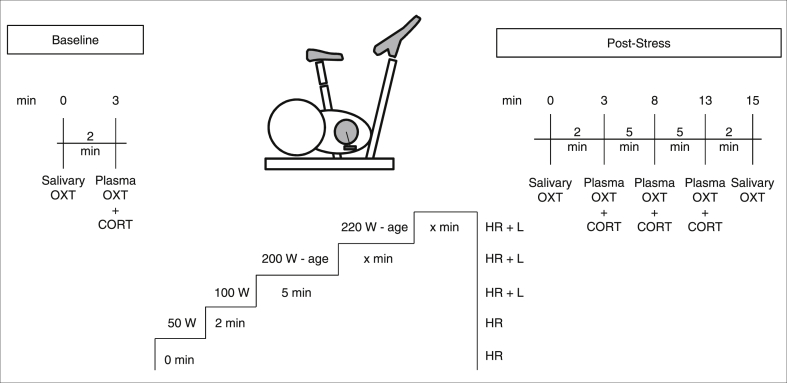
Fig. 1
Fig. 1
Experimental set-up. Heart rate (HR) was measured at the start (0 ​min) and 2 ​min after the start of the cycling. HR and lactate levels (L) were measured 7 ​min after the start of the cycling and prior to the stop of the cycling depending on the individual performance.
Fig. 2a-d
Fig. 2a-d
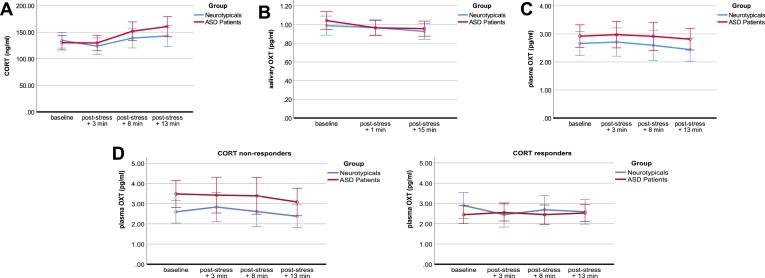
Hormonal changes in response to stress. Figure 2a. Cortisol (CORT) concentrations are illustrated over time for the neurotypical (blue) and autistic group (red). When adding age as covariate, the time effect for the total sample did not reach significance any more. Figure 2b. Salivary oxytocin (OXT) concentrations are illustrated over time for the neurotypical (blue) and autistic group (red). Figure 2c. Plasma oxytocin (OXT) concentrations are illustrated over time for the neurotypical (blue) and autistic group (red). Figures 2d. Plasma oxytocin (OXT) concentrations are illustrated over time for the subsample of CORT non-responders (quotient of the CORT concentrations +13 ​min/baseline ​< ​1.155) and CORT responders (quotient of the CORT concentrations +13 ​min/baseline ​≥ ​1.155). When adding age as covariate, the group effect of neurotypicals and patients with autism spectrum disorder (ASD) did not reach significance any more. For Figures 2a-d ddata are shown as means ​± ​2 Standard Error of Means. (For interpretation of the references to colour in this figure legend, the reader is referred to the Web version of this article.)
Fig. 3a and b
Fig. 3a and b
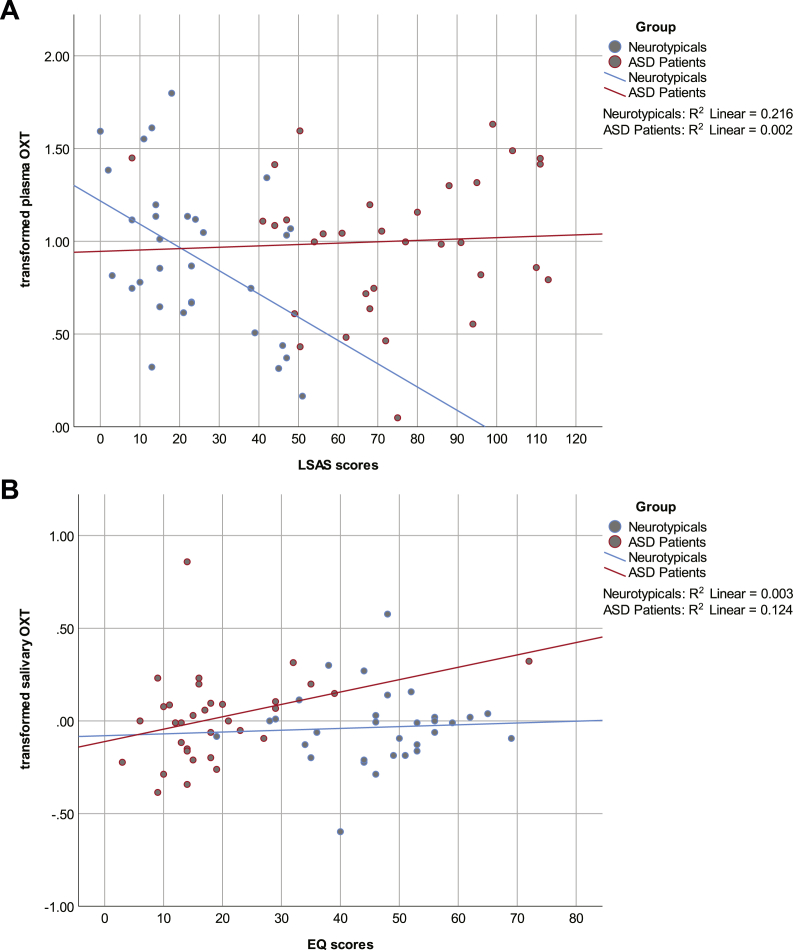
Behavioral phenotype in relation to basal oxytocin (OXT) concentrations. Figure 3a. Social anxious traits on plasma OXT concentrations. Regression of Liebowitz Social Anxiety Scale (LSAS) scores upon transformed plasma OXT concentrations at baseline for the neurotypical (blue) and autistic group (red). Figure 3b. Empathetic traits on salivary OXT concentrations. Regression of empathy quotient (EQ) scores upon transformed salivary OXT concentrations at baseline for the neurotypical (blue) and autistic group (red). (For interpretation of the references to colour in this figure legend, the reader is referred to the Web version of this article.)

References

    1. American Psychiatric Association . fifth ed. America Psychiatric Publishing; Arlington, VA: 2013. Diagnostic and Statistical Manual of Mental Disorders.
    1. Lai M.C., Baron-Cohen S. Identifying the lost generation of adults with autism spectrum conditions. The Lancet Psychiatry. 2015;2:1013–1027. doi: 10.1016/S2215-0366(15)00277-1. - DOI - PubMed
    1. Albantakis L., Parpart H., Thaler H., Krankenhagen M., Böhm J., Zillekens I.C., Schilbach L. Depression bei Erwachsenen mit Autismus-Spektrum-Störung. Nervenheilkunde. 2018;37:587–593.
    1. Bhandari R., Paliwal J.K., Kuhad A. Neuropsychopathology of autism spectrum disorder: complex interplay of genetic, epigenetic, and environmental factors. Adv. Neurobiol. 2020;24:97–141. doi: 10.1007/978-3-030-30402-7_4. - DOI - PubMed
    1. Neumann I.D., Landgraf R. Balance of brain oxytocin and vasopressin: implications for anxiety. depression, and social behaviors. 2012 doi: 10.1016/j.tins.2012.08.004. - DOI - PubMed

LinkOut - more resources