


Detecting, preventing and treating non-adherence to immunosuppression after kidney transplantation
- PMID: 35756738
- PMCID: PMC9217626
- DOI: 10.1093/ckj/sfac017
Detecting, preventing and treating non-adherence to immunosuppression after kidney transplantation
Abstract
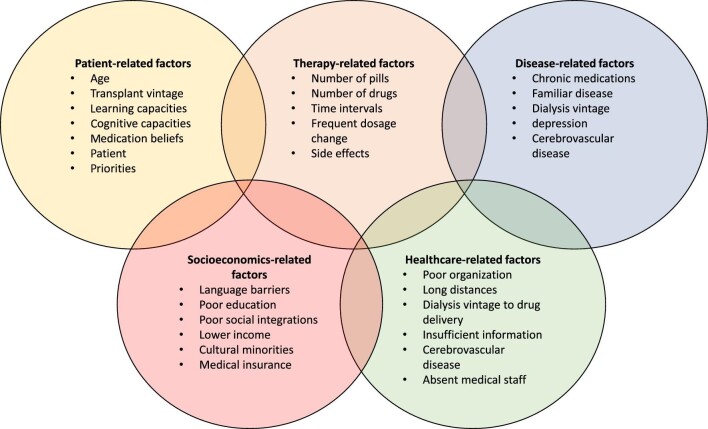
Medication non-adherence (MNA) is a major issue in kidney transplantation and it is associated with increased risk of rejection, allograft loss, patients' death and higher healthcare costs. Despite its crucial importance, it is still unclear what are the best strategies to diagnose, prevent and treat MNA. MNA can be intentional (deliberate refusal to take the medication as prescribed) or unintentional (non-deliberate missing the prescribed medication). Its diagnosis may rely on direct methods, aiming at measuring drug ingestions, or indirect methods that analyse the habits of patients to adhere to correct drug dose (taking adherence) and interval (time adherence). Identifying individual risk factors for MNA may provide the basis for a personalized approach to the treatment of MNA. Randomized control trials performed so far have tested a combination of strategies, such as enhancing medication adherence through the commitment of healthcare personnel involved in drug distribution, the use of electronic reminders, therapy simplification or various multidisciplinary approaches to maximize the correction of individual risk factors. Although most of these approaches reduced MNA in the short-term, the long-term effects on MNA and, more importantly, on clinical outcomes remain unclear. In this review, we provide a critical appraisal of traditional and newer methods for detecting, preventing and treating non-adherence to immunosuppression after kidney transplantation from the perspective of the practising physician.
Keywords: behaviour therapy; drug monitoring; graft rejection; immunosuppressive agents; medication adherence; organ transplantation; patient education; risk factors.
© The Author(s) 2022. Published by Oxford University Press on behalf of the ERA.
Figures
References
-
- Gondos A, Dohler B, Brenner Het al. Kidney graft survival in Europe and the United States: strikingly different long-term outcomes. Transplantation 2013; 95: 267–274 - PubMed
-
- Gonzalez-Molina M, Burgos D, Cabello Met al. Impact of immunosuppression treatment on the improvement in graft survival after deceased donor renal transplantation: a long-term cohort study. Nefrologia 2014; 34: 570–578 - PubMed
-
- Wang JH, Skeans MA, Israni AK. Current status of kidney transplant outcomes: dying to survive. Adv Chronic Kidney Dis 2016; 23: 281–286 - PubMed
-
- Vlaminck H, Maes B, Evers Get al. Prospective study on late consequences of subclinical non-compliance with immunosuppressive therapy in renal transplant patients. Am J Transplant 2004; 4: 1509–1513 - PubMed
-
- Denhaerynck K, Burkhalter F, Schafer-Keller Pet al. Clinical consequences of non adherence to immunosuppressive medication in kidney transplant patients. Transpl Int 2009; 22: 441–446 - PubMed
Publication types
LinkOut - more resources
Full Text Sources
