


Evaluation of sawbones training protocol in bone quality classification using tactile sensation
- PMID: 35756783
- PMCID: PMC9201665
- DOI: 10.1016/j.jds.2021.12.013
Evaluation of sawbones training protocol in bone quality classification using tactile sensation
Abstract
Background/purpose: Bone quality may affect the implantation protocol. This study aimed to assess whether training protocols could improve novice dental practitioners' abilities in judging bone densities with tactile sensation.
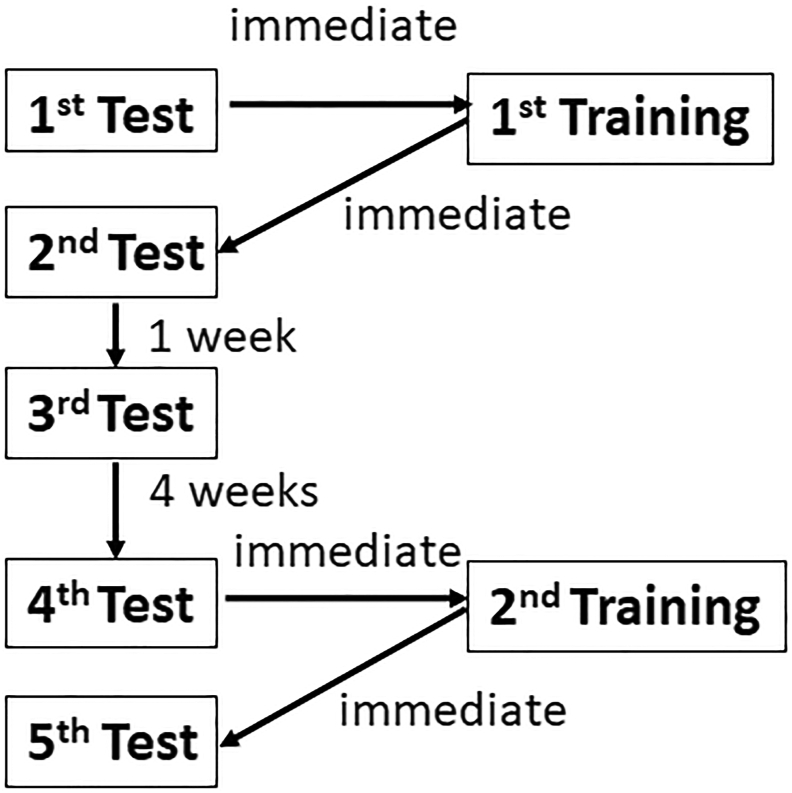
Materials and methods: Twenty-five operators were recruited to evaluate the density of artificial polyurethane bone blocks by a 2-mm twist-drill drilling and reported the bone quality perceived in a 100-mm VAS line. Five blocks (densities: 0.08-0.48 g/cm3) were used to simulate cancellous bone with extremely low to medium-high densities. Five tests were performed on three days, separated by one week and one month. A training session was arranged on the first day and the third day. In each test, the operator drilled a 0.8 g/cm3 block as the reference (VAS = 100) and then the five test blocks in a randomized sequence. Each training session included a 0.8 g/cm3 followed by five 0.16 and 0.32 g/cm3 alternative block-drillings. VAS values and number of density-sequencing errors were analyzed with GLM repeated measures and Friedman test.
Results: While mean VAS values were significantly different among the five test blocks, it was not noticed in blocks of the same density between test sessions. Significant linear correlations were observed between VAS values and block densities. Training did not influence the VAS evaluation and hardness sequencing in general but training significantly reduced the sequencing errors in operators with inferior initial performance.
Conclusion: The proposed training protocol can improve the bone-quality perception among less experience dentists with poorer initial performance in bone density evaluation.
Keywords: Artificial bone blocks; Bone quality; Dental education; Dental implant; Tactile sensation.
© 2021 Association for Dental Sciences of the Republic of China. Publishing services by Elsevier B.V.
Conflict of interest statement
The authors have no conflict of interest relevant to this article.
Figures


References
-
- van Steenberghe D., Jacobs R., Desnyder M., Maffei G., Quirynen M. The relative impact of local and endogenous patient-related factors on implant failure up to the abutment stage. Clin Oral Implants Res. 2002;13:617–622. - PubMed
-
- Engquist B., Bergendal T., Kallus T., Linden U. A retrospective multicenter evaluation of osseointegrated implants supporting overdentures. Int J Oral Maxillofac Implants. 1988;3:129–134. - PubMed
-
- Jaffin R.A., Berman C.L. The excessive loss of Brånemark fixtures in type IV bone: a 5-year analysis. J Periodontol. 1991;62:2–4. - PubMed
-
- Marković A., Calvo-Guirado J.L., Lazić Z., et al. Evaluation of primary stability of self-tapping and non-self-tapping dental implants. A 12-week clinical study. Clin Implant Dent Relat Res. 2013;15:341–349. - PubMed
-
- O'Sullivan D., Sennerby L., Jagger D., Meredith N. A comparison of two methods of enhancing implant primary stability. Clin Implant Dent Relat Res. 2004;6:48–57. - PubMed
LinkOut - more resources
Full Text Sources
