


History of Spinal Cord "Pain" Pathways Including the Pathways Not Taken
- PMID: 35756909
- PMCID: PMC9218418
- DOI: 10.3389/fpain.2022.910954
History of Spinal Cord "Pain" Pathways Including the Pathways Not Taken
Abstract
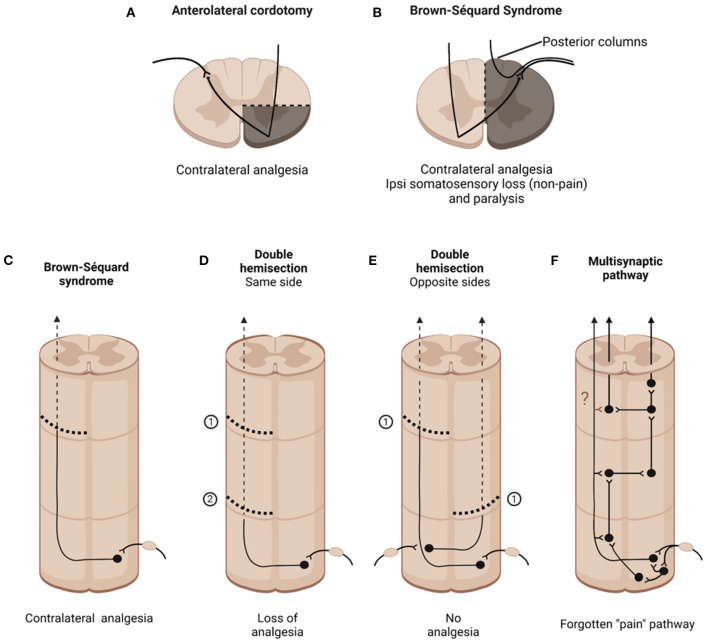
Traditional medical neuroanatomy/neurobiology textbooks teach that pain is generated by several ascending pathways that course in the anterolateral quadrant of the spinal cord, including the spinothalamic, spinoreticular and spinoparabrachial tracts. The textbooks also teach, building upon the mid-19th century report of Brown-Séquard, that unilateral cordotomy, namely section of the anterolateral quadrant, leads to contralateral loss of pain (and temperature). In many respects, however, this simple relationship has not held up. Most importantly, pain almost always returns after cordotomy, indicating that activation of these so-called "pain" pathways may be sufficient to generate pain, but they are not necessary. Indeed, Brown-Séquard, based on his own studies, eventually came to the same conclusion. But his new view of "pain" pathways was largely ignored, and certainly did not forestall Spiller and Martin's 1912 introduction of cordotomy to treat patients. This manuscript reviews the history of "pain" pathways that followed from the first description of the Brown-Séquard Syndrome and concludes with a discussion of multisynaptic spinal cord ascending circuits. The latter, in addition to the traditional oligosynaptic "pain" pathways, may be critical to the transmission of "pain" messages, not only in the intact spinal cord but also particularly after injury.
Keywords: Brown-Séquard Syndrome; anterolateral quadrant; multisynaptic spinal cord pathway; pain pathways; spinothalamic tract.
Copyright © 2022 Basbaum.
Conflict of interest statement
The author declares that the research was conducted in the absence of any commercial or financial relationships that could be construed as a potential conflict of interest. The handling editor TY and the reviewer HF declared a shared affiliation with the author at the time of review.
Figures
References
-
- Noordenbos W. Pain: Problems Pertaining to the Transmission of Nerve Impulses Which Give Rise to Pain. Amsterdam: Elsevier; (1959) p. 182.
-
- Livingston WK. Pain and Suffering, editors. Howard Fields. Washington, DC: IASP Press; (1943) p. 250.
-
- Basbaum AI. The bane of pain is mainly in the brain. In: Linden DJ, editor. Think Tank: Forty Neuroscientists Explore the Biological Roots of Human Experience. New Haven, Conn: Yale University Press; (2018). p. 128–134.
-
- Lenz FA, Casey KL, Jones EG, Willis WD. The Human Pain System: Experimental and Clinical Perspective. Cambridge UK: Cambridge University Press; (2010). p. 638.
-
- Brown-Séquard CE. Course of Lectures on the Physiology and Pathology of the Central Nervous System. Collins, Philadelphia: Collins, Printer; (1860).
