


Adjunctive Inspiratory Muscle Training During a Rehabilitation Program in Patients With Breast Cancer: An Exploratory Double-Blind, Randomized, Controlled Pilot Study
- PMID: 35756985
- PMCID: PMC9214315
- DOI: 10.1016/j.arrct.2022.100196
Adjunctive Inspiratory Muscle Training During a Rehabilitation Program in Patients With Breast Cancer: An Exploratory Double-Blind, Randomized, Controlled Pilot Study
Abstract
Objective: To investigate whether inspiratory muscle training (IMT) offered adjunctively to an exercise training program reduces symptoms of dyspnea in survivors of breast cancer.
Design: Double-blind, parallel-group, randomized controlled trial.
Setting: Outpatient rehabilitation program in a university hospital.
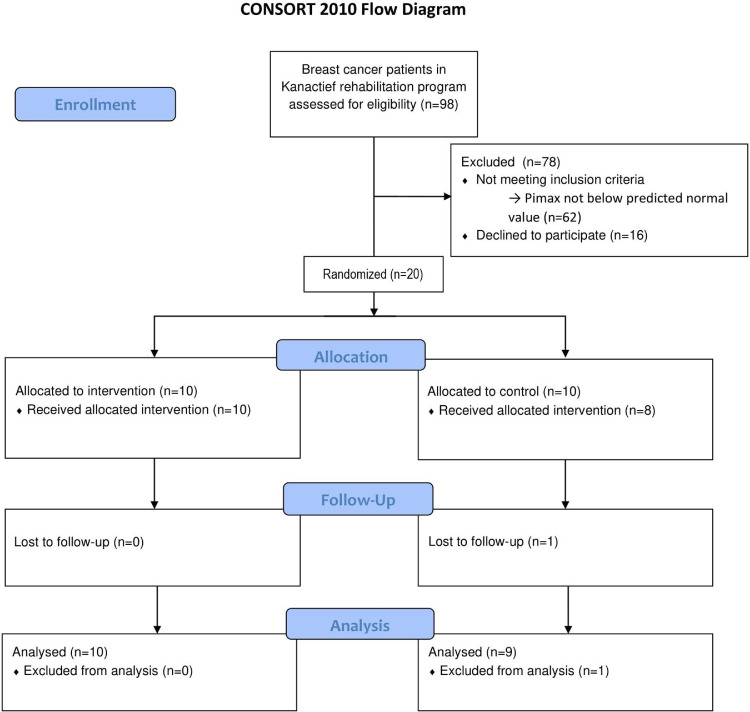
Participants: Ninety-eight female patients with breast cancer who completed adjuvant treatment and subsequently entered cancer rehabilitation were screened for participation. Inclusion criteria were reduced inspiratory muscle strength and/or symptoms of dyspnea. Twenty patients (N=20) were randomly assigned to an intervention group (n=10) or a control group (n=10).
Intervention: Both groups received a 3-month exercise training program in combination with either IMT (intervention) or sham-IMT (control).
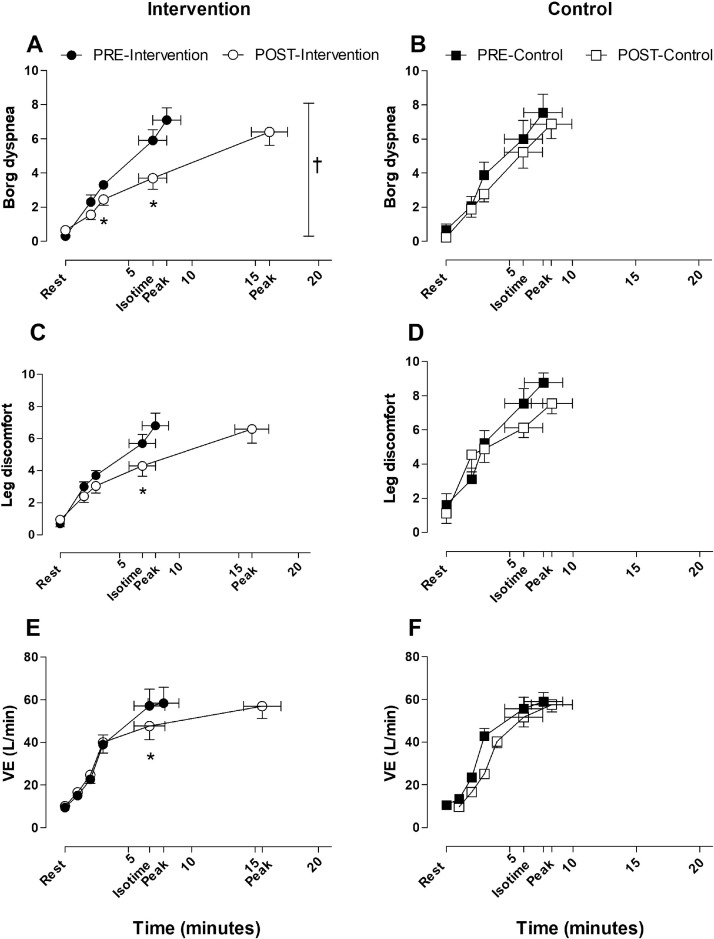
Main outcome measures: Changes in dyspnea intensity perception (10-point Borg Scale) at comparable time points (isotime) during constant work rate cycling was the primary outcome. Secondary outcomes included changes in respiratory muscle function, exercise capacity, and changes in symptoms of dyspnea during daily life (Transitional Dyspnea Index [TDI]).
Results: The intervention group achieved a larger reduction in exertional dyspnea at isotime compared with the control group (-1.8 points; 95% CI, -3.7 to 0.13; P=.066). The intervention group also exhibited larger improvements in dyspnea during daily life (TDI score, +2.9 points; 95% CI, 0.5-5.3; P=.022) and improved both respiratory muscle endurance (+472 seconds; 95% CI, 217-728; P=.001) and cycling endurance (+428 seconds; 95% CI, 223-633; P=.001) more than the control group.
Conclusions: Because of the limited sample size all obtained findings need to be interpreted with caution. The study offers initial insights into the potential of adjunctive IMT in selected survivors of breast cancer. Larger multicenter studies should be performed to further explore the potential role and general acceptance of this intervention as a rehabilitation tool in selected patients after breast cancer treatment.
Keywords: BDI, Baseline Dyspnea Index; Breast neoplasms; Breathing exercises; Dyspnea; Exercise; IMT, inspiratory muscle training; MID, minimal important difference; Muscle strength; PImax, maximal inspiratory pressure; Physical therapy modalities; Randomized controlled trial; Rehabilitation; TDI, Transitional Dyspnea Index.
© 2022 The Authors.
Figures
References
-
- Salehiniya H, Ghoncheh M, Pournamdar Z. Incidence and mortality and epidemiology of breast cancer in the world. Asian Pacific J Cancer Prev. 2016;17:43–46. - PubMed
-
- Miller KD, Siegel RL, Lin CC, et al. Cancer treatment and survivorship statistics, 2016. CA Cancer J Clin. 2016;66:271–289. - PubMed
-
- Lovelace DL, McDaniel LR, Golden D. Long-term effects of breast cancer surgery, treatment, and survivor care. J Midwifery Womens Health. 2019;64:713–724. - PubMed
-
- Garabeli Cavalli Kluthcovsky AC, Urbanetz AA, de Carvalho DS, Pereira Maluf EM, Schlickmann Sylvestre GC, Bonatto Hatschbach SB. Fatigue after treatment in breast cancer survivors: Prevalence, determinants and impact on health-related quality of life. Support Care Cancer. 2012;20:1901–1909. - PubMed
LinkOut - more resources
Full Text Sources
