


The Nuclear Envelope as a Regulator of Immune Cell Function
- PMID: 35757775
- PMCID: PMC9226455
- DOI: 10.3389/fimmu.2022.840069
The Nuclear Envelope as a Regulator of Immune Cell Function
Abstract
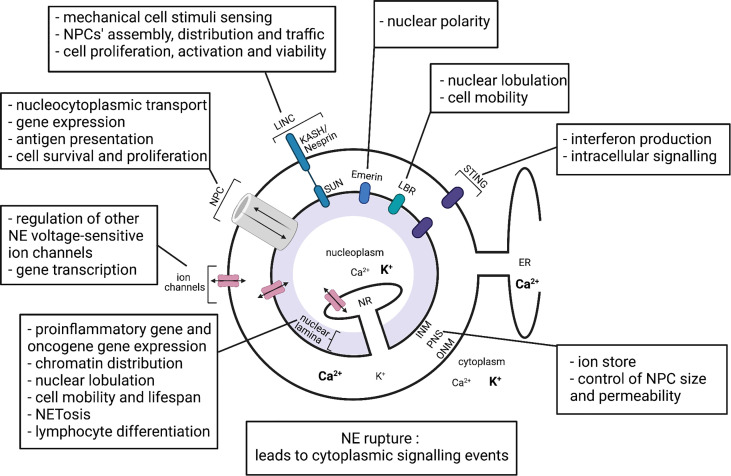
The traditional view of the nuclear envelope (NE) was that it represented a relatively inert physical barrier within the cell, whose main purpose was to separate the nucleoplasm from the cytoplasm. However, recent research suggests that this is far from the case, with new and important cellular functions being attributed to this organelle. In this review we describe research suggesting an important contribution of the NE and its constituents in regulating the functions of cells of the innate and adaptive immune system. One of the standout properties of immune cells is their ability to migrate around the body, allowing them to carry out their physiological/pathophysiology cellular role at the appropriate location. This together with the physiological role of the tissue, changes in tissue matrix composition due to disease and aging, and the activation status of the immune cell, all result in immune cells being subjected to different mechanical forces. We report research which suggests that the NE may be an important sensor/transducer of these mechanical signals and propose that the NE is an integrator of both mechanical and chemical signals, allowing the cells of the innate immune system to precisely regulate gene transcription and functionality. By presenting this overview we hope to stimulate the interests of researchers into this often-overlooked organelle and propose it should join the ranks of mitochondria and phagosome, which are important organelles contributing to immune cell function.
Keywords: immune cells; inflammation; ion channels; lamins; nuclear envelope; nucleus.
Copyright © 2022 Selezneva, Gibb and Willis.
Conflict of interest statement
The authors declare that the research was conducted in the absence of any commercial or financial relationships that could be construed as a potential conflict of interest.
Figures
References
Publication types
MeSH terms
LinkOut - more resources
Full Text Sources
