Transcranial direct current stimulation in the management of phantom limb pain: a systematic review of randomized controlled trials
- PMID: 35758072
- PMCID: PMC10019480
- DOI: 10.23736/S1973-9087.22.07439-1
Transcranial direct current stimulation in the management of phantom limb pain: a systematic review of randomized controlled trials
Abstract
Introduction: Phantom limb pain (PLP) after amputation is a frequent entity that conditions the life of those who suffer it. Current treatment methods are not sufficiently effective for PLP management. We aim to analyze the clinical application of transcranial direct current (tDCS) in people with amputation suffering from PLP.
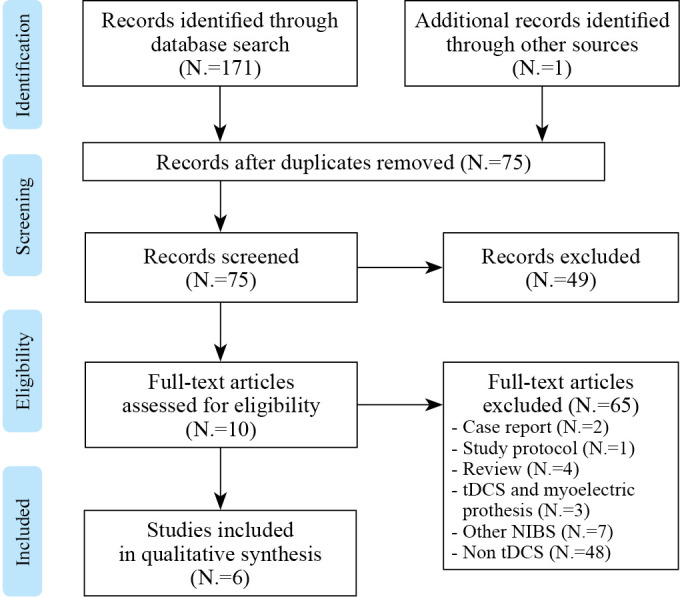
Evidence acquisition: The following databases were consulted in September 2021: MEDLINE, EMBASE, The Web of Science, PEDro, SCOPUS and SciELO. Randomized controlled trials investigating the use of tDCS in people with amputation undergoing PLP were selected. Demographic data, type and cause of amputation, time since amputation, stimulation parameters, and outcomes were extracted.
Evidence synthesis: Six articles were included in this review (seven studies were considered because one study performed two individual protocols). All included studies evaluated PLP; six evaluated the phantom limb sensations (PLS) and two evaluated the psychiatric disorders. In all included studies the intensity and frequency of PLP was reduced, in three PLS were reduced, and in none study psychiatric symptoms were modified.
Conclusions: Anodic tDCS over the contralateral M1 to the affected limb, with an intensity of 1-2 mA, for 15-20 minutes seems to significantly reduce PLP in people with amputation. Single-session treatment could modify PLP intensity for hours, and multi-session treatment could modify PLP for months. Limited evidence suggests that PLS and psychiatric disorders should be treated with different PLP electrode placements. Further studies with larger sample size and longer follow-up times are needed to establish the priority of tDCS application in the PLP management.
Conflict of interest statement
Figures
Similar articles
-
Immediate and Sustained Effects of 5-Day Transcranial Direct Current Stimulation of the Motor Cortex in Phantom Limb Pain.J Pain. 2015 Jul;16(7):657-65. doi: 10.1016/j.jpain.2015.03.013. Epub 2015 Apr 8. J Pain. 2015. PMID: 25863170
-
Brain and spinal stimulation therapies for phantom limb pain: a systematic review.Health Technol Assess. 2018 Nov;22(62):1-94. doi: 10.3310/hta22620. Health Technol Assess. 2018. PMID: 30407905 Free PMC article.
-
Motor and parietal cortex stimulation for phantom limb pain and sensations.Pain. 2013 Aug;154(8):1274-80. doi: 10.1016/j.pain.2013.03.040. Epub 2013 Apr 19. Pain. 2013. PMID: 23707312
-
Prevalence and incidence of phantom limb pain, phantom limb sensations and telescoping in amputees: A systematic rapid review.Eur J Pain. 2021 Jan;25(1):23-38. doi: 10.1002/ejp.1657. Epub 2020 Sep 28. Eur J Pain. 2021. PMID: 32885523 Review.
-
Optimizing Rehabilitation for Phantom Limb Pain Using Mirror Therapy and Transcranial Direct Current Stimulation: A Randomized, Double-Blind Clinical Trial Study Protocol.JMIR Res Protoc. 2016 Jul 6;5(3):e138. doi: 10.2196/resprot.5645. JMIR Res Protoc. 2016. PMID: 27383993 Free PMC article.
Cited by
-
Brain stimulation for chronic pain management: a narrative review of analgesic mechanisms and clinical evidence.Neurosurg Rev. 2023 May 29;46(1):127. doi: 10.1007/s10143-023-02032-1. Neurosurg Rev. 2023. PMID: 37247036 Free PMC article. Review.
-
Phantom Limb Pain Management.J Hand Surg Am. 2025 Feb;50(2):208-215. doi: 10.1016/j.jhsa.2024.09.007. Epub 2024 Oct 21. J Hand Surg Am. 2025. PMID: 39436344 Review.
-
Beyond traditional therapies: a network meta-analysis on the treatment efficacy for chronic phantom limb pain.Reg Anesth Pain Med. 2025 Mar 5;50(3):213-224. doi: 10.1136/rapm-2023-105104. Reg Anesth Pain Med. 2025. PMID: 38388020 Free PMC article.
References
-
- Weinstein SM. Phantom limb pain and related disorders. Neurol Clin 1998;16:919–36. https://www.ncbi.nlm.nih.gov/entrez/query.fcgi?cmd=Retrieve&db=PubMed&l... 10.1016/S0733-8619(05)70105-5 - DOI - PubMed
-
- Ahmad N, Thomas GN, Gill P, Chan C, Torella F. Lower limb amputation in England: prevalence, regional variation and relationship with revascularisation, deprivation and risk factors. A retrospective review of hospital data. J R Soc Med 2014;107:483–9. https://www.ncbi.nlm.nih.gov/entrez/query.fcgi?cmd=Retrieve&db=PubMed&l... 10.1177/0141076814557301 - DOI - PMC - PubMed
-
- Pacheco-Barrios K, Meng X, Fregni F. Neuromodulation Techniques in Phantom Limb Pain: A Systematic Review and Meta-analysis. Pain Med 2020;21:2310–22. https://www.ncbi.nlm.nih.gov/entrez/query.fcgi?cmd=Retrieve&db=PubMed&l... 10.1093/pm/pnaa039 - DOI - PMC - PubMed
-
- Malavera A, Silva FA, Fregni F, Carrillo S, Garcia RG. Repetitive transcranial magnetic stimulation for phantom limb pain in land mine victims: a double-blinded, randomized, sham-controlled trial. J Pain 2016;17:911–8. https://www.ncbi.nlm.nih.gov/entrez/query.fcgi?cmd=Retrieve&db=PubMed&l... 10.1016/j.jpain.2016.05.003 - DOI - PMC - PubMed
-
- Akyuz G, Giray E. Noninvasive neuromodulation techniques for the management of phantom limb pain: a systematic review of randomized controlled trials. Int J Rehabil Res 2019;42:1–10. https://www.ncbi.nlm.nih.gov/entrez/query.fcgi?cmd=Retrieve&db=PubMed&l... 10.1097/MRR.0000000000000317 - DOI - PubMed
Publication types
MeSH terms
LinkOut - more resources
Full Text Sources
Research Materials