. 2022 Aug 31;10(4):e0196122.
doi: 10.1128/spectrum.01961-22. Epub 2022 Jun 27.

Microdomain Protein Nce102 Is a Local Sensor of Plasma Membrane Sphingolipid Balance

Affiliations

Microdomain Protein Nce102 Is a Local Sensor of Plasma Membrane Sphingolipid Balance

Jakub Zahumenský et al. Microbiol Spectr. .

Abstract

Sphingolipids are essential building blocks of eukaryotic membranes and important signaling molecules that are regulated tightly in response to environmental and physiological inputs. While their biosynthetic pathway has been well-described, the mechanisms that facilitate the perception of sphingolipid levels at the plasma membrane remain to be uncovered. In Saccharomyces cerevisiae, the Nce102 protein has been proposed to function as a sphingolipid sensor as it changes its plasma membrane distribution in response to sphingolipid biosynthesis inhibition. We show that Nce102 redistributes specifically in regions of increased sphingolipid demand, e.g., membranes of nascent buds. Furthermore, we report that the production of Nce102 increases following sphingolipid biosynthesis inhibition and that Nce102 is internalized when excess sphingolipid precursors are supplied. This finding suggests that the total amount of Nce102 in the plasma membrane is a measure of the current need for sphingolipids, whereas its local distribution marks sites of high sphingolipid demand. The physiological role of Nce102 in the regulation of sphingolipid synthesis is demonstrated by mass spectrometry analysis showing reduced levels of hydroxylated complex sphingolipids in response to heat stress in the nce102Δ deletion mutant. We also demonstrate that Nce102 behaves analogously in the widespread human fungal pathogen Candida albicans, suggesting a conserved principle of local sphingolipid control across species. IMPORTANCE Microorganisms are challenged constantly by their rapidly changing environment. To survive, they have developed diverse mechanisms to quickly perceive stressful situations and adapt to them appropriately. The primary site of both stress sensing and adaptation is the plasma membrane. We identified the yeast protein Nce102 as a marker of local sphingolipid levels and fluidity in the plasma membrane. Nce102 is an important structural and functional component of the membrane compartment Can1 (MCC), a plasma membrane microdomain stabilized by a large cytosolic hemitubular protein scaffold, the eisosome. The MCC/eisosomes are widely conserved among fungi and unicellular algae. To determine if Nce102 carries out similar functions in other organisms, we analyzed the human fungal pathogen Candida albicans and found that Nce102 responds to sphingolipid levels also in this organism, which has potential applications for the development of novel therapeutic approaches. The presented study represents a valuable model for how organisms regulate plasma membrane sphingolipids.

Keywords: eisosome; microdomain; plasma membrane; sphingolipid; stress sensor.


Conflict of interest statement

The authors declare a conflict of interest. We declare that the research was conducted in the absence of any commercial or financial relationships that could be construed as a potential conflict of interest. M.D.P. is a co-founder and Chief Scientific Officer (CSO) of MicroRid Technologies Inc.

Figures

FIG 1
FIG 1
Inhibition of sphingolipid biosynthesis induces the production of Nce102. (A and B) S. cerevisiae cells expressing NCE102-GFP either alone (A) or together with the endoplasmic reticulum marker dsRed-HDEL (B) cultivated for 6 h and exposed to indicated chemicals for 2 h. Arrowheads in B indicate endoplasmic reticulum. Scale bars: 5 μm. (C to E) Quantification of the number of Nce102-GFP patches per cell cross-section (C), mean cell GFP intensity (D), and the ratio of mean GFP fluorescence intensity in the plasma membrane (PM) and the cell interior (E) in cultures treated as in A. Mean ± SD from 3 to 5 biological replicates (dots; 170 to 230 cells under each condition). *, P ≤ 0.05; **, P ≤ 0.01; ****, P ≤ 0.0001. One-way ANOVA. (F) Western blot quantification of Nce102 amount in cultures treated as in A. Data are presented as mean ± SD from 3 biological replicates. The results did not reach statistical significance (one-way ANOVA) because of variability between experiments. However, the Nce102 amount was always higher in myriocin-treated cultures than in the control in three independent experiments. Shown is a representative membrane with tubulin as the loading control. Myriocin (MYR), 10 μM; cycloheximide (CHX), 100 μg/mL.
FIG 2
FIG 2
Inhibition of sphingolipid biosynthesis induces the release of Slm1 from the eisosome. (A) Confocal microscopy images of S. cerevisiae cells expressing SLM1-GFP together with the core eisosome protein PIL1-mRFP cultivated for 6 h and exposed to indicated chemicals for 2 h. Scale bars: 5 μm. Dashed lines with arrows indicate cells and the direction of line intensity plots displayed in F. (B to E) Quantification of the number of Slm1-GFP and Pil1-mRFP patches per cell cross-section (B), mean cell GFP/mRFP intensity (C), the ratio of mean GFP/mRFP fluorescence intensity in the plasma membrane (PM) and the cell interior (D), and Pearson’s colocalization coefficient of Slm1-GFP and Pil1-mRFP (E) in cultures treated as in A. Mean ± SD from 3 to 5 biological replicates (Slm1-GFP, triangles; Pil1-mRFP, diamonds; colocalization, dots; 150 to 200 cells under each condition). *, P ≤ 0.05; **, P ≤ 0.01; ***, P ≤ 0.001; ****, P ≤ 0.0001. One-way ANOVA. (F) Normalized line intensity plots of Slm1-GFP (cyan) and Pil1-mRFP (magenta) along the plasma membrane of cells as indicated in A. Myriocin (MYR), 10 μM; cycloheximide (CHX), 100 μg/mL; phytosphingosine (PHS), 20 μM.
FIG 3
FIG 3
Nce102 migrates out of the MCC and is internalized in the presence of excess sphingolipid precursors. (A and B) Confocal microscopy images of S. cerevisiae cells expressing NCE102-GFP either alone (A) or together with the vacuole membrane marker Vph1-mCherry (B) cultivated for 6 h and exposed to indicated chemicals for 2 h. Scale bars: 5 μm. Arrowheads in A indicate plasma membrane invaginations. (C to H) Quantification of the number of Nce102-GFP patches per cell cross-section (C), mean cell GFP intensity (D), the ratio of mean GFP fluorescence intensity in the plasma membrane (PM) and the cell interior (E), prominence of patches (ratio of intensities in peaks and valleys in line plots along plasma membranes of individual cells) (F), and mean fluorescence intensity in the plasma membrane (G) and cell interior (H) in cultures treated as in A. Mean ± SD from 3 to 5 biological replicates (dots; 170 to 230 cells under each condition). *, P ≤ 0.05; ***, P ≤ 0.001; ****, P ≤ 0.0001. One-way ANOVA. (I and J) Confocal microscopy images of S. cerevisiae cells expressing NCE102-GFP either in the wild type (I) or in a vps4 deletion mutant (J) cultivated for 6 h and exposed to indicated chemicals for 2 h. Arrowheads indicate plasma membrane invaginations and intracellular vesicles. Scale bars: 5 μm. Cycloheximide (CHX), 100 μg/mL; dihydrosphingosine (DHS), concentration as indicated; phytosphingosine (PHS), concentrations in B and I as indicated in (A), 20 μM in (J).
FIG 4
FIG 4
Nce102 migration out of the MCC in response to sphingolipid inhibition is dependent on active budding. (A) Confocal microscopy images of S. cerevisiae cells expressing NCE102-GFP cultivated for 6 h, treated with myriocin at a time (t) of 0 min, and imaged in a time-lapse manner. Maximum intensity projections of 9 subsequent focal planes are presented. (B) The dependence of plasma membrane Nce102-GFP patch density on time quantified in images from a single time-lapse experiment (representative cropped area in A). Data are presented as median and interquartile range from 25 cells in each image. (C) Confocal microscopy images of S. cerevisiae cells expressing NCE102-GFP cultivated for 5 h, treated with hydroxyurea for 3 h, and subsequently treated for 2 h with myriocin. (D and E) Quantification of the number of Nce102-GFP patches per cell cross-section (D) and mean cell intensity (E) in cultures treated as in C. Mean ± SD from 3 biological replicates (dots; 100 to 150 cells per condition). *, P ≤ 0.05; **, P ≤ 0.01; ****, P ≤ 0.0001. One-way ANOVA. (F) Confocal microscopy images of S. cerevisiae cells cultivated for 6 h, stained with FM4-64 dye, and treated as indicated, followed by a 2-h cultivation. (G) Quantification of FM4-64 uptake by the cells treated as in F, calculated as the ratio of integral GFP intensity in the cell interior and in the whole cell. Mean ± SD from 3 biological replicates (dots; 150 to 230 cells per condition). *, P = 0.0161. Paired t test. Myriocin (MYR), 10 μM; hydroxyurea (HU), 200 mM; FM4-64 (N-(3-triethylammoniumpropyl)-4-(6-(4-(diethylamino) phenyl) hexatrienyl) pyridinium dibromide), 2 μM. In A, C, and F, scale bars: 5 μm. In D, E, and G, mean ± SD from 3 biological replicates (150 to 220 cells under each condition; dots).
FIG 5
FIG 5
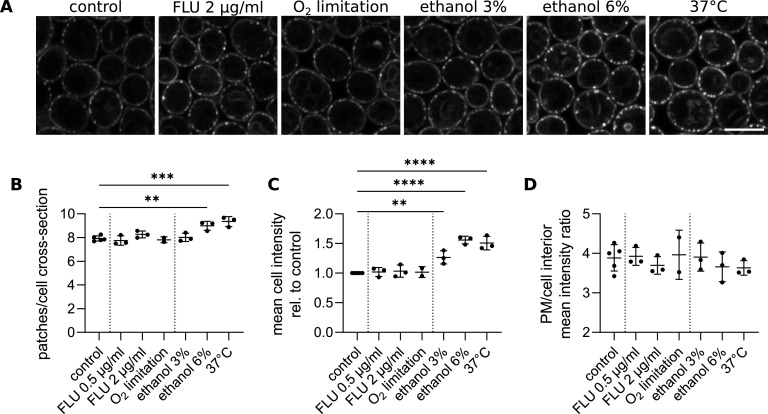
Nce102 localization and abundance change in response to increasing plasma membrane fluidity and sphingolipid levels. (A) Confocal microscopy images of S. cerevisiae cells expressing NCE102-GFP cultivated for 6 h and exposed to indicated stress conditions for 2 h. Scale bar: 5 μm. (B to D) Quantification of the number of Nce102-GFP patches per cell cross-section (B), mean cell intensity (C), ratio of mean GFP fluorescence intensity in the plasma membrane (PM) and the cell interior (D) in cultures treated as in A. Mean ± SD from 3 to 5 biological replicates (dots; 300 to 400 cells under each condition). *, P ≤ 0.05; **, P ≤ 0.01; ***, P ≤ 0.001; ****, P ≤ 0.0001. One-way ANOVA. No statistical difference was found between conditions in D. Vertical dotted lines separate groups of stress conditions, left to right, as follows: control, ergosterol biosynthesis inhibition, and increase of membrane fluidity. FLU, fluconazole.
FIG 6
FIG 6
Nce102 response to chronic stress. (A) Confocal microscopy images of S. cerevisiae cells expressing NCE102-GFP treated with indicated stress upon inoculation and cultivated for the indicated time. Scale bars: 5 μm. White asterisks indicate dead cells. (B to F) Quantification of the number of Nce102-GFP patches per cell cross-section (B), mean cell GFP intensity (C), integral intensity in the plasma membrane (PM) (D) and in the intracellular space (E), and patch prominence, i.e., GFP intensity in the patches relative to the surrounding plasma membrane, (F) in cell cultures treated as in A. Mean ± SD from 3 biological replicates (dots; 150 cells in 48 h 37°C condition, dead cells were excluded from analysis; 250 to 400 cells in all other conditions). *, P ≤ 0.05; **, P ≤ 0.01; ***, P ≤ 0.001; ****, P ≤ 0.0001. One-way ANOVA. Vertical dotted lines separate cultivation times. (G) Western blot quantification of Nce102 amount in S. cerevisiae cultures grown for 48 h under chronic exposure to indicated stress. Data are presented as mean ± SD from 3 biological replicates. Because of the variability between experiments, no statistically significant difference between the treatments was found (one-way ANOVA). However, the reported trend was comparable in three independent experiments. Representative Western blot membrane and Coomassie-stained gel were used as the loading control. Note the different order of treatments in the graph and on the gel/membrane. FLU, fluconazole; PHS, phytosphingosine.
FIG 7
FIG 7
Mass spectrometry analysis of sphingolipid content. S. cerevisiae wild type and nce102Δ cultures were treated with indicated stress conditions upon inoculation and cultivated for 48 h (same as in Fig. 6); 3 to 4 biological replicates. (A) Principal-component analysis for sphingolipid amount across samples. (B) Contribution of individual lipids to PC1 (full circles) and PC2 (full circles). (C) Log2 fold changes in sphingolipid amounts in response to indicated chronic stress relative to respective control; nce102Δ control relative to wild-type control. Note that mannosyl-di-(inositolphosphoryl)-ceramides [M(IP)2Cs] were not detected in our assay. (D) Analysis of the correlation (Pearson’s coefficient) between the amount of Nce102 (as reported in Fig. 6) and individual lipids. Full symbols, statistically significant correlation (two-tailed P ≤ 0.05); empty symbols, correlation below threshold of statistical significance (P > 0.05); μr, mean Pearson’s correlation coefficient calculated from statistically significant values. FLU, fluconazole; LCBs, long-chain bases; Cer, ceramide; PhytoCer, phytoceramide; IPC, inositol phosphoceramides; MIPCs, mannosyl inositolphosphoceramides; SL, sphingolipids; OH-, prefix indicates hydroxylation of respective lipids.
FIG 8
FIG 8
Nce102 behaves analogously in C. albicans and S. cerevisiae. (A and C) Deconvolved wide-field fluorescence microscopy images of C. albicans cells expressing CaNCE102-GFP cultivated for 6 h and exposed to myriocin for 2 h (A) or treated with indicated stress upon inoculation and cultivated for 48 h (C). Scale bars: 5 μm. (B and D) Quantification of the number of CaNce102-GFP patches per cell cross-section following either 2-h myriocin treatment (B) or chronic exposure to indicated stress (C). (E) Quantification of the ratio of mean GFP fluorescence intensity in the plasma membrane (PM) and the cell interior following chronic exposure to indicated stress. No statistically significant difference between the treatments was found (one-way ANOVA). (F) Western blot quantification of Nce102 amount in C. albicans cultures grown for 48 h under chronic exposure to indicated stress. Mean ± SD from 3 biological replicates. Representative Western blot membrane and Coomassie-stained gel were used as the loading control. Note the different order of treatments in the graph and on the gel/membrane. Myriocin (MYR), 10 μM; FLU, fluconazole. In B, data are represented as box plots with median and range (minimum to maximum) indicated, with one biological replicate (control, 975 cells; myriocin, 512 cells). In D and E, mean values ± SD from 2 biological replicates (≥100 cells under each condition; dots). In D and F, *, P ≤ 0.05; **, P ≤ 0.01; ***, P ≤ 0.001. One-way ANOVA.

References

    1. Malínská K, Malínský J, Opekarová M, Tanner W. 2003. Visualization of protein compartmentation within the plasma membrane of living yeast cells. Mol Biol Cell 14:4427–4436. doi: 10.1091/mbc.e03-04-0221. - DOI - PMC - PubMed
    1. Young ME, Karpova TS, Brugger B, Moschenross DM, Wang GK, Schneiter R, Wieland FT, Cooper JA. 2002. The Sur7p family defines novel cortical domains in Saccharomyces cerevisiae, affects sphingolipid metabolism, and is involved in sporulation. Mol Cell Biol 22:927–934. doi: 10.1128/MCB.22.3.927-934.2002. - DOI - PMC - PubMed
    1. Malinska K, Malinsky J, Opekarova M, Tanner W. 2004. Distribution of Can1p into stable domains reflects lateral protein segregation within the plasma membrane of living S. cerevisiae cells. J Cell Sci 117:6031–6041. doi: 10.1242/jcs.01493. - DOI - PubMed
    1. Grossmann G, Opekarová M, Malinsky J, Weig-Meckl I, Tanner W. 2007. Membrane potential governs lateral segregation of plasma membrane proteins and lipids in yeast. EMBO J 26:1–8. doi: 10.1038/sj.emboj.7601466. - DOI - PMC - PubMed
    1. Grossmann G, Malinsky J, Stahlschmidt W, Loibl M, Weig-Meckl I, Frommer WB, Opekarová M, Tanner W. 2008. Plasma membrane microdomains regulate turnover of transport proteins in yeast. J Cell Biol 183:1075–1088. doi: 10.1083/jcb.200806035. - DOI - PMC - PubMed

Publication types

MeSH terms

LinkOut - more resources