Prevalence and Vascular Distribution of Multiterritorial Atherosclerosis Among Community-Dwelling Adults in Southeast China
- PMID: 35759265
- PMCID: PMC9237794
- DOI: 10.1001/jamanetworkopen.2022.18307
Prevalence and Vascular Distribution of Multiterritorial Atherosclerosis Among Community-Dwelling Adults in Southeast China
Abstract
Importance: Data are limited on the prevalence and vascular distribution of multiterritorial atherosclerotic plaque and stenosis in community populations.
Objective: To investigate the prevalence and vascular distribution of multiterritorial atherosclerotic plaque and stenosis in older, community-dwelling populations in China.
Design, setting, and participants: This cross-sectional study was based on the baseline survey from the Polyvascular Evaluation for Cognitive Impairment and Vascular Events (PRECISE) study, a population-based prospective cohort study that enrolled community-dwelling adults aged 50 to 75 years based on cluster sampling from 6 villages and 4 living communities of Lishui city in southeast China. Data were collected from May 2017 to September 2019 and analyzed from September to November 2021.
Main outcomes and measures: Atherosclerotic plaque and stenosis at baseline were assessed in multiple vascular territories. Brain vessel wall magnetic resonance imaging (MRI) for intracranial and extracranial arteries; computed tomography angiography (CTA) for coronary, subclavian, aorta, renal, and iliofemoral arteries; and ankle-brachial index for peripheral arteries were performed at baseline survey. The extent of atherosclerosis was assessed according to the number of these 8 vascular sites affected, and polyvascular lesions were defined as at least 2 affected sites.
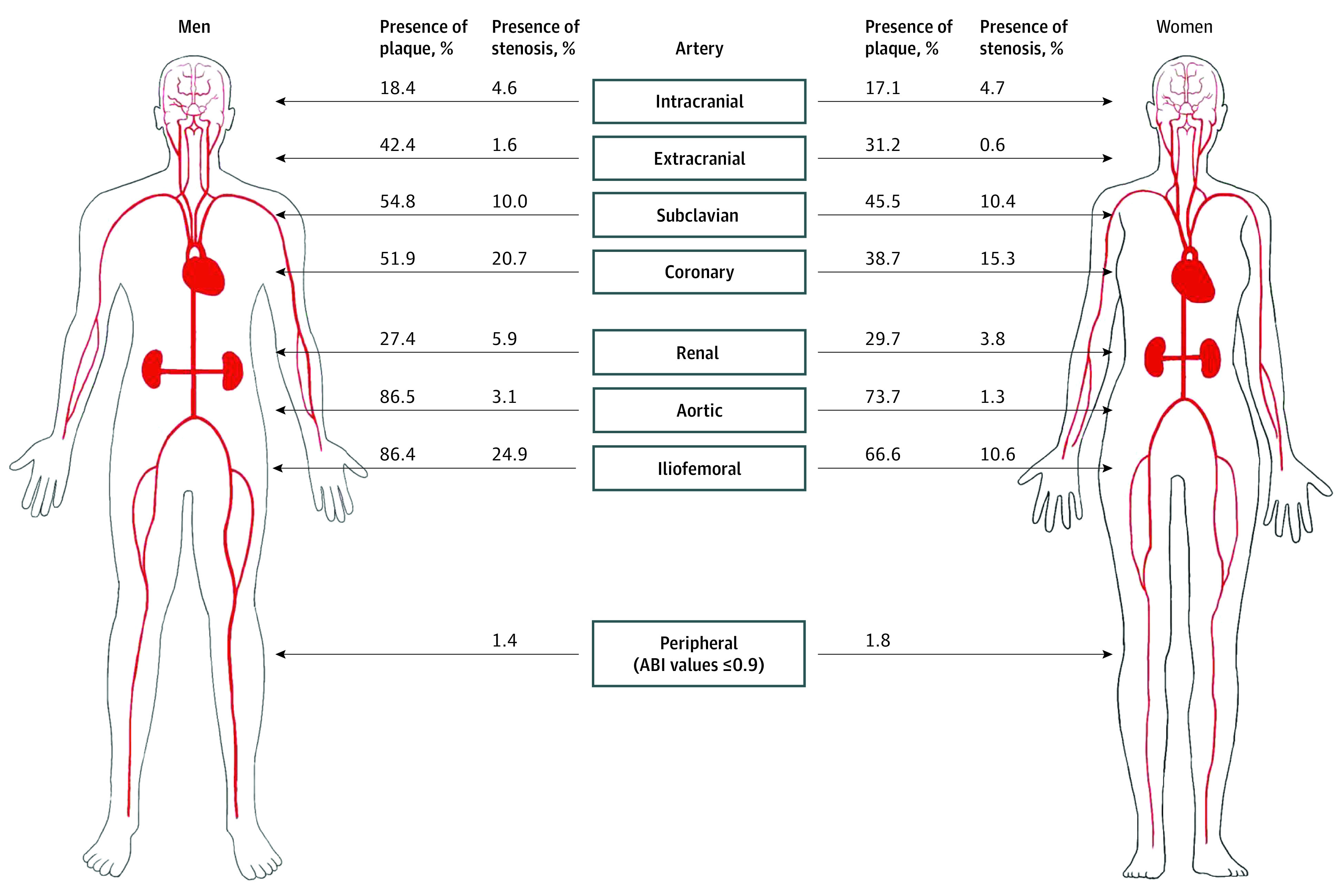
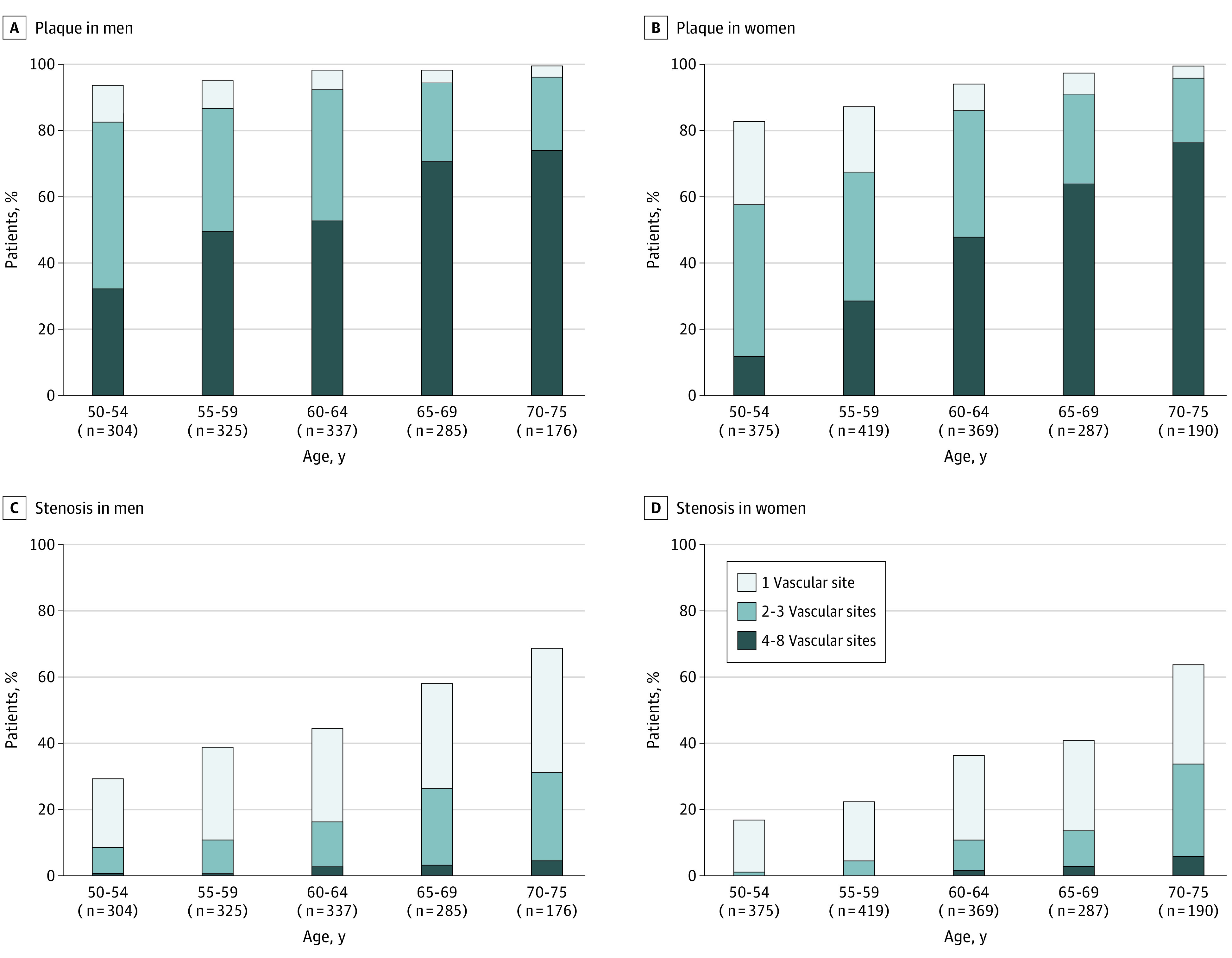
Results: A total of 3433 of 4202 invited individuals consented to participate in the study. After excluding 366 participants with contraindications for MRI or CTA scanning, with life expectancies of 4 years of fewer, or with mental disease, a total of 3067 community-dwelling adults were enrolled. The mean (SD) age was 61.2 (6.7) years; 1640 (53.5%) were women, and 74 (2.4%) had prevalent ASCVD. Most participants (2870 [93.6%]) had atherosclerotic plaques in at least 1 vascular territory. Atherosclerotic plaques were mostly detected in the aorta (2419 [79.6%]) and iliofemoral arteries (2312 [75.8%]), followed by subclavian (1500 [49.8%]), coronary (1366 [44.9%]), extracranial (1110 [36.4%]), renal (873 [28.7%]), and intracranial (542 [17.7%]) arteries. A substantial proportion of participants (1180 [38.5%]) had arterial stenosis of 50% or greater, predominantly affecting the coronary (542 [17.8%]) and iliofemoral (527 [17.3%]) arteries. Polyvascular atherosclerotic plaque was observed in 2541 participants (82.8%), with 1436 (46.8%) with plaque affecting 4 or more vascular territories, and polyvascular stenosis was observed in 412 patients (13.4%).
Conclusions and relevance: In this study, atherosclerotic plaque was highly prevalent in the older community population in China, and a substantial proportion of individuals reach stenosis of 50% or greater.
Conflict of interest statement
Figures