


Shared Decision-Making Training for Home Care Teams to Engage Frail Older Adults and Caregivers in Housing Decisions: Stepped-Wedge Cluster Randomized Trial
- PMID: 35759791
- PMCID: PMC9533197
- DOI: 10.2196/39386
Shared Decision-Making Training for Home Care Teams to Engage Frail Older Adults and Caregivers in Housing Decisions: Stepped-Wedge Cluster Randomized Trial
Abstract
Background: Frail older adults and caregivers need support from their home care teams in making difficult housing decisions, such as whether to remain at home, with or without assistance, or move into residential care. However, home care teams are often understaffed and busy, and shared decision-making training is costly. Nevertheless, overall awareness of shared decision-making is increasing. We hypothesized that distributing a decision aid could be sufficient for providing decision support without the addition of shared decision-making training for home care teams.
Objective: We evaluated the effectiveness of adding web-based training and workshops for care teams in interprofessional shared decision-making to passive dissemination of a decision guide on the proportion of frail older adults or caregivers of cognitively-impaired frail older adults reporting active roles in housing decision-making.
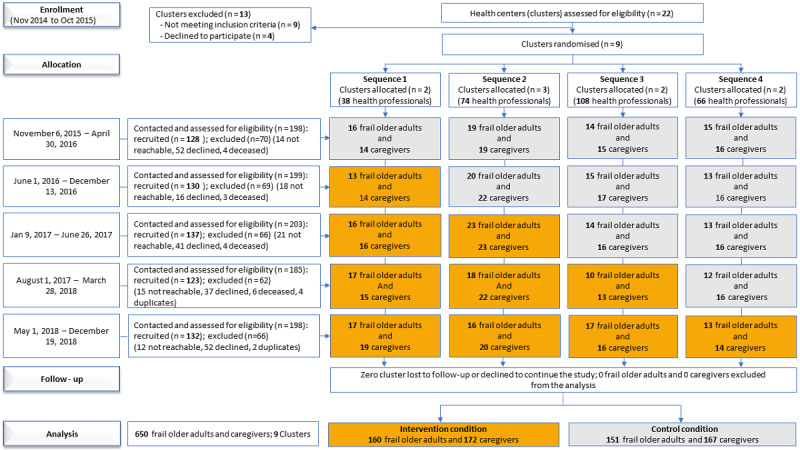
Methods: We conducted a stepped-wedge cluster randomized trial with home care teams in 9 health centers in Quebec, Canada. Participants were frail older adults or caregivers of cognitively impaired frail older adults facing housing decisions and receiving care from the home care team at one of the participating health centers. The intervention consisted of a 1.5-hour web-based tutorial for the home care teams plus a 3.5-hour interactive workshop in interprofessional shared decision-making using a decision guide that was designed to support frail older adults and caregivers in making housing decisions. The control was passive dissemination of the decision guide. The primary outcome was an active role in decision-making among frail older adults and caregivers, measured using the Control Preferences Scale. Secondary outcomes included decisional conflict and perceptions of how much care teams involved frail older adults and caregivers in decision-making. We performed an intention-to-treat analysis.
Results: A total of 311 frail older adults were included in the analysis, including 208 (66.9%) women, with a mean age of 81.2 (SD 7.5) years. Among 339 caregivers of cognitively-impaired frail older adults, 239 (70.5%) were female and their mean age was 66.4 (SD 11.7) years. The intervention increased the proportion of frail older adults reporting an active role in decision-making by 3.3% (95% CI -5.8% to 12.4%, P=.47) and the proportion of caregivers of cognitively-impaired frail older adults by 6.1% (95% CI -11.2% to 23.4%, P=.49). There was no significant impact on the secondary outcomes. However, the mean score for the frail older adults' perception of how much health professionals involved them in decision-making increased by 5.4 (95% CI -0.6 to 11.4, P=.07) and the proportion of caregivers who reported decisional conflict decreased by 7.5% (95% CI -16.5% to 1.6%, P=.10).
Conclusions: Although it slightly reduced decisional conflict for caregivers, shared decision-making training did not equip home care teams significantly better than provision of a decision aid for involving frail older adults and their caregivers in decision-making.
Trial registration: ClinicalTrials.gov NCT02592525; https://clinicaltrials.gov/show/NCT02592525.
Keywords: home care; nursing homes; patient engagement; shared decision-making.
©Évèhouénou Lionel Adisso, Monica Taljaard, Dawn Stacey, Nathalie Brière, Hervé Tchala Vignon Zomahoun, Pierre Jacob Durand, Louis-Paul Rivest, France Légaré. Originally published in JMIR Aging (https://aging.jmir.org), 20.09.2022.
Conflict of interest statement
Conflicts of Interest: DS holds a University of Ottawa research chair in knowledge translation to patients. The authors have no further conflcits of interest to declare.
Figures
References
-
- Murman D. The Impact of Age on Cognition. Semin Hear. 2015 Aug;36(3):111–21. doi: 10.1055/s-0035-1555115. https://europepmc.org/abstract/MED/27516712 00674 - DOI - PMC - PubMed
-
- Roy N, Dubé Roxanne, Després Carole, Freitas A, Légaré France. Choosing between staying at home or moving: A systematic review of factors influencing housing decisions among frail older adults. PLoS One. 2018;13(1):e0189266. doi: 10.1371/journal.pone.0189266. https://dx.plos.org/10.1371/journal.pone.0189266 PONE-D-17-25696 - DOI - PMC - PubMed
-
- Garvelink MM, Emond J, Menear M, Brière Nathalie, Freitas A, Boland L, Perez MMB, Blair L, Stacey D, Légaré France. Development of a decision guide to support the elderly in decision making about location of care: an iterative, user-centered design. Res Involv Engagem. 2016;2:26. doi: 10.1186/s40900-016-0040-0. https://researchinvolvement.biomedcentral.com/articles/10.1186/s40900-01... 40 - DOI - PMC - PubMed
Associated data
LinkOut - more resources
Full Text Sources
Medical
