


Could respiration-driven blood oxygen changes modulate neural activity?
- PMID: 35761104
- PMCID: PMC9794637
- DOI: 10.1007/s00424-022-02721-8
Could respiration-driven blood oxygen changes modulate neural activity?
Abstract
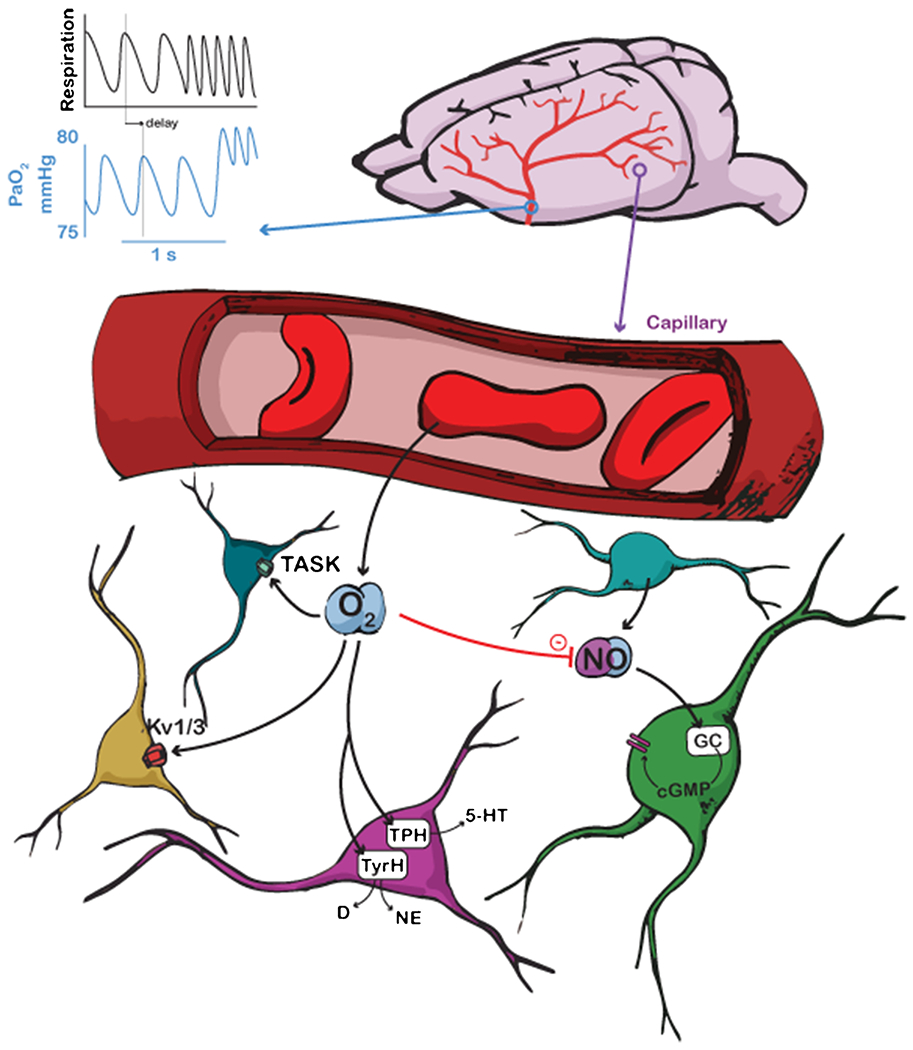
Oxygen is critical for neural metabolism, but under most physiological conditions, oxygen levels in the brain are far more than are required. Oxygen levels can be dynamically increased by increases in respiration rate that are tied to the arousal state of the brain and cognition, and not necessarily linked to exertion by the body. Why these changes in respiration occur when oxygen is already adequate has been a long-standing puzzle. In humans, performance on cognitive tasks can be affected by very high or very low oxygen levels, but whether the physiological changes in blood oxygenation produced by respiration have an appreciable effect is an open question. Oxygen has direct effects on potassium channels, increases the degradation rate of nitric oxide, and is rate limiting for the synthesis of some neuromodulators. We discuss whether oxygenation changes due to respiration contribute to neural dynamics associated with attention and arousal.
Keywords: Cognition; Neural excitability; Nitric oxide; Oxygen; Respiration.
© 2022. The Author(s), under exclusive licence to Springer-Verlag GmbH Germany, part of Springer Nature.
Conflict of interest statement
Competing interests:
The authors have no competing interests to declare that are relevant to the content of this article.
Figures
References
-
- Angelova PR, Kasymov V, Christie I, Sheikhbahaei S, Turovsky E, Marina N, Korsak a, Zwicker J, Teschemacher aG, Ackland GL, Funk GD, Kasparov S, Abramov aY, Gourine aV (2015) Functional Oxygen Sensitivity of Astrocytes. Journal of Neuroscience 35:10460–10473. doi: 10.1523/JNEUROSCI.0045-15.2015 - DOI - PMC - PubMed
Publication types
MeSH terms
Substances
Grants and funding
LinkOut - more resources
Full Text Sources
