


Infants later diagnosed with autism have lower canonical babbling ratios in the first year of life
- PMID: 35761377
- PMCID: PMC9235227
- DOI: 10.1186/s13229-022-00503-8
Infants later diagnosed with autism have lower canonical babbling ratios in the first year of life
Abstract
Background: Canonical babbling-producing syllables with a mature consonant, full vowel, and smooth transition-is an important developmental milestone that typically occurs in the first year of life. Some studies indicate delayed or reduced canonical babbling in infants at high familial likelihood for autism spectrum disorder (ASD) or who later receive an ASD diagnosis, but evidence is mixed. More refined characterization of babbling in the first year of life in infants with high likelihood for ASD is needed.
Methods: Vocalizations produced at 6 and 12 months by infants (n = 267) taking part in a longitudinal study were coded for canonical and non-canonical syllables. Infants were categorized as low familial likelihood (LL), high familial likelihood diagnosed with ASD at 24 months (HL-ASD) or not diagnosed (HL-Neg). Language delay was assessed based on 24-month expressive and receptive language scores. Canonical babble ratio (CBR) was calculated by dividing the number of canonical syllables by the number of total syllables. Generalized linear (mixed) models were used to assess the relationship between group membership and CBR, controlling for site, sex, and maternal education. Logistic regression was used to assess whether canonical babbling ratios at 6 and 12 months predict 24-month diagnostic outcome.
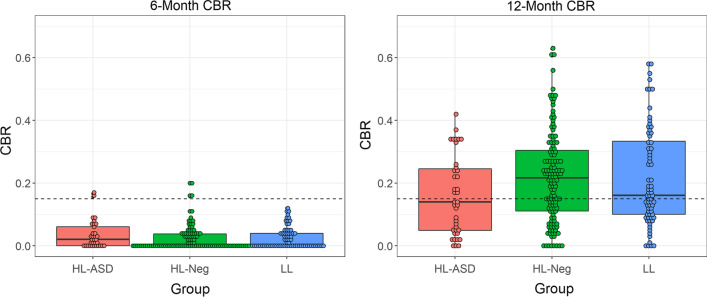
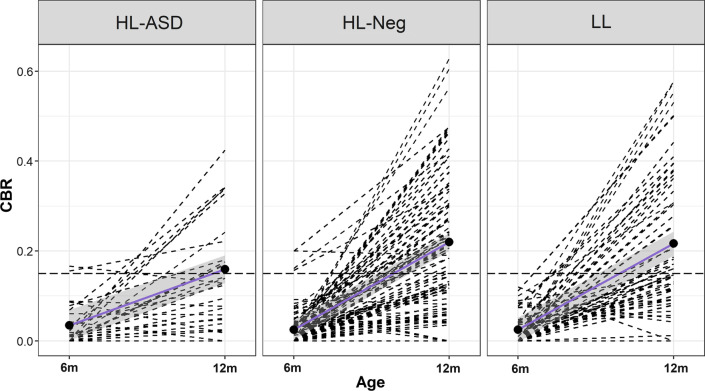
Results: No diagnostic group differences in CBR were detected at 6 months, but HL-ASD infants produced significantly lower CBR than both the HL-Neg and LL groups at 12 months. HL-Neg infants with language delay also showed reduced CBR at 12 months. Neither 6- nor 12-month CBR was significant predictors of 24-month diagnostic outcome (ASD versus no ASD) in logistic regression.
Limitations: Small numbers of vocalizations produced by infants at 6 months may limit the reliability of CBR estimates. It is not known if results generalize to infants who are not at high familial likelihood, or infants from more diverse racial and socioeconomic backgrounds.
Conclusions: Lower canonical babbling ratios are apparent by the end of the first year of life in ASD regardless of later language delay, but are also observed for infants with later language delay without ASD. Canonical babbling may lack specificity as an early marker when used on its own.
© 2022. The Author(s).
Conflict of interest statement
The authors declare that they have no competing interests.
Figures


References
-
- American Psychiatric Association . Diagnostic and statistical manual of mental disorders (DSM-5®) Washington, DC: American Psychiatric Pub; 2013.
-
- Belardi K, Watson LR, Faldowski RA, Hazlett H, Crais E, Baranek GT, McComish C, Patten E, Oller DK. A retrospective video analysis of canonical babbling and volubility in infants with Fragile X Syndrome at 9–12 months of age. J Autism Dev Disord. 2017;47(4):1193–1206. doi: 10.1007/s10803-017-3033-4. - DOI - PMC - PubMed
Publication types
MeSH terms
Grants and funding
LinkOut - more resources
Full Text Sources
Medical
Miscellaneous
