


A combination of stromal PD-L1 and tumoral nuclear β-catenin expression as an indicator of colorectal carcinoma progression and resistance to chemoradiotherapy in locally advanced rectal carcinoma
- PMID: 35762092
- PMCID: PMC9353658
- DOI: 10.1002/cjp2.285
A combination of stromal PD-L1 and tumoral nuclear β-catenin expression as an indicator of colorectal carcinoma progression and resistance to chemoradiotherapy in locally advanced rectal carcinoma
Abstract
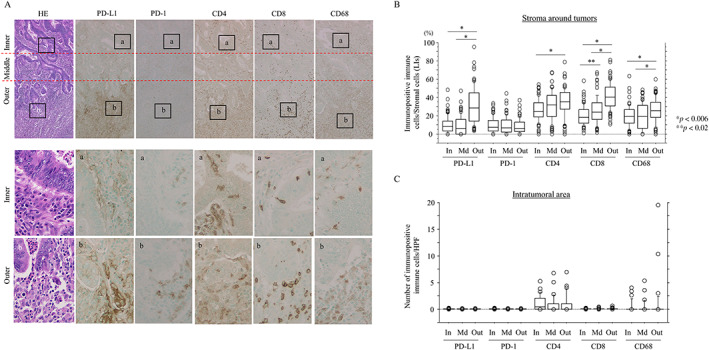
Programmed cell death-1 (PD-1) and its ligand (PD-L1) are significant mediators of immune suppression in the tumor microenvironment. We focused on the immunological impact of PD-1/PD-L1 signaling during tumor progression in colorectal carcinoma (CRC) and its association with resistance to neoadjuvant chemoradiotherapy (NCRT) in locally advanced rectal carcinoma (LAd-RC). Histopathological and immunohistochemical analyses of 100 CRC cases (including 34 RC) without NCRT and 109 NCRT-treated LAd-RC cases were performed. Membranous tumoral PD-L1 expression was identified in 9 of 100 (9%) CRC cases, including 1 of 34 (2.9%) RC cases, but PD-L1 immunopositivity was not associated with any clinicopathological factors, with the exception of deficient mismatch repair (dMMR) status. In contrast, stromal PD-L1+ immune cells, which frequently exhibited coexpression of PD-1 and CD8 markers, were significantly correlated with tumor vessel invasion, nuclear β-catenin+ tumor budding cancer stem cell (CSC)-like features, and unfavorable prognosis. In the LAd-RC cases, stromal CD8+ (but not PD-L1+) immune cell infiltration in pretreatment-biopsied samples was significantly and positively associated with therapeutic efficacy. After NCRT, tumoral PD-L1 expression was observed in only 2 of 83 (2.4%) tumors, independent of dMMR status, whereas high stromal PD-L1+ and tumoral nuclear β-catenin positivity were significantly linked to a poor response to NCRT and high tumor budding features. In addition, high stromal PD-L1 immunoreactivity was significantly associated with poorer overall survival. In conclusion, a combination of stromal PD-L1+ immune cells and nuclear β-catenin+ tumor budding may contribute to tumor progression in CRC and resistance to NCRT in LAd-RC, through formation of niche-like lesions that exhibit immune resistance and CSC properties.
Keywords: PD-1; PD-L1; cancer stem cell; colorectal carcinoma; neoadjuvant chemoradiotherapy; β-catenin.
© 2022 The Authors. The Journal of Pathology: Clinical Research published by The Pathological Society of Great Britain and Ireland and John Wiley & Sons Ltd.
Figures


References
-
- Onyoh EF, Hsu W‐F, Chang L‐C, et al. The rise of colorectal cancer in Asia: epidemiology, screening, and management. Curr Gastroenterol Rep 2019; 21: 36. - PubMed
-
- Galon J, Costes A, Sanchez‐Cabo F, et al. Type, density, and location of immune cells within human colorectal tumors predict clinical outcome. Science 2006; 313: 1960–1964. - PubMed
Publication types
MeSH terms
Substances
LinkOut - more resources
Full Text Sources
Research Materials
