


Amyloid, tau and metabolic PET correlates of cognition in early and late-onset Alzheimer's disease
- PMID: 35762829
- PMCID: PMC10200306
- DOI: 10.1093/brain/awac229
Amyloid, tau and metabolic PET correlates of cognition in early and late-onset Alzheimer's disease
Abstract
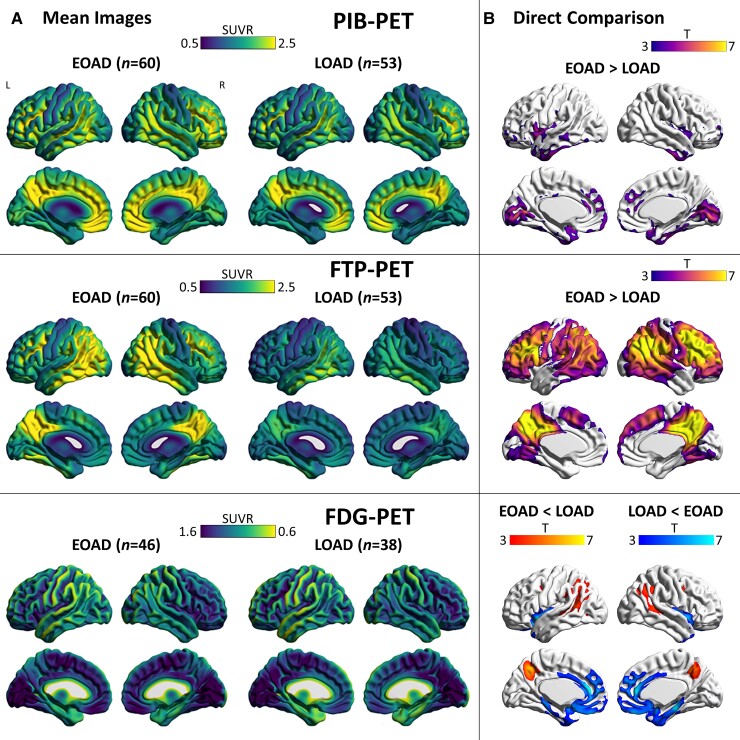
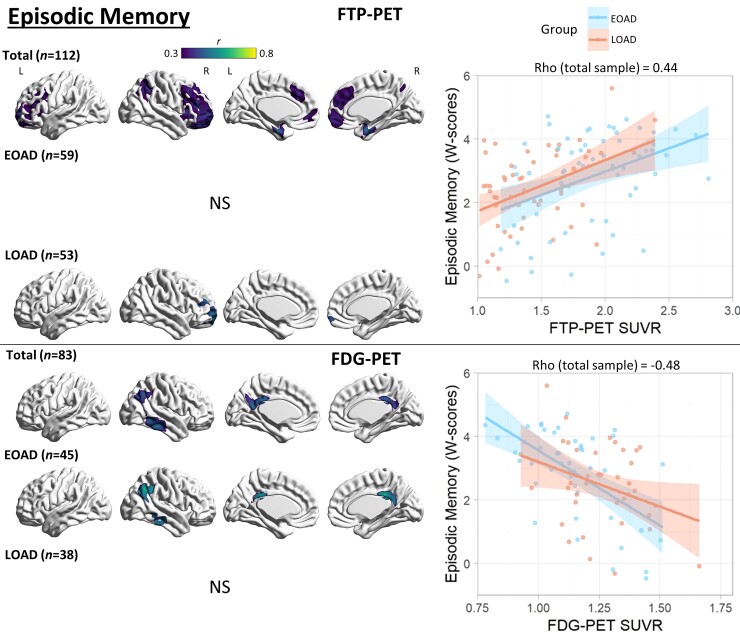
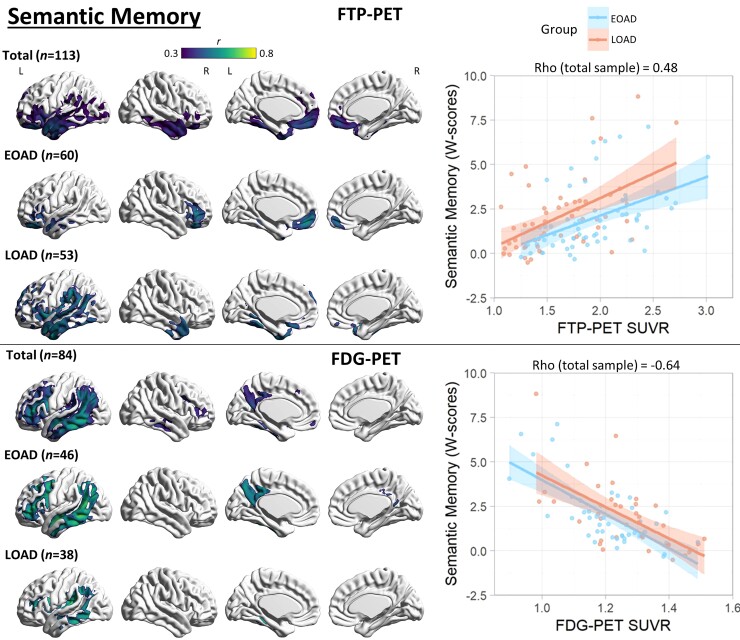
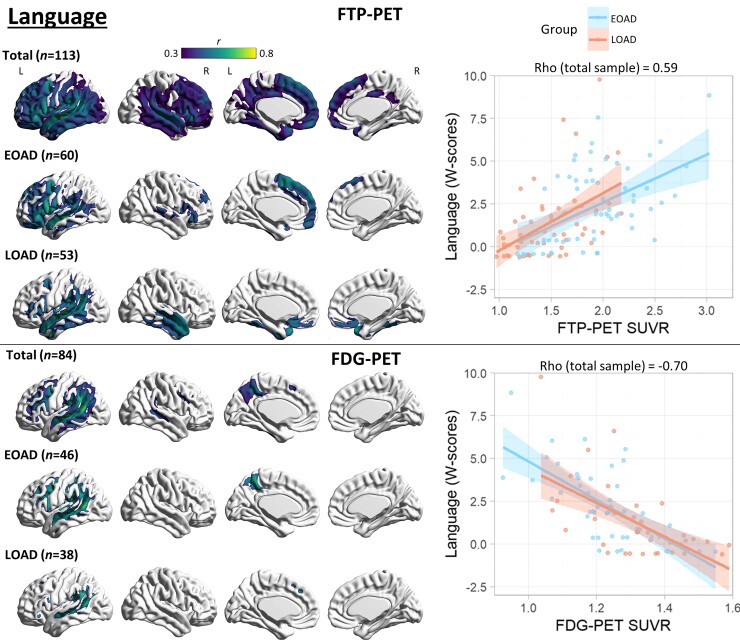
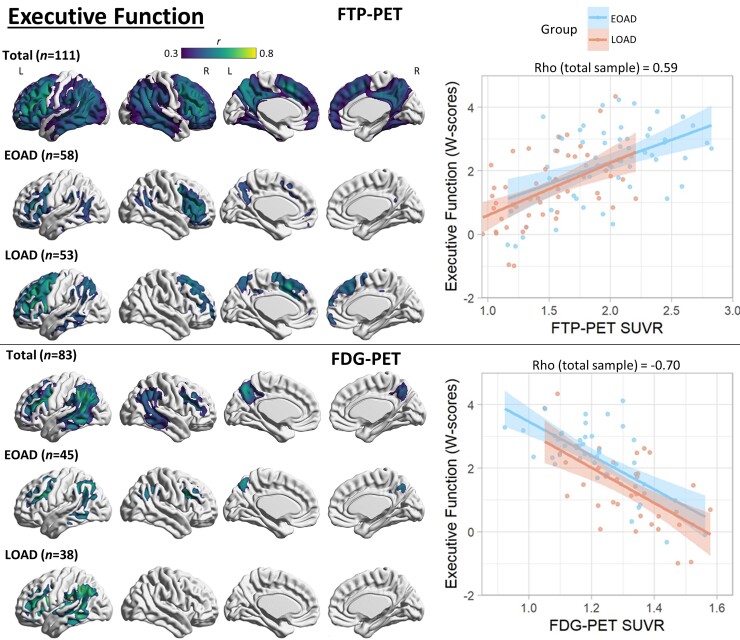
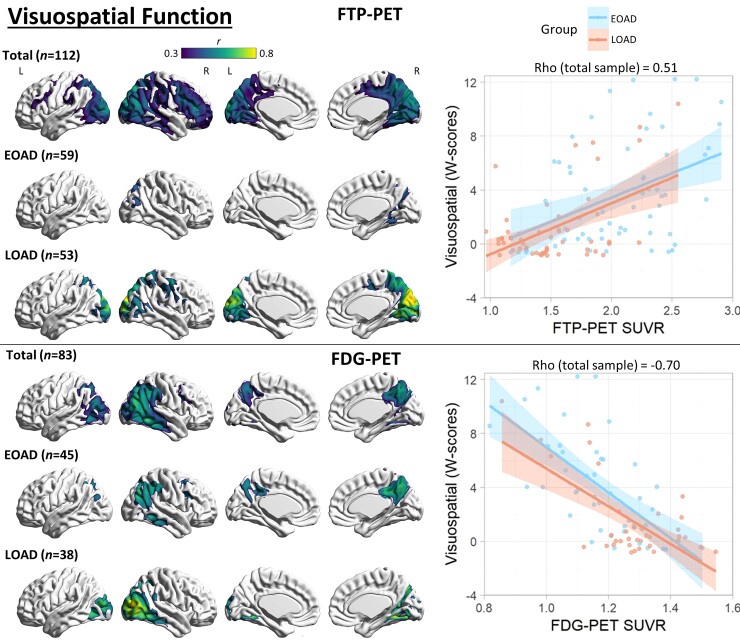
Early-onset (age < 65) Alzheimer's disease is associated with greater non-amnestic cognitive symptoms and neuropathological burden than late-onset disease. It is not fully understood whether these groups also differ in the associations between molecular pathology, neurodegeneration and cognitive performance. We studied amyloid-positive patients with early-onset (n = 60, mean age 58 ± 4, MMSE 21 ± 6, 58% female) and late-onset (n = 53, mean age 74 ± 6, MMSE 23 ± 5, 45% female) Alzheimer's disease who underwent neurological evaluation, neuropsychological testing, 11C-Pittsburgh compound B PET (amyloid-PET) and 18F-flortaucipir PET (tau-PET). 18F-fluorodeoxyglucose PET (brain glucose metabolism PET) was also available in 74% (n = 84) of participants. Composite scores for episodic memory, semantic memory, language, executive function and visuospatial domains were calculated based on cognitively unimpaired controls. Voxel-wise regressions evaluated correlations between PET biomarkers and cognitive scores and early-onset versus late-onset differences were tested with a PET × Age group interaction. Mediation analyses estimated direct and indirect (18F-fluorodeoxyglucose mediated) local associations between 18F-flortaucipir binding and cognitive scores in domain-specific regions of interest. We found that early-onset patients had higher 18F-flortaucipir binding in parietal, lateral temporal and lateral frontal cortex; more severe 18F-fluorodeoxyglucose hypometabolism in the precuneus and angular gyrus; and greater 11C-Pittsburgh compound B binding in occipital regions compared to late-onset patients. In our primary analyses, PET-cognition correlations did not meaningfully differ between age groups.18F-flortaucipir and 18F-fluorodeoxyglucose, but not 11C-Pittsburgh compound B, were significantly associated with cognition in expected domain-specific patterns in both age groups (e.g. left perisylvian/language, frontal/executive, occipital/visuospatial). 18F-fluorodeoxyglucose mediated the relationship between 18F-flortaucipir and cognition in both age groups across all domains except episodic memory in late-onset patients. Additional direct effects of 18F-flortaucipir were observed for executive function in all age groups, language in early-onset Alzheimer's disease and in the total sample and visuospatial function in the total sample. In conclusion, tau and neurodegeneration, but not amyloid, were similarly associated with cognition in both early and late-onset Alzheimer's disease. Tau had an association with cognition independent of neurodegeneration in language, executive and visuospatial functions in the total sample. Our findings support tau PET as a biomarker that captures both the clinical severity and molecular pathology specific to Alzheimer's disease across the broad spectrum of ages and clinical phenotypes in Alzheimer's disease.
Keywords: Alzheimer’s disease; PET; cognition; early-onset; tau.
© The Author(s) 2022. Published by Oxford University Press on behalf of the Guarantors of Brain. All rights reserved. For permissions, please e-mail: journals.permissions@oup.com.
Conflict of interest statement
B.L.M. receives research support from the NIH/NIA and the Centers for Medicare & Medicaid Services (CMS) as grants for the Memory and Aging Center. As an additional disclosure, B.L.M. serves as Medical Director for the John Douglas French Foundation; Scientific Director for the Tau Consortium; Director/Medical Advisory Board of the Larry L. Hillblom Foundation; Scientific Advisory Board Member for the National Institute for Health Research Cambridge Biomedical Research Centre and its subunit, the Biomedical Research Unit in Dementia (UK); and Board Member for the American Brain Foundation (ABF). R.L.J. serves as an Associate Editor for Alzheimer’s Research & Therapy. G.D.R. has research support from Avid Radiopharmaceuticals, GE Healthcare, Life Molecular Imaging, Genentech; has served as a consultant for Eisai, Eli Lilly, Genentech, GE Healthcare, Johnson & Johnson, Roche; and serves as an Associate Editor for
Figures
References
-
- Lambert MA, Bickel H, Prince M, et al. Estimating the burden of early onset dementia; Systematic review of disease prevalence. Eur J Neurol. 2014;21:563–569. - PubMed
-
- Cacace R, Sleegers K, Van Broeckhoven C. Molecular genetics of early-onset Alzheimer’s disease revisited. Alzheimers Dement. 2016;12:733–748. - PubMed
Publication types
MeSH terms
Substances
Grants and funding
- MR/T033371/1/MRC_/Medical Research Council/United Kingdom
- R35 AG072362/AG/NIA NIH HHS/United States
- MC_UU_00030/14/MRC_/Medical Research Council/United Kingdom
- MC_U105597119/MRC_/Medical Research Council/United Kingdom
- P30 AG062422/AG/NIA NIH HHS/United States
- K99 AG065501/AG/NIA NIH HHS/United States
- P01 AG019724/AG/NIA NIH HHS/United States
- R01 NS050915/NS/NINDS NIH HHS/United States
- K24 AG045333/AG/NIA NIH HHS/United States
- AACSF-19-617663/ALZ/Alzheimer's Association/United States
- R01 AG062758/AG/NIA NIH HHS/United States
- RF1 NS050915/NS/NINDS NIH HHS/United States
- MR/P01271X/1/MRC_/Medical Research Council/United Kingdom
- R01 AG045611/AG/NIA NIH HHS/United States
- MR/L023784/2/MRC_/Medical Research Council/United Kingdom
- MC_UU_00005/12/MRC_/Medical Research Council/United Kingdom
- K24 DC015544/DC/NIDCD NIH HHS/United States
