


A national survey of COVID-19 vaccine acceptance in Nigeria
- PMID: 35764433
- PMCID: PMC9221949
- DOI: 10.1016/j.vaccine.2022.06.050
A national survey of COVID-19 vaccine acceptance in Nigeria
Abstract
Introduction: The COVID-19 vaccine is essential to reduce the global impact of the pandemic. Understanding its acceptance is key to Nigeria's national COVID-19 control strategies.
Methods: Between the 6th and 22nd of January 2021, we conducted a non-probability convenience sampling of 3076 respondents using online and in-person interviews to assess the prevalence and predictors of the COVID-19 vaccine acceptance in Nigeria.
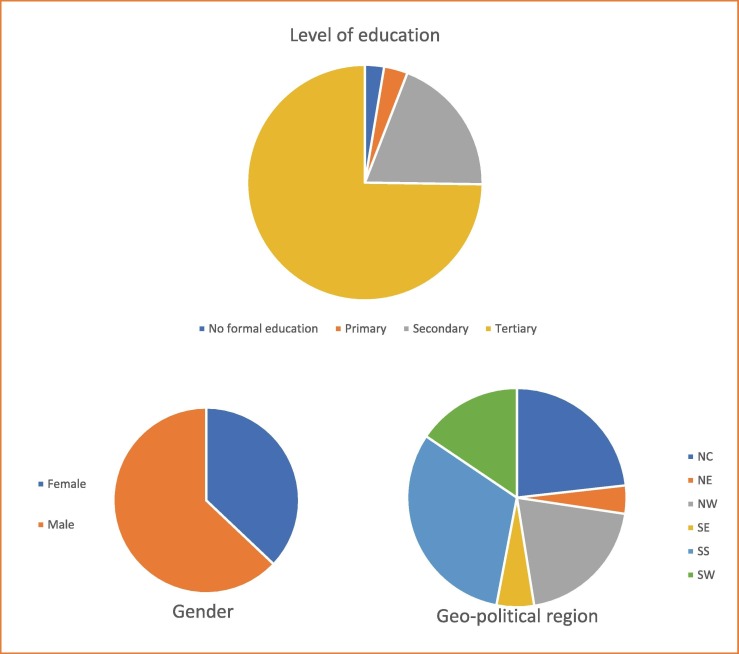
Findings: Of the 3076 recruited participants, 74.7% (n = 2300/3076) had tertiary education. The median age group was 30-39 years (35.1%, n = 1097/3076) whereas 31% (n = 952/3076) of all respondents had a monthly income<30,000 Naira (65 USD). The survey results indicated that a wide range of the respondents were in government employment (34.1%, n = 1050/3076). The majority of our study participants (92.2%, n = 2835/3076) believe that COVID-19 is real and not a hoax. Only 27.9% (n = 858/3076) of the study participants have been tested for COVID-19 and 17.8 % (n = 152/858) of the tested respondents were COVID-19 positive by PCR. Half (50.7%; n = 1560/3076) of the study participants were willing to take the vaccine once available. The majority of the respondents (81.1%, n = 2496/3076) were not willing to pay for the vaccine. Only 15.9% (n = 483/3076) of the respondents rated the government's handling of the pandemic above average. The potential acceptance of the COVID-19 vaccine was significantly affected by the age and the monthly income of the respondents. Respondents older than 60 years old (OR: 3.02, 95% CI: 1.69,5.41; p < 0.001) and those that earn between 250,000-500,000 Naira monthly (OR: 1.38; 95% CI: 1.11,1.70; p < 0.001) were more likely to accept the COVID-19 vaccine respectively. In addition, the respondents' perception of the existence of the disease (OR: 1.45; 95% CI: 0.99,2.18; p > 0.05), the need for a COVID-19 vaccine (OR: 16; 95% CI: 11.63,22.10; p < 0.001), the willingness to pay (OR: 1.68; 95% CI: 1.39,2.01; p < 0.001) and the rating of the government handling of the pandemic (OR: 2.25; 95% CI: 1.57,3.23; p < 0.001) were critical to the acceptance of the COVID-19 vaccine.
Interpretation: With 50.7% vaccine acceptance, Nigeria's public health policymakers must prioritize and develop strategies that will effectively increase COVID-19 vaccine acceptance across the country with emphasis on trust, transparency and strong leadership.
Keywords: COVID-19; Nigeria; Vaccine Acceptance.
Copyright © 2022 Elsevier Ltd. All rights reserved.
Conflict of interest statement
Declaration of Competing Interest The authors declare that they have no known competing financial interests or personal relationships that could have appeared to influence the work reported in this paper.
Figures
References
-
- WHO Coronavirus Disease (COVID-19) Dashboard [Internet]. COVID19.who.int. 2021 [cited 24 January 2021]. Available from: https://COVID19.who.int/?gclid=Cj0KCQiA0rSABhDlARIsAJtjfCd1LcjQvFusy9-jF....
-
- COVID-19 Map - Johns Hopkins Coronavirus Resource Center [Internet]. Johns Hopkins Coronavirus Resource Center. 2021 [cited 24 January 2021]. Available from: https://coronavirus.jhu.edu/map.html.
-
- Africa CDC - COVID-19 Daily Updates [Internet]. Africa CDC. 2021 [cited 24 January 2021]. Available from: https://africacdc.org/COVID-19/
-
- Population, total - Nigeria | Data [Internet]. Data.worldbank.org. 2021 [cited 24 January 2021]. Available from: https://data.worldbank.org/indicator/SP.POP.TOTL?locations=NG
-
- Nigeria Center for Disease Control (NCDC). COVID-19 Situation Report:Weekly Epidemiological Report 14. Available from: https://COVID19.ncdc.gov.ng.
MeSH terms
Substances
LinkOut - more resources
Full Text Sources
Medical
