


Alpha-power in electroencephalography as good outcome predictor for out-of-hospital cardiac arrest survivors
- PMID: 35764807
- PMCID: PMC9240023
- DOI: 10.1038/s41598-022-15144-3
Alpha-power in electroencephalography as good outcome predictor for out-of-hospital cardiac arrest survivors
Abstract
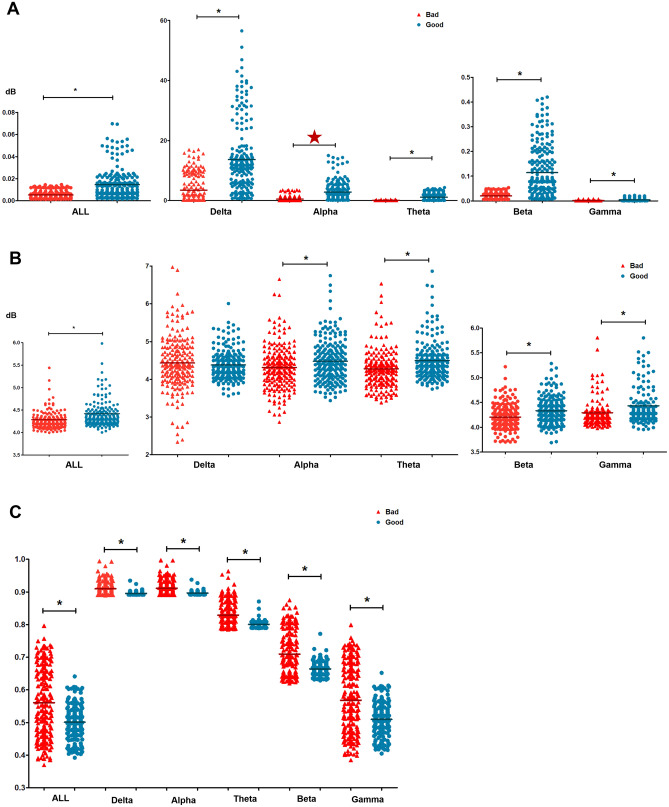
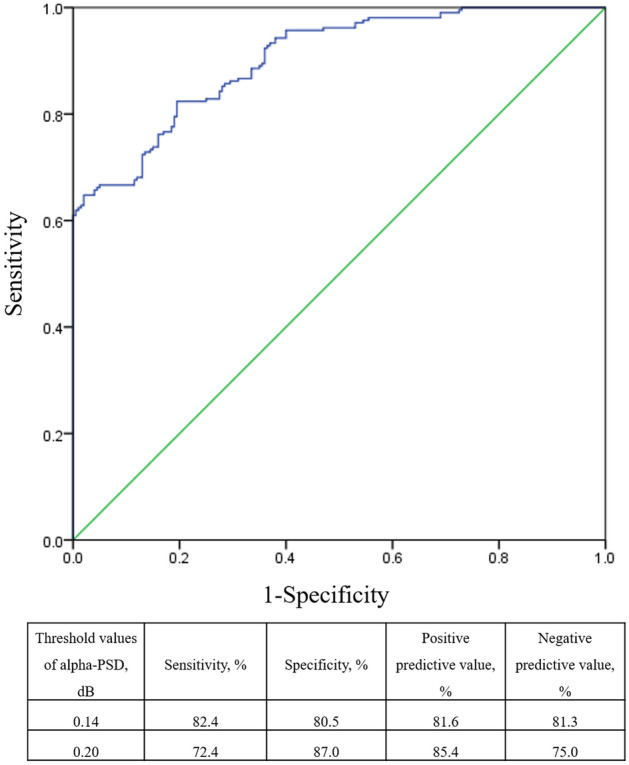
This study aimed to investigate the utility of quantitative EEG biomarkers for predicting good neurologic outcomes in OHCA survivors treated with targeted temperature management (TTM) using power spectral density (PSD), event-related spectral perturbation (ERSP), and spectral entropy (SE). This observational registry-based study was conducted at a tertiary care hospital in Korea using data of adult nontraumatic comatose OHCA survivors who underwent standard EEG and treated with TTM between 2010 and 2018. Good neurological outcome at 1 month (Cerebral Performance Category scores 1 and 2) was the primary outcome. The linear mixed model analysis was performed for PSD, ESRP, and SE values of all and each frequency band. Thirteen of the 54 comatose OHCA survivors with TTM and EEG were excluded due to poor EEG quality or periodic/rhythmic pattern, and EEG data of 41 patients were used for analysis. The median time to EEG was 21 h, and the rate of the good neurologic outcome at 1 month was 52.5%. The good neurologic outcome group was significantly younger and showed higher PSD and ERSP and lower SE features for each frequency than the poor outcome group. After age adjustment, only the alpha-PSD was significantly higher in the good neurologic outcome group (1.13 ± 1.11 vs. 0.09 ± 0.09, p = 0.031) and had best performance with 0.903 of the area under the curve for predicting good neurologic outcome. Alpha-PSD best predicts good neurologic outcome in OHCA survivors and is an early biomarker for prognostication. Larger studies are needed to conclusively confirm these findings.
© 2022. The Author(s).
Conflict of interest statement
The authors declare no competing interests.
Figures

References
-
- Atwood C, Eisenberg MS, Herlitz J, Rea TD. Incidence of EMS-treated out-of-hospital cardiac arrest in Europe. Resuscitation. 2005;67:75–80. - PubMed
-
- Mozaffarian D, et al. Heart disease and stroke statistics–2015 update: A report from the American Heart Association. Circulation. 2015;131:e29–322. - PubMed
-
- Dragancea I, Rundgren M, Englund E, Friberg H, Cronberg T. The influence of induced hypothermia and delayed prognostication on the mode of death after cardiac arrest. Resuscitation. 2013;84:337–342. - PubMed
-
- Lemiale V, et al. Intensive care unit mortality after cardiac arrest: The relative contribution of shock and brain injury in a large cohort. Intensive Care Med. 2013;39:1972–1980. - PubMed
-
- Ben-Hamouda N, Taccone FS, Rossetti AO, Oddo M. Contemporary approach to neurologic prognostication of coma after cardiac arrest. Chest. 2014;146:1375–1386. - PubMed
Publication types
MeSH terms
LinkOut - more resources
Full Text Sources
