. 2022 Jun 28;19(1):169.
doi: 10.1186/s12974-022-02523-w.

Gut microbiota depletion by antibiotics ameliorates somatic neuropathic pain induced by nerve injury, chemotherapy, and diabetes in mice

Affiliations

Gut microbiota depletion by antibiotics ameliorates somatic neuropathic pain induced by nerve injury, chemotherapy, and diabetes in mice

Pingchuan Ma et al. J Neuroinflammation. .

Abstract

Background: Gut microbiota has been found involved in neuronal functions and neurological disorders. Whether and how gut microbiota impacts chronic somatic pain disorders remain elusive.

Methods: Neuropathic pain was produced by different forms of injury or diseases, the chronic constriction injury (CCI) of the sciatic nerves, oxaliplatin (OXA) chemotherapy, and streptozocin (STZ)-induced diabetes in mice. Continuous feeding of antibiotics (ABX) cocktail was used to cause major depletion of the gut microbiota. Fecal microbiota, biochemical changes in the spinal cord and dorsal root ganglion (DRG), and the behaviorally expressed painful syndromes were assessed.

Results: Under condition of gut microbiota depletion, CCI, OXA, or STZ treatment-induced thermal hyperalgesia or mechanical allodynia were prevented or completely suppressed. Gut microbiota depletion also prevented CCI or STZ treatment-induced glial cell activation in the spinal cord and inhibited cytokine production in DRG in OXA model. Interestingly, STZ treatment failed to induce the diabetic high blood glucose and painful hypersensitivity in animals with the gut microbiota depletion. ABX feeding starting simultaneously with CCI, OXA, or STZ treatment resulted in instant analgesia in all the animals. ABX feeding starting after establishment of the neuropathic pain in CCI- and STZ-, but not OXA-treated animals produced significant alleviation of the thermal hyeralgesia or mechanical allodynia. Transplantation of fecal bacteria from SPF mice to ABX-treated mice partially restored the gut microbiota and fully rescued the behaviorally expressed neuropathic pain, of which, Akkermansia, Bacteroides, and Desulfovibrionaceae phylus may play a key role.

Conclusion: This study demonstrates distinct roles of gut microbiota in the pathogenesis of chronic painful conditions with nerve injury, chemotherapy and diabetic neuropathy and supports the clinical significance of fecal bacteria transplantation.

Keywords: Chemotherapy; Diabetes; Gut microbiota; Neuropathic pain.


Conflict of interest statement

The authors declare that there is no conflict of interests regarding the publication of this paper.

Figures
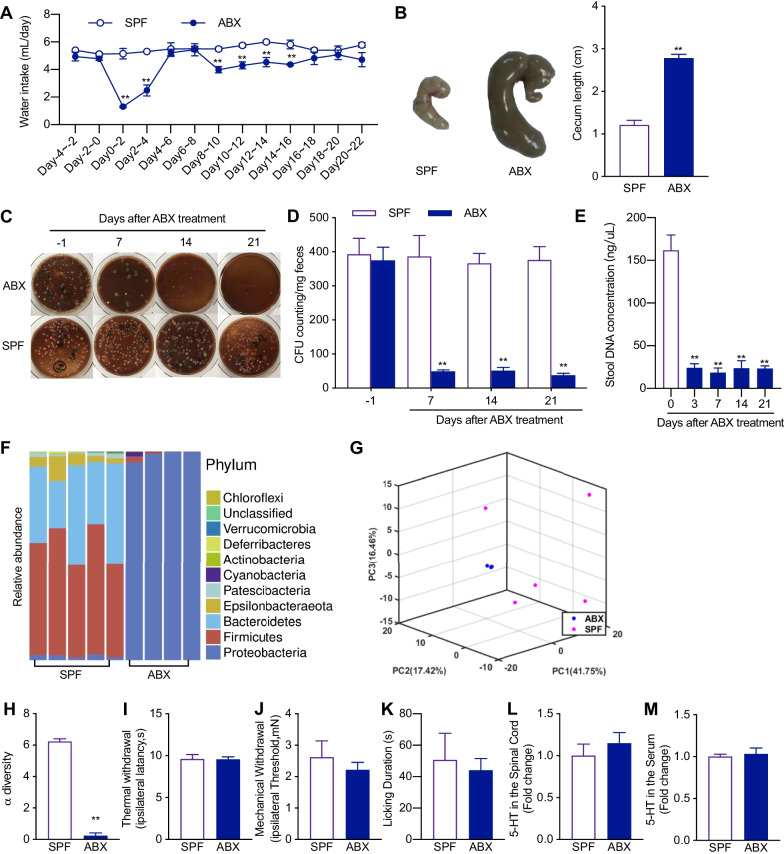
Fig. 1
Fig. 1
The continuous feeding of antibiotics (ABX) cocktail depletes majority of gut microbiota without affecting the behaviorally expressed thermal and mechanical sensory sensitivity in naïve mice. A Time course of the water intake in animals with SPF- and ABX-treatment. Two-way ANOVA with Sidak multiple comparison test **p < 0.01 (n = 3 in each group). B Representative images and statistical summary of the cecum from SPF and ABX-treated mice. The enlarged cecum and dark cecal content were shown in ABX-treated mice. Unpaired t-test **p < 0.01 (n = 6 in each group). C, D Representative images (C) and statistical summary (D) of colony-formation units (CFUs) of the fecal microbiota plated on TSA media. CFUs were reduced at day 7 and remained low at day 14 and 21 following ABX treatment. Two-way ANOVA with Sidak multiple comparison test, **p < 0.01 versus SPF (n = 6 in each group). E Effect of ABX treatment on the stool DNA concentration. One-way ANOVA with Dunnett multiple comparison test **p < 0.01 (n = 2–3). F Stacked bar-chart plot of the fecal microbiota composition of SPF and ABX-treated mice at phylum level. G The Principal Component Analysis of gut microbiota composition of SPF and ABX-treated mice (ABX: n = 4; SFP: n = 5). H 16S rRNA sequencing of fecal microbiota showing that the α-diversity of the microbiota was reduced in ABX-treated mice, compared to SPF mice. Unpaired t-test **p < 0.01(ABX: n = 4; SPF: n = 5). IK ABX treatment did not alter the thermal (I) and mechanical sensory sensitivity (J) and capsaicin-induced licking (K) behavior. Unpaired t-test (n = 5 in each group). L, M 5-HT concentration in the spinal (L) and serum (M) of the SPF and ABX-treated mice. Unpaired t-test (L n = 8; M n = 5)
Fig. 2
Fig. 2
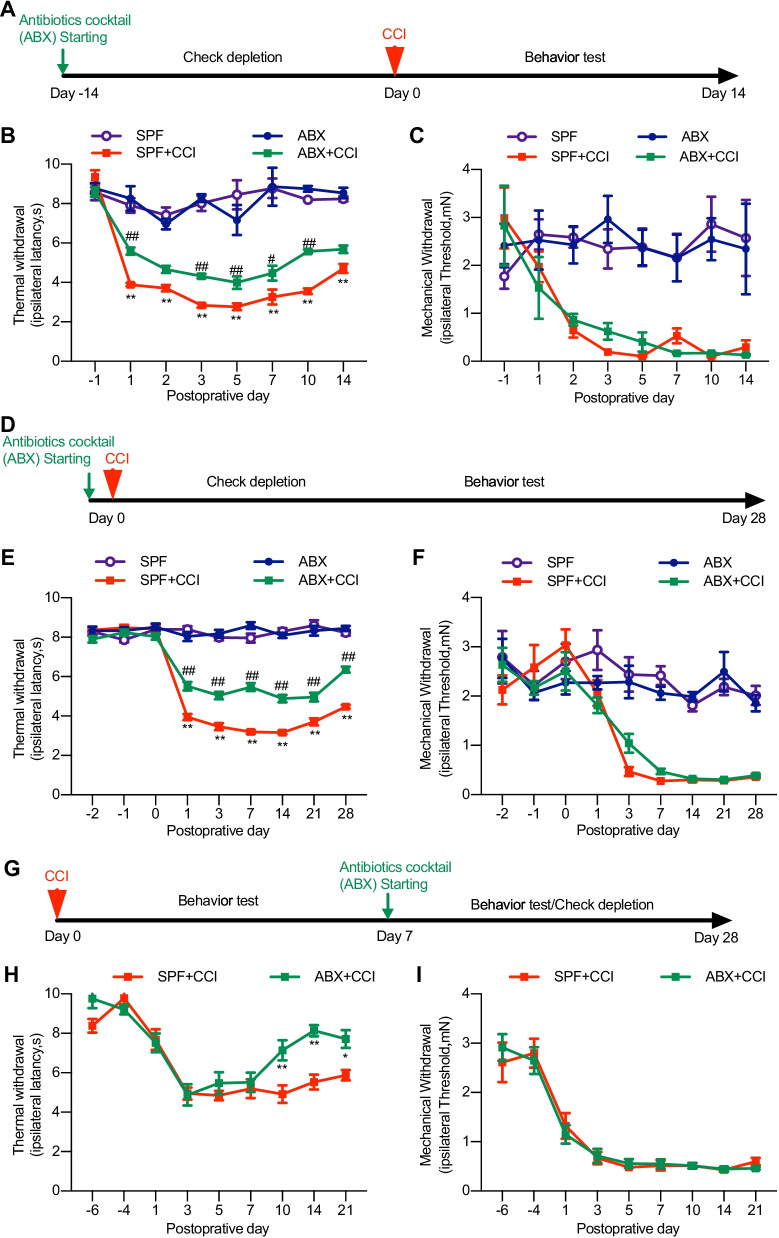
The continuous feeding of ABX alleviates CCI-induced thermal hyperalgesia but not mechanical allodynia. AC Pre-depletion of gut microbiota, two weeks earlier than CCI treatment. DF The continuous feeding of ABX starting simultaneously with CCI treatment. GI The continuous feeding of ABX starting two weeks after CCI treatment when the thermal hyperalgesia and mechanical allodynia had been established. B, E Two-way ANOVA with Dunnett multiple comparison test **p < 0.01 SPF + CCI versus SPF, ##p < 0.01 SPF + CCI versus ABX + CCI. C, F **p < 0.01 versus SPF. H *p < 0.05 **p < 0.01 versus SPF + CCI. Numbers of animals included in each of the groups: A–C, n = 6 in SPF, n = 10 in SPF + CCI, n = 5 in ABX, n = 7 in ABX + CCI); E, F, n = 10 in SPF and ABX, n = 12 in SPF + CCI and ABX + CCI; H, I: n = 10 in SPF + CCI, n = 11 in ABX + CCI
Fig. 3
Fig. 3
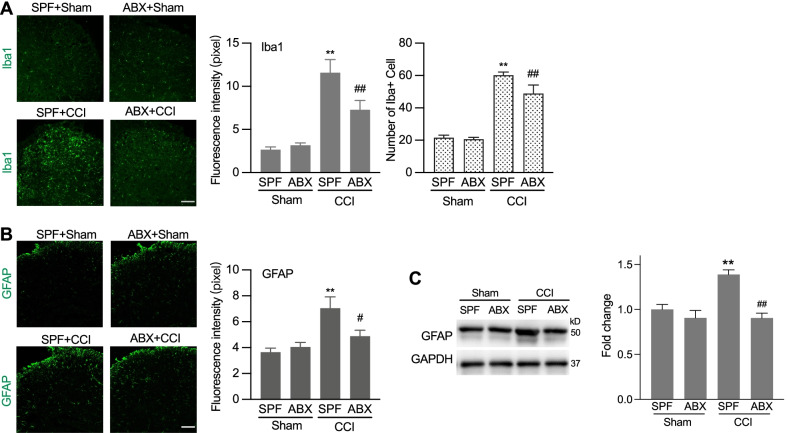
ABX treatment alleviated CCI-induced activation of microglia and astrocyte in the spinal cord of mice. A Representative images of the Iba-1 microglia immunostaining (scale bar: 100 µm) and the quantification of the fluorescence intensity (upper) and cell numbers (lower) of the Iba1 immunostained cells. One-way ANOVA with Dunnett multiple comparison test **p < 0.01 versus SPF, ##p < 0.01 versus SPF + CCI (15 slides from 4 SPF sham mice, 15 slides from 4 ABX sham mice, 12 slides from 4 SPF + CCI mice, and 11 slides from 3 ABX + CCI mice). B Representative images of the GFAP astrocyte immunostaining (scale bar: 100 µm) and the quantification of the fluorescence intensity the GFAP immunostaining cells. One-way ANOVA with Dunnett multiple comparison test **p < 0.01 versus SPF, #p < 0.05 versus SPF + CCI (48 slides from 4 SPF mice, 51 slides from 4 ABX mice, 28 slides from 4 SPF + CCI mice, and 28 slides from 3 ABX + CCI mice). C Representative image of bands and statistical summary of the western blot analysis showing that CCI-induced GFAP increase was reversed by ABX treatment. n = 3 in each group. **p < 0.01 versus SPF, ##p < 0.01 versus SPF + CCI. Tissues were taken from SPF and ABX-treated mice at day 7 after CCI or sham operation (AC)
Fig. 4
Fig. 4
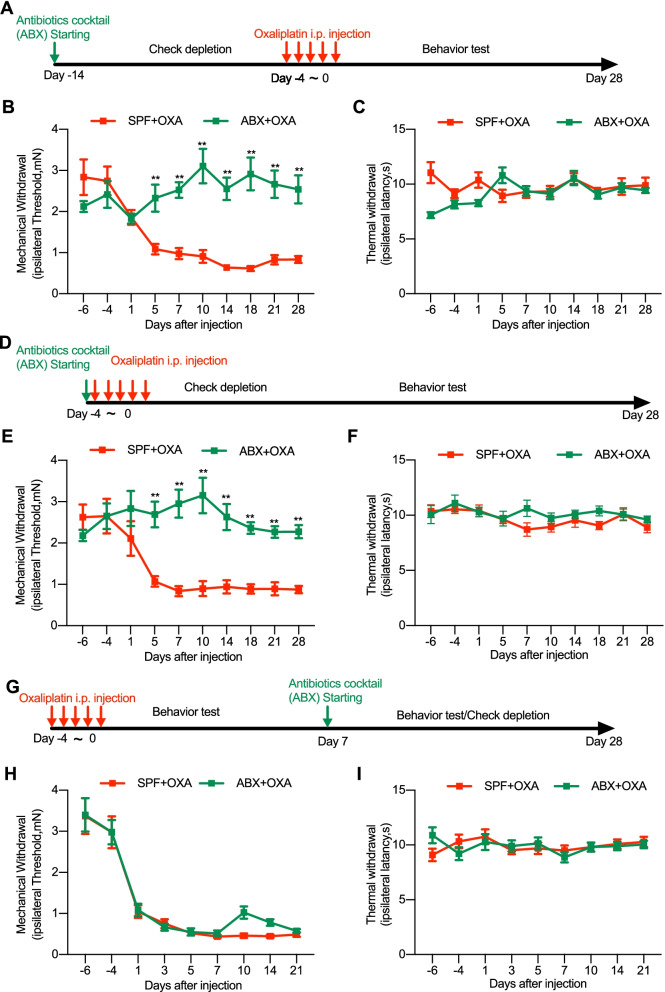
The continuous feeding of ABX alleviates chemotherapy (OXA)-induced mechanical allodynia. OXA treatment itself did not induced significant alteration of thermal sensitivity. AC Pre-depletion of gut microbiota, two weeks earlier than OXA treatment. DF The continuous feeding of ABX starting simultaneously with OXA treatment. GI The continuous feeding of ABX starting two weeks after OXA treatment when the mechanical allodynia had been established. Two-way ANOVA with Sidak multiple comparison test. **p < 0.01, SPF + OXA versus ABX + OXA. Numbers of animals: n = 11 in SPF + OXA; n = 10 in ABX + OXA)
Fig. 5
Fig. 5
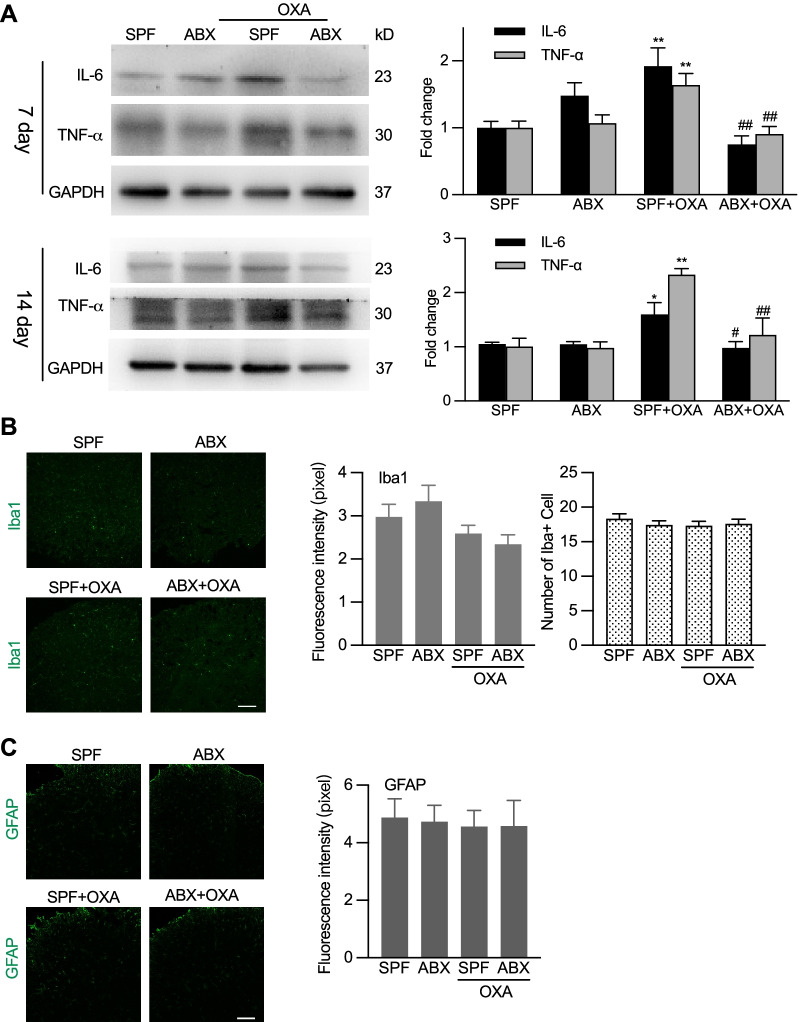
Differential effects of ABX treatment on chemotherapy-induced cytokine production in DRG and glia cell activation in the spinal cord. A Western blotting analysis showing that ABX treatment suppressed the expression of IL-6 and TNF-α in DRG in day 7 and 14 after OXA treatment. Left: representative Western blot bands. Right: statistical summary. One-way ANOVA with Tukey multiple comparison test *p < 0.05, **p < 0.01 SPF + OXA versus SPF; #p < 0.05, ##p < 0.01 ABX + OXA versus SPF + OXA (on day 7: IL-6, n = 6 in each group; TNF-α, n = 7 in ABX, n = 6 in other groups, and on day 14: n = 3 in each group). B, C Both OXA and ABX treatment did not alter the activation of microglial cells and astrocytes in the spinal cord. Left: representative images of immunostaining of Iba1 and GFAP. Scale bar: 100 µm. Right: quantification of the fluorescence intensity and cell numbers of Iba1 immunostaining. Tissues were taken 7 days after OXA treatment (B and C). In B, 15 slides from 4 mice in SPF, 16 slides from 4 mice in ABX, 16 slides from 4 mice in SPF + OXA, 17 slides from 4 mice in ABX + OXA. In C, 6 slides from 4 mice in each group
Fig. 6
Fig. 6
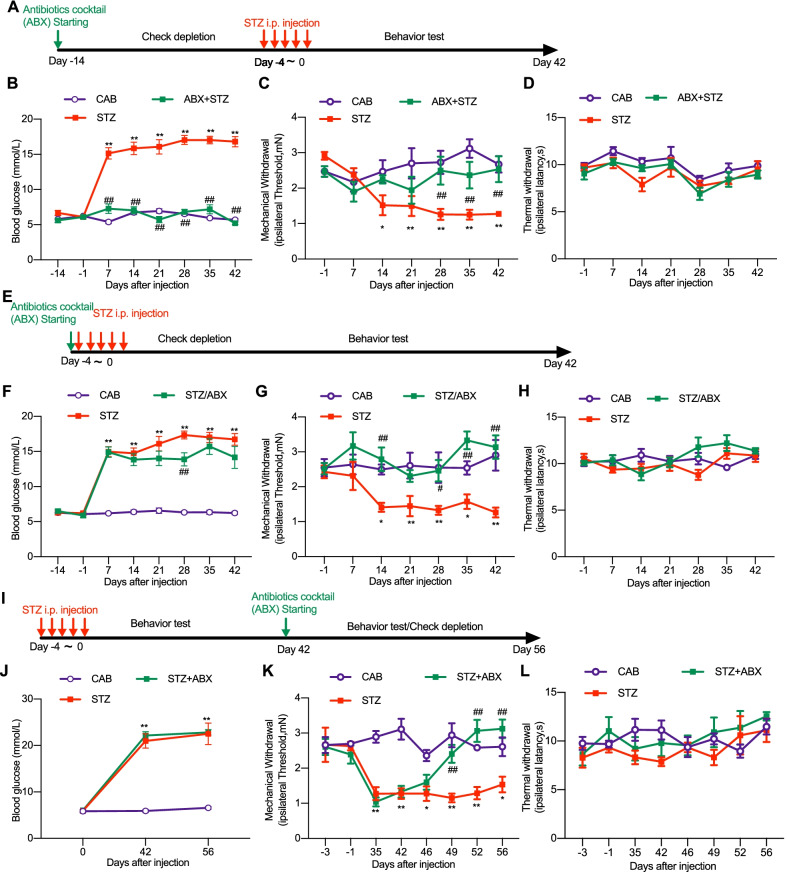
Differential effects of continuous feeding of ABX on STZ-induced diabetic high blood glucose and mechanical allodynia. STZ treatment itself did not induced significant alteration of thermal sensitivity. AD Pre-depletion of gut microbiota, with continuous feeding of ABX starting two weeks earlier than STZ treatment (A), prevented STZ-induced high blood glucose (B) and mechanical allodynia (C), without affecting the thermal sensitivity (D). EH The continuous feeding of ABX starting simultaneously with STZ treatment (E) reduced STZ-induced mechanical allodynia (G) without significantly affecting the high blood glucose (F) and the thermal sensitivity (H). IL The continuous feeding of ABX starting 42 days after STZ treatment (I) when the high blood glucose and mechanical allodynia had been established suppressed the mechanical allodynia (K) without affecting the high blood glucose (J) and the thermal sensitivity (L). Two-way ANOVA with Dunnett multiple comparison test *p < 0.05, **p < 0.01, STZ versus citric acid buffer (CAB) control. #p < 0.05, ##p < 0.01, STZ + ABX versus STZ alone. Numbers of animals: in BD, n = 6 in CAB; n = 12 in STZ at day 21 and 28, n = 11 at day 14, n = 13 at other data points; in ABX + STZ, n = 16 (B) and n = 8 (C and D). In F–H, n = 6 in CAB; n = 13 in STZ; in STZ + ABX, n = 7 at day 42, n = 9 at day − 7. In J-L, n = 8 in each of the groups
Fig. 7
Fig. 7
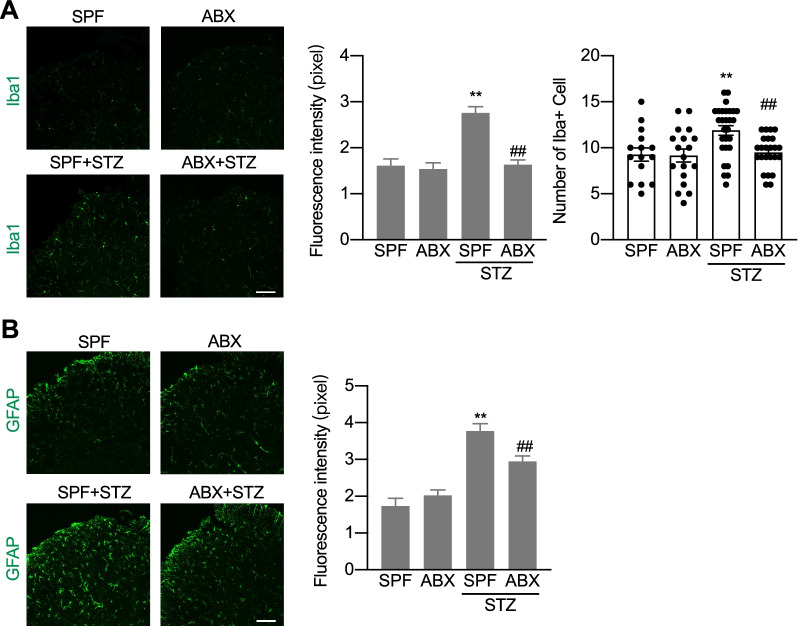
ABX treatment reduces STZ-induced activation of microglia and astrocyte in the spinal cord of mice. A Representative images of the Iba-1 microglia immunostaining (scale bar: 100 µm) and the quantification of the fluorescence intensity (upper) and cell numbers (lower) of the Iba1 immunostaining cells. One-way ANOVA with Dunnett multiple comparison test **p < 0.01 versus SPF, ##p < 0.01 versus SPF + STZ (15 slides from 4 SPF and ABX mice, 28 slides from 4 mice with SPF + STZ, and 24 slides from 4 mice with ABX + STZ). B Representative images of the GFAP astrocyte immunostaining (scale bar: 100 µm) and the quantification of the fluorescence intensity of the GFAP immunostaining cells. One-way ANOVA with Dunnett multiple comparison test **p < 0.01 versus SPF, #p < 0.05 versus SPF + STZ (21 slides from 4 SPF mice, 24 slides from 4 ABX mice, 22 slides from 4 SPF + STZ mice, and 23 slides from 4 ABX + STZ mice). Tissues were taken from SPF and ABX-treated mice at day 42 after STZ or sham operation (A and B)
Fig. 8
Fig. 8
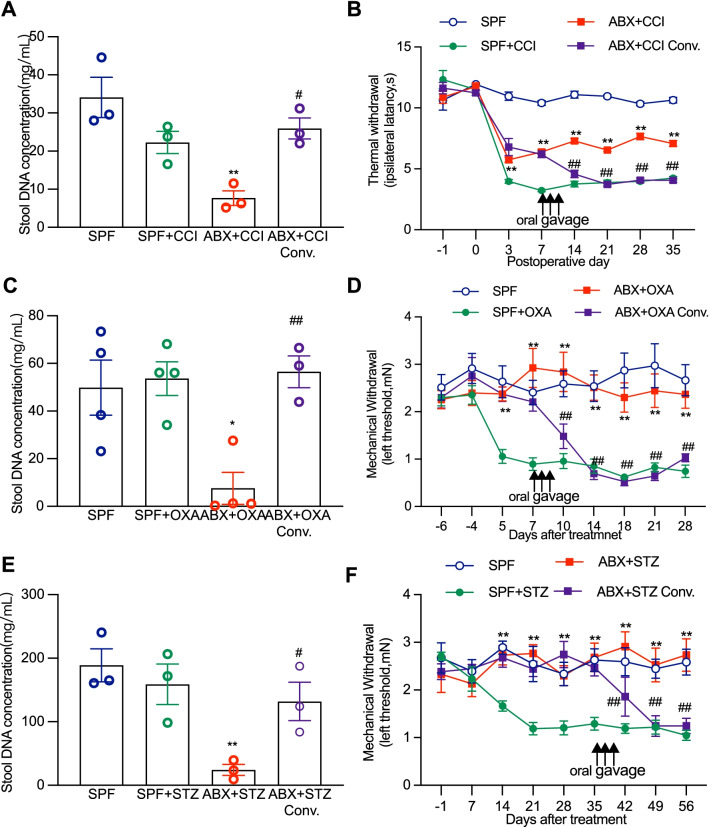
Oral gavage of fecal microbiota from SPF mice restores ABX-induced gut microbiota depletion and rescues neuropathic pain. Fecal bacteria conventionalization was used to restore the depleted gut microbiota and the successful restoration of fecal microbiota was verified by detecting fecal microbiota DNA concentration. AF ABX-induced gut microbiota depletion and analgesic effects were restored and reversed following fecal bacteria conventionalization in the animals that received treatment of CCI (A, B), OXA (C, D) and STZ (E, F). Arrows show the timing of fecal bacteria conventionalization and ABX withdrawal. Statistical analysis, one-way ANOVA (A, C, E) or two-way ANOVA with Dunnett multiple comparison (B, D, F), A **p < 0.01 versus SPF, #p < 0.05 versus ABX + CCI (n = 3 in each group). B **p < 0.01 versus SPF + CCI, ##p < 0.01 versus ABX + CCI (n = 9 at day 7 in ABX + CCI conv, n = 12 at day -1/0/3, n = 7 at other data points, n = 10 in other group). C *p < 0.05 versus SPF, ##p < 0.01 versus ABX + OXA (n = 4 in SPF, n = 4 in SPF + OXA, n = 4 in ABX + OXA, n = 3 in ABX + OXA conv.). D **p < 0.01 versus SPF + OXA, ##p < 0.01 versus ABX + OXA (n = 10 in SPF and ABX, n = 11 in ABX + OXA, n = 6 in ABX + OXA conv at day 10, n = 5 at day 14/18/21/28, n = 10 at other data points). E **p < 0.01 versus SPF, #p < 0.05 versus ABX + STZ (n = 3 in each group). F **p < 0.01 versus SPF + STZ, ##p < 0.01 versus ABX + STZ (n = 6 in CAB, n = 7 in ABX + STZ, n = 8 in others group)
Fig. 9
Fig. 9
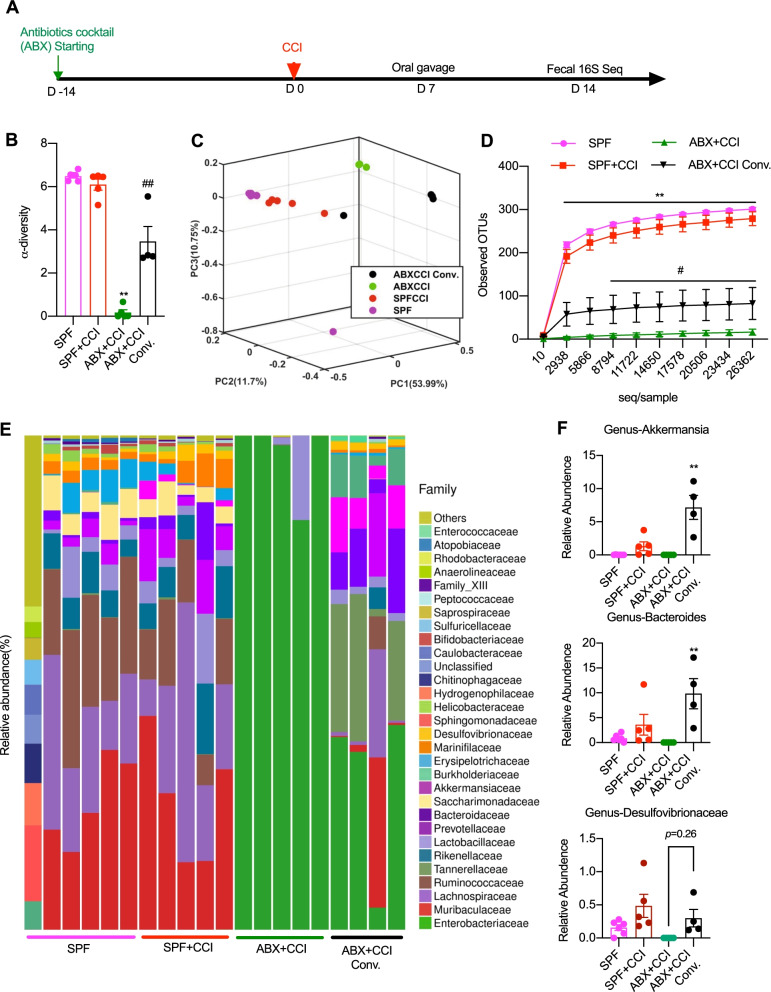
16S rRNA sequencing profiles of the gut microbiota in SPF control mice and those with CCI and ABX treatment as well as restoration of gut microbiota. A Timeline of experimental design. B α-diversity (Shannon) of the composition of microbiota. One-way ANOVA with Dunnett multiple comparison, **p < 0.01 versus SPF; ##p < 0.01 versus ABX + CCI. C PCA analysis showing the major differences in the composition of microbiota. D Observed operational taxonomic units (OUTs) of microbiota. Two-way ANOVA with Tukey multiple comparison **p < 0.01 versus SPF + CCI, #p < 0.05 versus ABX + CCI. E Stacked bar-chart showing gut microbiota composition at family level. F Specific bacteria genus abundance that corelated with the restoration of pain hypersensitivity. Oral fecal microbiota gavage increased the relative abundance of Akkermansia genus (upper), Desulfovibrionaceae genus (middle), and Bacteroides genus (bottom). One-way ANOVA with Tukey multiple comparison ##p < 0.01 versus ABX + CCI. Number of animals: n = 6 in SPF, n = 5 in SPF + CCI, n = 5 in ABX + CCI, and n = 4 in ABX + CCI Conv

References

    1. Fan Y, Pedersen O. Gut microbiota in human metabolic health and disease. Nat Rev Microbiol. 2021;19:55–71. doi: 10.1038/s41579-020-0433-9. - DOI - PubMed
    1. Belkaid Y, Hand TW. Role of the microbiota in immunity and inflammation. Cell. 2014;157:121–141. doi: 10.1016/j.cell.2014.03.011. - DOI - PMC - PubMed
    1. Dey N, Wagner VE, Blanton LV, Cheng J, Fontana L, Haque R, Ahmed T, Gordon JI. Regulators of gut motility revealed by a gnotobiotic model of diet-microbiome interactions related to travel. Cell. 2015;163:95–107. doi: 10.1016/j.cell.2015.08.059. - DOI - PMC - PubMed
    1. Luczynski P, Tramullas M, Viola M, Shanahan F, Clarke G, O’Mahony S, Dinan TG, Cryan JF. Microbiota regulates visceral pain in the mouse. Elife. 2017; 6. - PMC - PubMed
    1. Schroeder BO, Backhed F. Signals from the gut microbiota to distant organs in physiology and disease. Nat Med. 2016;22:1079–1089. doi: 10.1038/nm.4185. - DOI - PubMed

Substances