


Determinants and reasons for switching anti-retroviral regimen among HIV-infected youth in a large township of South Africa (2002-2019)
- PMID: 35765006
- PMCID: PMC9237968
- DOI: 10.1186/s12981-022-00453-4
Determinants and reasons for switching anti-retroviral regimen among HIV-infected youth in a large township of South Africa (2002-2019)
Abstract
Background: There are limited data exploring antiretroviral therapy (ART) changes and time to change among South Africa young people living with HIV/AIDS.
Objective: We describe the time to first drug switch, which includes ART regimen change (three drug switch) and substitutions (single drug switch). We describe common reasons for ART switch among young people aged 10 to 24 years in South Africa.
Methods: We conducted a retrospective cohort study at a primary health care clinic in Cape Town, South Africa, providing ART to HIV-infected adolescents and adults since 2002. Those aged 10 to 24 years at ART initiation, who accessed care clinic between September 2002 and April 2019. Data was retrieved from electronic information systems: ART regimens, ART changes, dates for initiation or stop of each drug/regimen, laboratory results (viral loads, haemoglobin, liver enzyme results, and creatinine to support the reason for ART switch. From written records, we abstracted reason for single drug switch or regimen change, as well as socio demographic and clinical data. We fitted cox regression models to determine factors associated with ART switch (Having a change in one or more drugs in ART combination) and the rate of occurrence.
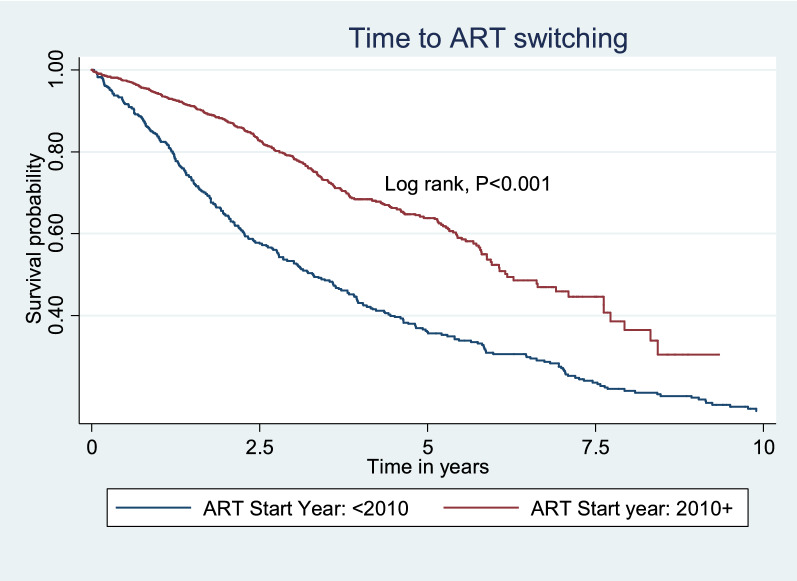
Results: Of 2601 adolescents included, 605 (24.9%) adolescents switched ART over 5090.5 person years at risk (PYAR), a rate of 11.9 /100PYAR. Median follow-up time was 4.4 (± 3.2) years. At multivariable analysis, the older age group was protective of the risk of ART switch: adjusted Hazard Ratio [aHR] 0.78, 95% CI 0.62-0.98, transfer status [transferred out 1.42 [1.11-1.82]. The hazard of ART switch increased with more severe HIV-disease at ART start, as observed by increasing WHO clinical stage or reduced CD4 count at baseline. The primary reasons for ART switch were side effects (20.0%), virological failure (17.9%) and formulation switch (27.8%). Others reasons included pregnancy, Hepatitis B, tuberculosis and psychosis.
Conclusion: ART switches are frequent and occur at a consistent rate across 7.5 years from initiation. The main reasons for ART switch were virological failure and drug side effects.
Keywords: Antiretroviral therapy; Drug switch; Reasons for switch; South Africa; Young people.
© 2022. The Author(s).
Conflict of interest statement
Not applicable.
Figures
References
-
- UNICEF. HIV and AIDS in adolescents. 2020 (Accessed 15 March 2021).
-
- UNAIDs. Ending the AIDS epidemic for adolescents, with adolescent: a practical guide to meaningfully engage adolescents in the AIDS response. 2016. https://www.unfpa.org/sites/default/files/pub-pdf/210079_UNAIDS_ENDING_T.... (Accessed 09 June 2022)
-
- UNAIDs. UNAIDs data 2019. 2019. https://www.unaids.org/en/resources/documents/2019/2019-UNAIDS-data.
-
- Organization WH. Consolidated guidelines on the use of antiretroviral drugs for treating and preventing HIV infection: recommendations for a public health approach. Genva: World Health Organization; 2016. - PubMed
Publication types
MeSH terms
Grants and funding
LinkOut - more resources
Full Text Sources
Medical
Research Materials
Miscellaneous
