Use of Janus kinase inhibitors in dermatomyositis: a systematic literature review
- PMID: 35766013
- PMCID: PMC10105327
- DOI: 10.55563/clinexprheumatol/hxin6o
Use of Janus kinase inhibitors in dermatomyositis: a systematic literature review
Abstract
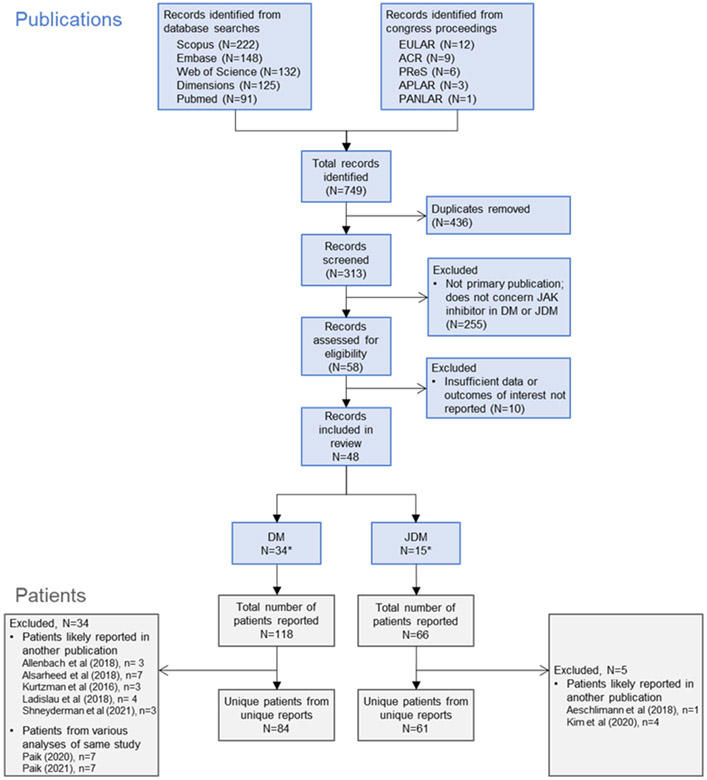
Dermatomyositis (DM) is an idiopathic inflammatory myopathy that commonly manifests with proximal muscle weakness and is associated with extramuscular pathology, including characteristic skin lesions such as Gottron's papules and heliotrope rash, as well as lung, gastrointestinal, joint, and cardiac involvement. Systemic corticosteroids are a cornerstone of therapy, and more recently intravenous immunoglobulin (IVIG; OCTAGAM®) has been approved by the US Food and Drug Administration for the treatment of adults with DM. Both steroids and IVIG represent nonspecific anti-inflammatory therapy, and more targeted approaches are lacking. Transcriptomics has identified upregulation of interferon (IFN)-regulated genes as key features of both adult DM and juvenile DM (JDM). Accordingly, blocking IFN signalling through inhibition of the Janus kinase (JAK) pathway represents a potential treatment option for DM. Placebo-controlled trial data assessing the use of JAK inhibitors for the treatment of DM are limited; as such, a systematic literature review was undertaken to assess the evidence of JAK inhibitors in the treatment of patients with DM. Terms related to DM and JAK inhibitors were searched using PubMed, Embase, Web of Science, Scopus, and Dimensions to identify peer-reviewed publications reporting patients with DM who were treated with a JAK inhibitor. Baseline demographics, clinical characteristics, and treatment outcome data were extracted. A total of 48 publications reporting 145 unique patients (adult DM, n=84; JDM, n=61) were identified. Among cases of adult DM, 61 of 84 (73%) had refractory skin disease at baseline, and all (61 of 61) reported improvement in cutaneous symptoms. Of patients with adult DM, 16 of 84 (19%) had refractory muscle disease at baseline, and all (16 of 16) reported improvement in muscle symptoms. In patients with adult DM complicated by interstitial lung disease (ILD; n=33), 31 (94%) patients improved with JAK inhibitor treatment. Among cases of JDM with refractory skin disease at baseline (60 of 61), most patients (57 of 60; 95%) showed improvements in skin symptoms after JAK inhibitor treatment. Of patients with JDM with refractory muscle disease at baseline (36 of 61), most (30 of 36; 83%) reported improvement in muscle symptoms. Four patients with JDM and ILD experienced improvement in lung disease activity following treatment with a JAK inhibitor. Among both DM and JDM cases, all patients (17 with DM and 16 with JDM) who had elevated serum IFN and/or IFN-stimulated gene expression at baseline showed reduction in IFN or IFN gene expression. Although the conclusions that can be drawn from this analysis are limited because of the differences in assessments used across publications, overall treatment of patients with DM or JDM with a JAK inhibitor was associated with significant improvement of a wide range of DM manifestations, including skin lesions, muscle weakness, and ILD. Our systematic literature review suggests that JAK inhibitors may be a viable treatment option for DM/JDM, and randomised controlled trials are necessary to confirm these findings.
Conflict of interest statement
Figures
References
-
- MARIE I: Morbidity and mortality in adult polymyositis and dermatomyositis. Curr Rheumatol Rep 2012. 14(3): 275–85. - PubMed
-
- GREENBERG SA, PINKUS JL, PINKUS GS et al. : Interferon-alpha/beta-mediated innate immune mechanisms in dermatomyositis. Ann Neurol 2005. 57(5): 664–78. - PubMed
-
- TEZAK Z, HOFFMAN EP, LUTZ JL et al. : Gene expression profiling in DQA1*0501+ children with untreated dermatomyositis: a novel model of pathogenesis. J Immunol 2002. 168(8): 4154–63. - PubMed
Publication types
MeSH terms
Substances
Grants and funding
LinkOut - more resources
Full Text Sources
Other Literature Sources
Medical