


Community health worker intervention to improve tooth brushing in young children: Results from a cluster randomized controlled trial
- PMID: 35766288
- PMCID: PMC9797618
- DOI: 10.1111/cdoe.12768
Community health worker intervention to improve tooth brushing in young children: Results from a cluster randomized controlled trial
Abstract
Objectives: Coordinated Oral health Promotion (CO-OP) Chicago is a cluster randomized controlled trial testing the efficacy of a community health worker (CHW) intervention to improve tooth brushing in low-income children.
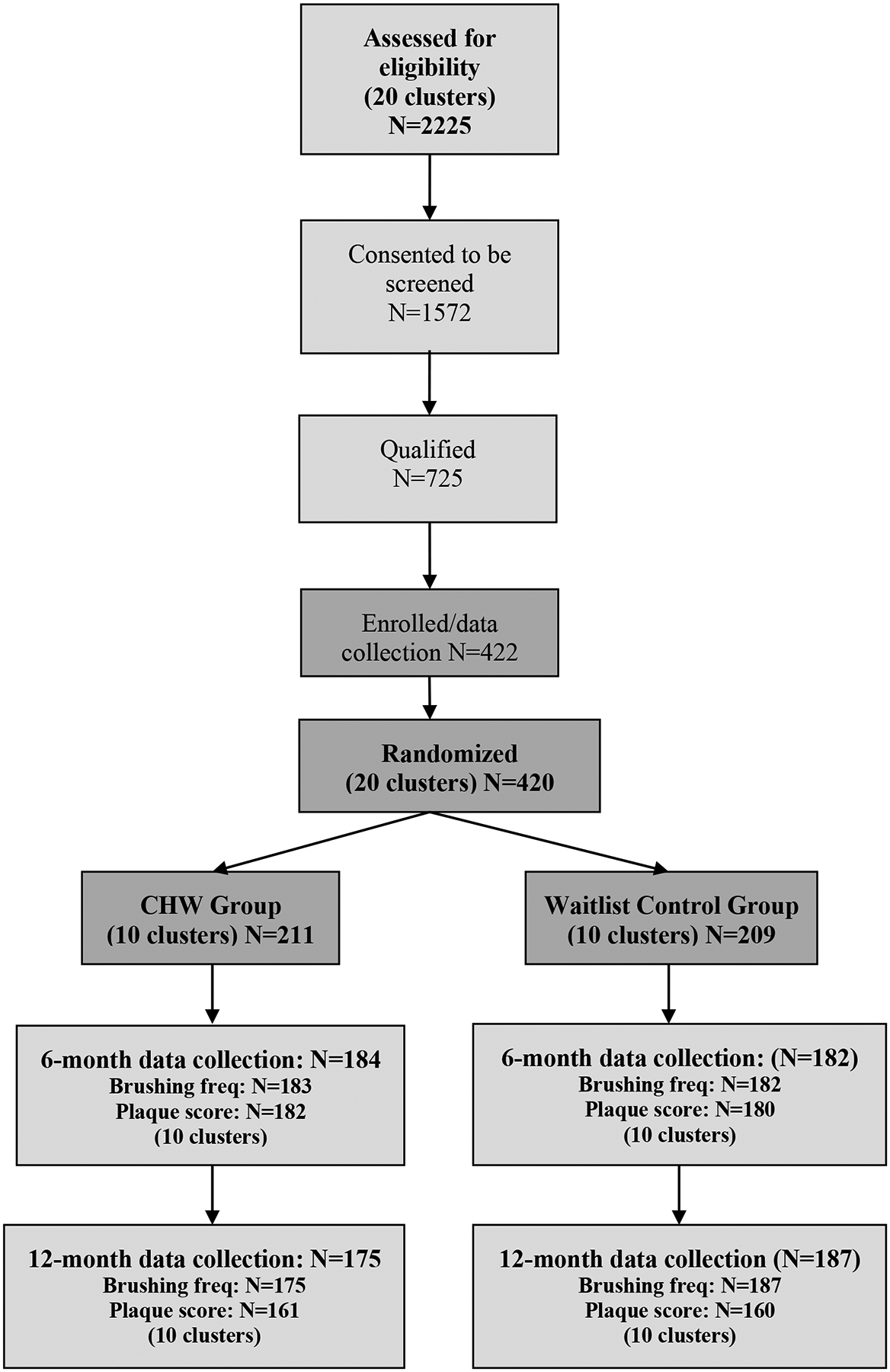
Methods: Four hundred twenty children under 3 years old (mean 21.5 months) were recruited from 20 sites in or near Chicago, IL. Children were identified mainly as Black race (41.9%) or Hispanic ethnicity (53.8%) and most (85.2%) had Medicaid. Intervention families were offered four CHW home visits over 1 year. Brushing frequency was self-reported. Plaque score was determined from images collected in homes using disclosing solution. Analyses used GEE logistic models with variable selection at p < .05.
Results: At enrolment, 45.0% of families reported twice a day or more child brushing frequency, and child plaque scores were poor (mean of 1.9, SD: 0.6). Data were obtained from 87.1% of children at 6 months and 86.2% at 12 months. In the CHW intervention arm (10 sites, N = 211), 23.7% received 4 visits, 12.8% 3 visits, 21.3% 2 visits, 23.2% 1 visit and 19% no visits from CHWs. No intervention effect was seen for brushing frequency or plaque score. Child brushing frequency improvement over time was associated with a range of child and caregiver factors. The only factor associated with a change in plaque score over time was parent involvement in brushing.
Conclusions: Oral-health-specific CHW services were not associated with improved brushing behaviours in these young children. However, caregiver involvement with brushing supported more quality brushing. More robust interventions are needed to support families during this critical developmental period.
Trial registration: ClinicalTrials.gov NCT03397589.
Keywords: disparities; oral health; pediatric dentistry; prevention.
© 2022 The Authors. Community Dentistry and Oral Epidemiology published by John Wiley & Sons Ltd.
Conflict of interest statement
References
-
- Fleming E, Afful J. Prevalence of Total and Untreated Dental Caries Among Youth: United States, 2015–2016. 2018. NCHS Data Brief, no 307. Hyattsville, MD. - PubMed
-
- Policy on Hospitalization and Operating Room Access for Oral Care of Infants, Children, Adolescents, and Individuals with Special Health Care Needs. Pediatr Dent. 2017;39(6):104–105. - PubMed
-
- Casamassimo PS, Thikkurissy S, Edelstein BL, Maiorini E. Beyond the dmft: The Human and Economic Cost of Early Childhood Caries. J Am Dent Assoc. 2009;140(6):650–657. - PubMed
-
- Goettems ML, Nascimento GG, Peres MA, et al. Influence of maternal characteristics and caregiving behaviours on children’s caries experience: An intergenerational approach. Community Dent Oral Epidemiol. 2018;46(5):435–441. - PubMed
Publication types
MeSH terms
Associated data
Grants and funding
LinkOut - more resources
Full Text Sources
Medical
Miscellaneous
