


Assessing the contribution of rare genetic variants to phenotypes of chronic obstructive pulmonary disease using whole-genome sequence data
- PMID: 35766891
- PMCID: PMC9652112
- DOI: 10.1093/hmg/ddac117
Assessing the contribution of rare genetic variants to phenotypes of chronic obstructive pulmonary disease using whole-genome sequence data
Abstract
Rationale: Genetic variation has a substantial contribution to chronic obstructive pulmonary disease (COPD) and lung function measurements. Heritability estimates using genome-wide genotyping data can be biased if analyses do not appropriately account for the nonuniform distribution of genetic effects across the allele frequency and linkage disequilibrium (LD) spectrum. In addition, the contribution of rare variants has been unclear.
Objectives: We sought to assess the heritability of COPD and lung function using whole-genome sequence data from the Trans-Omics for Precision Medicine program.
Methods: Using the genome-based restricted maximum likelihood method, we partitioned the genome into bins based on minor allele frequency and LD scores and estimated heritability of COPD, FEV1% predicted and FEV1/FVC ratio in 11 051 European ancestry and 5853 African-American participants.
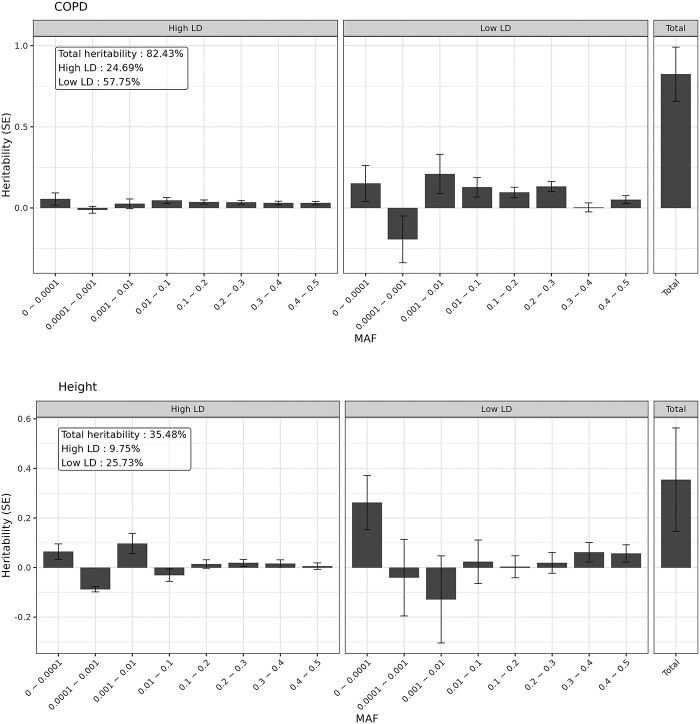
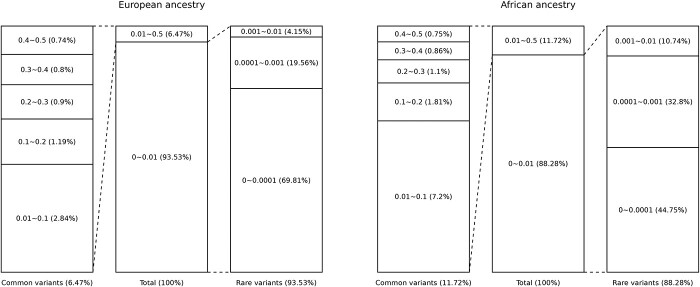
Measurements and main results: In European ancestry participants, the estimated heritability of COPD, FEV1% predicted and FEV1/FVC ratio were 35.5%, 55.6% and 32.5%, of which 18.8%, 19.7%, 17.8% were from common variants, and 16.6%, 35.8%, and 14.6% were from rare variants. These estimates had wide confidence intervals, with common variants and some sets of rare variants showing a statistically significant contribution (P-value < 0.05). In African-Americans, common variant heritability was similar to European ancestry participants, but lower sample size precluded calculation of rare variant heritability.
Conclusions: Our study provides updated and unbiased estimates of heritability for COPD and lung function, and suggests an important contribution of rare variants. Larger studies of more diverse ancestry will improve accuracy of these estimates.
© The Author(s) 2022. Published by Oxford University Press. All rights reserved. For Permissions, please email: journals.permissions@oup.com.
Figures



References
-
- Silverman, E.K., Chapman, H.A., Drazen, J.M., Weiss, S.T., Rosner, B., Campbell, E.J., O'Donnell, W.J., Reilly, J.J., Ginns, L. and Mentzer, S. (1998) Genetic epidemiology of severe, early-onset chronic obstructive pulmonary disease: risk to relatives for airflow obstruction and chronic bronchitis. Am. J. Respir. Crit. Care Med., 157, 1770–1778. - PubMed
-
- Sakornsakolpat, P., Prokopenko, D., Lamontagne, M., Reeve, N.F., Guyatt, A.L., Jackson, V.E., Shrine, N., Qiao, D., Bartz, T.M., Kim, D.K. et al. (2019) Genetic landscape of chronic obstructive pulmonary disease identifies heterogeneous cell-type and phenotype associations. Nat. Genet., 51, 494–505. - PMC - PubMed
Publication types
MeSH terms
Grants and funding
- HHSN268201100037C/HL/NHLBI NIH HHS/United States
- R21 HL153700/HL/NHLBI NIH HHS/United States
- R01 HG006139/HG/NHGRI NIH HHS/United States
- U54 HG003273/HG/NHGRI NIH HHS/United States
- R21 HL129924/HL/NHLBI NIH HHS/United States
- HHSN268201500014C/HL/NHLBI NIH HHS/United States
- R03 HL154284/HL/NHLBI NIH HHS/United States
- K23 HL130627/HL/NHLBI NIH HHS/United States
- R01 HL077612/HL/NHLBI NIH HHS/United States
- R01 HL153805/HL/NHLBI NIH HHS/United States
- R01 HL093081/HL/NHLBI NIH HHS/United States
- U01 HL089856/HL/NHLBI NIH HHS/United States
