


Perceptions of Partners' Fertility Preferences and Women's Covert Contraceptive Use in Eight Sub-Saharan African Countries
- PMID: 35767464
- PMCID: PMC9545344
- DOI: 10.1111/sifp.12206
Perceptions of Partners' Fertility Preferences and Women's Covert Contraceptive Use in Eight Sub-Saharan African Countries
Abstract
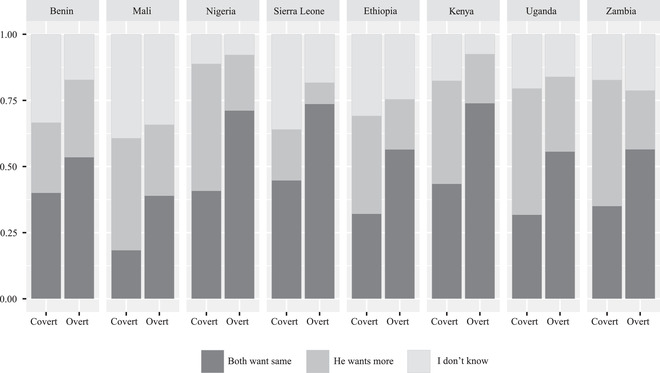
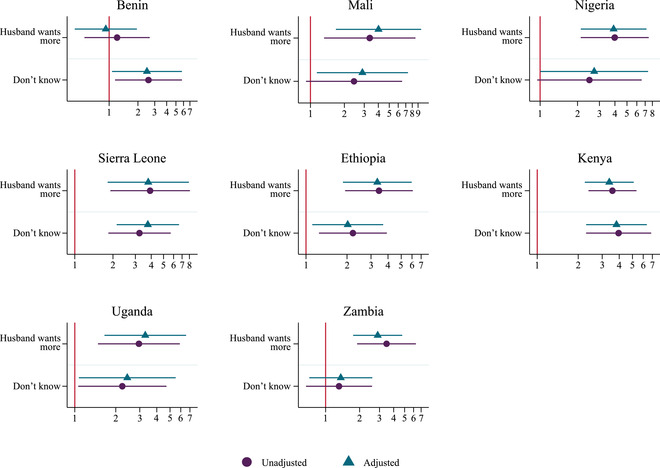
Covert use of contraception is a common but underreported and understudied phenomenon where one partner uses contraception without the other's knowledge. We used Demographic and Health Survey couple data to examine the relationship between wives' perceptions of husbands' fertility preferences and type of contraceptive use (overt vs. covert) in Benin, Ethiopia, Kenya, Mali, Nigeria, Sierra Leone, Uganda, and Zambia using logistic regression. Wives who perceived that their husbands wanted more children than them had increased odds of using covertly, compared to those who perceived that husbands wanted the same number of children in all countries except Benin, and the strength of the relationships ranged from adjusted odds ratio (aOR) 2.89 (95 percent confidence interval (CI) 1.75-4.76) in Zambia to aOR 4.01 (95 percent CI 1.68-9.58) in Mali. Wives who reported not knowing their husbands' fertility preferences had increased odds of using covertly compared to wives who perceived that their husbands wanted the same number of children in all countries except Zambia, ranging from aOR 2.02 (95 percent CI 1.11-3.69) in Ethiopia to aOR 3.82 (95 percent CI 2.29-6.37) in Kenya. Our findings indicate that efforts to increase partner engagement to align couple's fertility preferences may encourage overt use.
Keywords: couples; covert contraceptive use; fertility preferences.
© 2022 The Authors. Studies in Family Planning published by Wiley Periodicals LLC on behalf of Population Council.
Figures
References
-
- Abdulkadir, Zainab , Bukar Grema, Godpower Michael and Omeiza S.Y.. 2020. “Effect of Antenatal Couple Counselling on Postpartum Uptake of Contraception among Antenatal Clients and their Spouses attending Antenatal Clinic of a Northern Nigeria Tertiary Hospital: A Randomized Controlled Trial.” West African Journal of Medicine, 37 (6): 695–702. - PubMed
-
- Adanikin, Abiodun Idowu , McGrath Nuala, and Padmadas Sabu S.. 2019. “Power Relations and Negotiations in Contraceptive Decision‐Making When Husbands Oppose Family Planning: Analysis of Ethnographic Vignette Couple Data in Southwest Nigeria.” Culture, Health & Sexuality 21 (12): 1439–1451. 10.1080/13691058.2019.1568576. - DOI - PubMed
-
- Agadjanian, Victor . 2005. “Fraught with Ambivalence: Reproductive Intentions and Contraceptive Choices in a Sub‐Saharan Fertility Transition.” Population Research and Policy Review 24 (6): 617–645. 10.1007/s11113-005-5096-8. - DOI
-
- Adelekan, Ademola , Omoregie Philomena, and Edoni Elizabeth. 2014. “Male Involvement in Family Planning: Challenges and Way Forward.” International Journal of Population Research 2014: 1–9. 10.1155/2014/416457. - DOI
MeSH terms
Substances
LinkOut - more resources
Full Text Sources
