BNT162b2 Vaccine Effectiveness against Omicron in Children 5 to 11 Years of Age
- PMID: 35767475
- PMCID: PMC9258754
- DOI: 10.1056/NEJMoa2205011
BNT162b2 Vaccine Effectiveness against Omicron in Children 5 to 11 Years of Age
Abstract
Background: Limited evidence is available on the real-world effectiveness of the BNT162b2 vaccine against coronavirus disease 2019 (Covid-19) and specifically against infection with the omicron variant among children 5 to 11 years of age.
Methods: Using data from the largest health care organization in Israel, we identified a cohort of children 5 to 11 years of age who were vaccinated on or after November 23, 2021, and matched them with unvaccinated controls to estimate the vaccine effectiveness of BNT162b2 among newly vaccinated children during the omicron wave. Vaccine effectiveness against documented severe acute respiratory syndrome coronavirus 2 (SARS-CoV-2) infection and symptomatic Covid-19 was estimated after the first and second vaccine doses. The cumulative incidence of each outcome in the two study groups through January 7, 2022, was estimated with the use of the Kaplan-Meier estimator, and vaccine effectiveness was calculated as 1 minus the risk ratio. Vaccine effectiveness was also estimated in age subgroups.
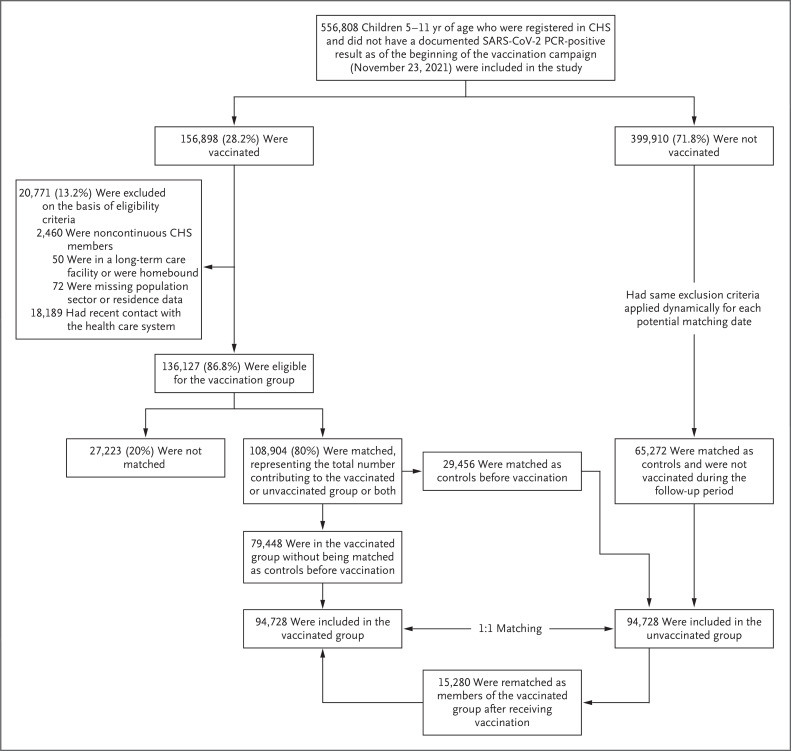
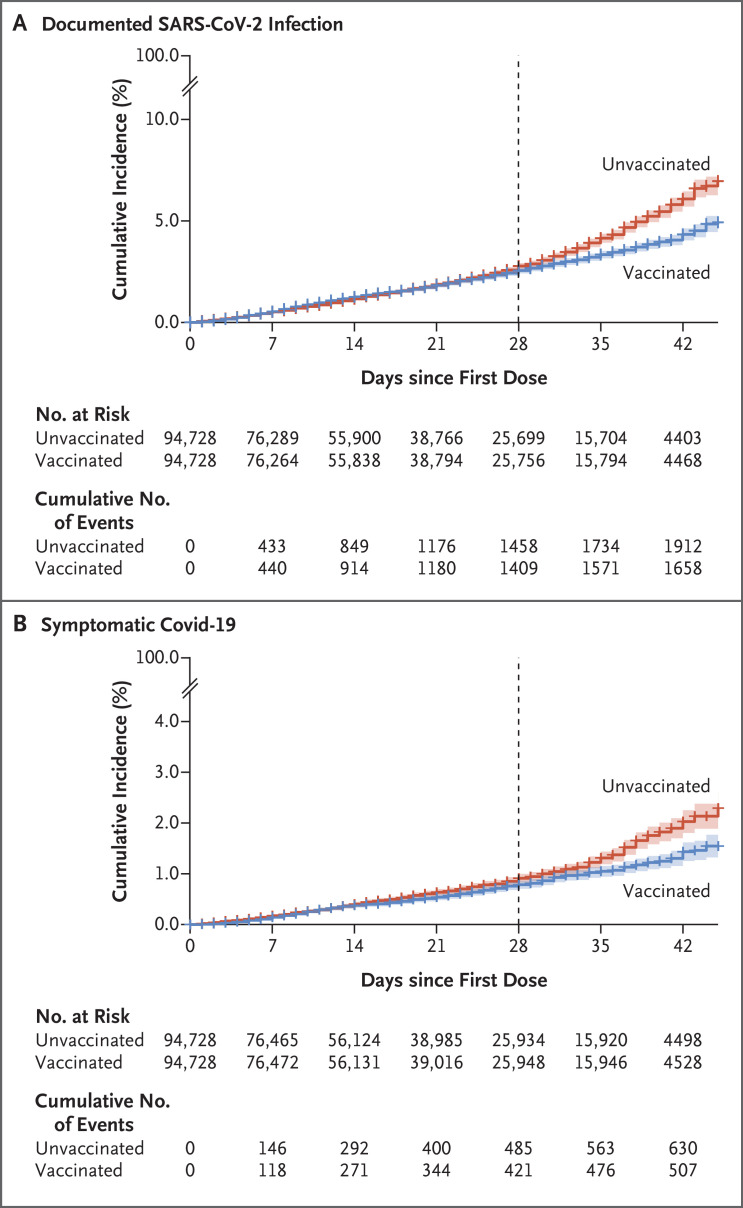
Results: Among 136,127 eligible children who had been vaccinated during the study period, 94,728 were matched with unvaccinated controls. The estimated vaccine effectiveness against documented infection was 17% (95% confidence interval [CI], 7 to 25) at 14 to 27 days after the first dose and 51% (95% CI, 39 to 61) at 7 to 21 days after the second dose. The absolute risk difference between the study groups at days 7 to 21 after the second dose was 1905 events per 100,000 persons (95% CI, 1294 to 2440) for documented infection and 599 events per 100,000 persons (95% CI, 296 to 897) for symptomatic Covid-19. The estimated vaccine effectiveness against symptomatic Covid-19 was 18% (95% CI, -2 to 34) at 14 to 27 days after the first dose and 48% (95% CI, 29 to 63) at 7 to 21 days after the second dose. We observed a trend toward higher vaccine effectiveness in the youngest age group (5 or 6 years of age) than in the oldest age group (10 or 11 years of age).
Conclusions: Our findings suggest that as omicron was becoming the dominant variant, two doses of the BNT162b2 messenger RNA vaccine provided moderate protection against documented SARS-CoV-2 infection and symptomatic Covid-19 in children 5 to 11 years of age. (Funded by the European Union through the VERDI project and others.).
Copyright © 2022 Massachusetts Medical Society.
Figures
References
-
- World Health Organization. Considering the impact of COVID-19 on children (https://www.euro.who.int/en/health-topics/Life-stages/child-and-adolesce...).
-
- World Health Organization. COVID-19 disease in children and adolescents: scientific brief. September 29, 2021. (https://www.who.int/publications/i/item/WHO-2019-nCoV-Sci_Brief-Children...).
-
- Zimmermann P, Curtis N. Why is COVID-19 less severe in children? A review of the proposed mechanisms underlying the age-related difference in severity of SARS-CoV-2 infections. Arch Dis Child 2020. December 1 (Epub ahead of print). - PubMed
MeSH terms
Substances
Supplementary concepts
Grants and funding
LinkOut - more resources
Full Text Sources
Other Literature Sources
Medical
Miscellaneous