


Is genetic risk of ADHD mediated via dopaminergic mechanism? A study of functional connectivity in ADHD and pharmacologically challenged healthy volunteers with a genetic risk profile
- PMID: 35768414
- PMCID: PMC9243079
- DOI: 10.1038/s41398-022-02003-y
Is genetic risk of ADHD mediated via dopaminergic mechanism? A study of functional connectivity in ADHD and pharmacologically challenged healthy volunteers with a genetic risk profile
Abstract
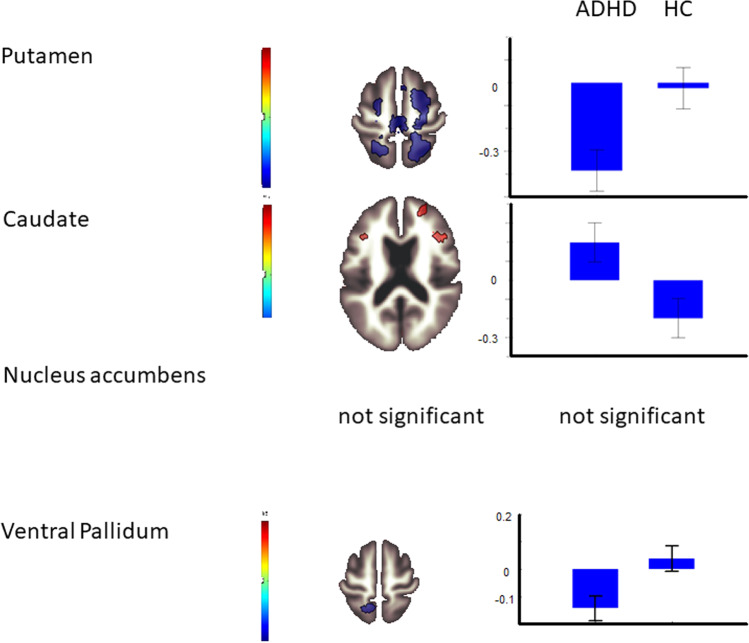
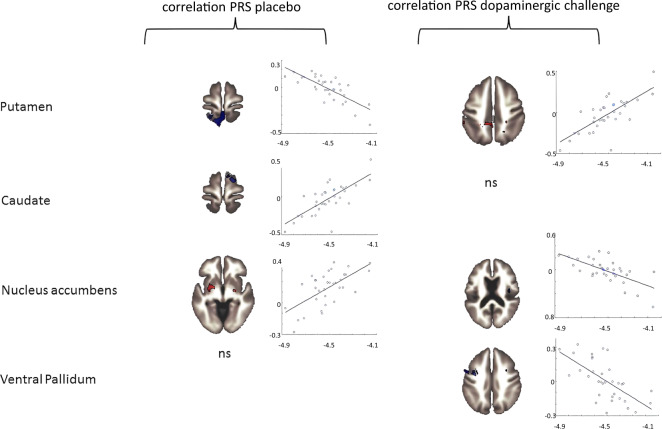
Recent GWAS allow us to calculate polygenic risk scores for ADHD. At the imaging level, resting-state fMRI analyses have given us valuable insights into changes in connectivity patterns in ADHD patients. However, no study has yet attempted to combine these two different levels of investigation. For this endeavor, we used a dopaminergic challenge fMRI study (L-DOPA) in healthy participants who were genotyped for their ADHD, MDD, schizophrenia, and body height polygenic risk score (PRS) and compared results with a study comparing ADHD patients and healthy controls. Our objective was to evaluate how L-DOPA-induced changes of reward-system-related FC are dependent on the individual polygenic risk score. FMRI imaging was used to evaluate resting-state functional connectivity (FC) of targeted subcortical structures in 27 ADHD patients and matched controls. In a second study, we evaluated the effect of ADHD and non-ADHD PRS in a L-DOPA-based pharmaco-fMRI-challenge in 34 healthy volunteers. The functional connectivity between the putamen and parietal lobe was decreased in ADHD patients. In healthy volunteers, the FC between putamen and parietal lobe was lower in ADHD high genetic risk participants. This direction of connectivity was reversed during L-DOPA challenge. Further findings are described for other dopaminergic subcortical structures. The FC between the putamen and the attention network showed the most consistent change in patients as well as in high-risk participants. Our results suggest that FC of the dorsal attention network is altered in adult ADHD as well as in healthy controls with higher genetic risk.
© 2022. The Author(s).
Conflict of interest statement
Prof. Dr. Andreas Reif received personal fees from MEDICE Arzneimittel Pütter GmbH & Co. KG, Shire PLC, neuraxpharm Arzneimittel GmbH, Janssen-Cilag GmbH and Servier Deutschland GmbH present or during 36 months prior to publication. Oliver Grimm received personal fees from MEDICE Arzneimittel Pütter GmbH & Co. KG. The remaining authors declare no competing interests.
Figures
Similar articles
-
Amisulpride and l-DOPA modulate subcortical brain nuclei connectivity in resting-state pharmacologic magnetic resonance imaging.Hum Brain Mapp. 2020 May;41(7):1806-1818. doi: 10.1002/hbm.24913. Epub 2019 Dec 27. Hum Brain Mapp. 2020. PMID: 31880365 Free PMC article. Clinical Trial.
-
Polygenic Risk Score-Derived Subcortical Connectivity Mediates Attention-Deficit/Hyperactivity Disorder Diagnosis.Biol Psychiatry Cogn Neurosci Neuroimaging. 2020 Mar;5(3):330-341. doi: 10.1016/j.bpsc.2019.11.014. Epub 2019 Dec 13. Biol Psychiatry Cogn Neurosci Neuroimaging. 2020. PMID: 32033925 Free PMC article.
-
Polygenic risk score for attention-deficit/hyperactivity disorder and brain functional networks segregation in a community-based sample.Genes Brain Behav. 2023 Apr;22(2):e12838. doi: 10.1111/gbb.12838. Epub 2023 Feb 21. Genes Brain Behav. 2023. PMID: 36811275 Free PMC article.
-
Resting state dynamic functional connectivity in children with attention deficit/hyperactivity disorder.J Neural Eng. 2021 Aug 16;18(4). doi: 10.1088/1741-2552/ac16b3. J Neural Eng. 2021. PMID: 34289458
-
ADHD-related sex differences in fronto-subcortical intrinsic functional connectivity and associations with delay discounting.J Neurodev Disord. 2018 Dec 13;10(1):34. doi: 10.1186/s11689-018-9254-9. J Neurodev Disord. 2018. PMID: 30541434 Free PMC article.
Cited by
-
Automatic diagnosis of schizophrenia and attention deficit hyperactivity disorder in rs-fMRI modality using convolutional autoencoder model and interval type-2 fuzzy regression.Cogn Neurodyn. 2023 Dec;17(6):1501-1523. doi: 10.1007/s11571-022-09897-w. Epub 2022 Nov 12. Cogn Neurodyn. 2023. PMID: 37974583 Free PMC article.
-
Multi-omics approach reveals dysregulated genes during hESCs neuronal differentiation exposure to paracetamol.iScience. 2023 Aug 28;26(10):107755. doi: 10.1016/j.isci.2023.107755. eCollection 2023 Oct 20. iScience. 2023. PMID: 37731623 Free PMC article.
-
Inactivation of hypocretin receptor-2 signaling in dopaminergic neurons induces hyperarousal and enhanced cognition but impaired inhibitory control.Mol Psychiatry. 2024 Feb;29(2):327-341. doi: 10.1038/s41380-023-02329-z. Epub 2023 Dec 21. Mol Psychiatry. 2024. PMID: 38123729 Free PMC article.
-
Adjuvant Therapy for Attention in Children with ADHD Using Game-Type Digital Therapy.Int J Environ Res Public Health. 2022 Nov 14;19(22):14982. doi: 10.3390/ijerph192214982. Int J Environ Res Public Health. 2022. PMID: 36429699 Free PMC article.
References
Publication types
MeSH terms
Substances
LinkOut - more resources
Full Text Sources
Medical
