


Is genetic risk of ADHD mediated via dopaminergic mechanism? A study of functional connectivity in ADHD and pharmacologically challenged healthy volunteers with a genetic risk profile
- PMID: 35768414
- PMCID: PMC9243079
- DOI: 10.1038/s41398-022-02003-y
Is genetic risk of ADHD mediated via dopaminergic mechanism? A study of functional connectivity in ADHD and pharmacologically challenged healthy volunteers with a genetic risk profile
Abstract
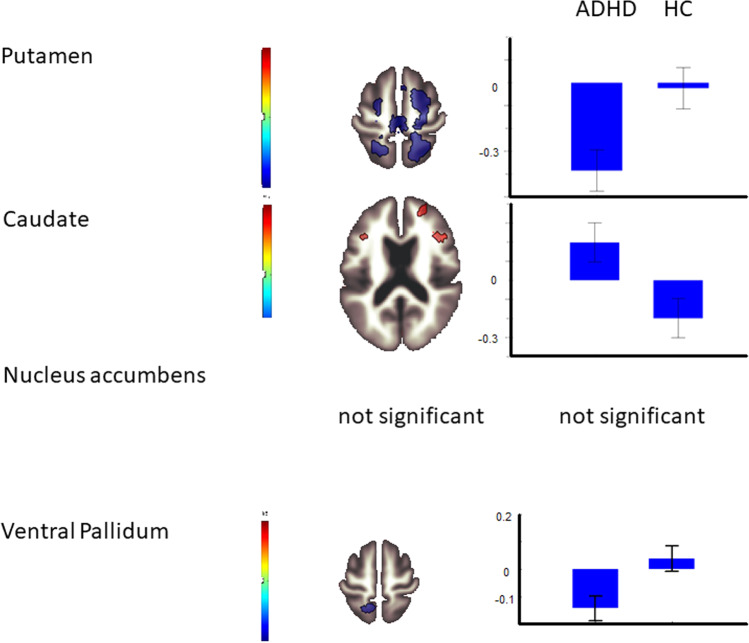
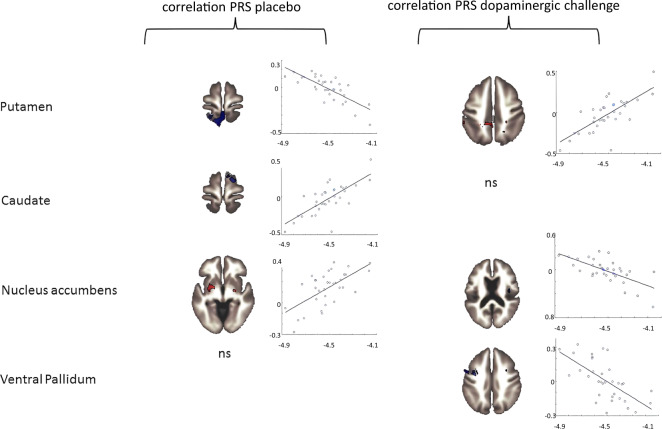
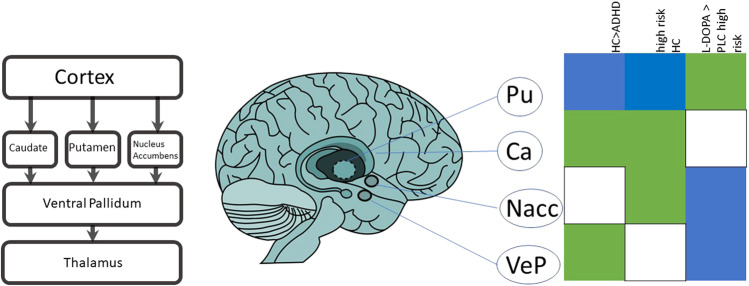
Recent GWAS allow us to calculate polygenic risk scores for ADHD. At the imaging level, resting-state fMRI analyses have given us valuable insights into changes in connectivity patterns in ADHD patients. However, no study has yet attempted to combine these two different levels of investigation. For this endeavor, we used a dopaminergic challenge fMRI study (L-DOPA) in healthy participants who were genotyped for their ADHD, MDD, schizophrenia, and body height polygenic risk score (PRS) and compared results with a study comparing ADHD patients and healthy controls. Our objective was to evaluate how L-DOPA-induced changes of reward-system-related FC are dependent on the individual polygenic risk score. FMRI imaging was used to evaluate resting-state functional connectivity (FC) of targeted subcortical structures in 27 ADHD patients and matched controls. In a second study, we evaluated the effect of ADHD and non-ADHD PRS in a L-DOPA-based pharmaco-fMRI-challenge in 34 healthy volunteers. The functional connectivity between the putamen and parietal lobe was decreased in ADHD patients. In healthy volunteers, the FC between putamen and parietal lobe was lower in ADHD high genetic risk participants. This direction of connectivity was reversed during L-DOPA challenge. Further findings are described for other dopaminergic subcortical structures. The FC between the putamen and the attention network showed the most consistent change in patients as well as in high-risk participants. Our results suggest that FC of the dorsal attention network is altered in adult ADHD as well as in healthy controls with higher genetic risk.
© 2022. The Author(s).
Conflict of interest statement
Prof. Dr. Andreas Reif received personal fees from MEDICE Arzneimittel Pütter GmbH & Co. KG, Shire PLC, neuraxpharm Arzneimittel GmbH, Janssen-Cilag GmbH and Servier Deutschland GmbH present or during 36 months prior to publication. Oliver Grimm received personal fees from MEDICE Arzneimittel Pütter GmbH & Co. KG. The remaining authors declare no competing interests.
Figures
References
Publication types
MeSH terms
Substances
LinkOut - more resources
Full Text Sources
Medical
