


Evaluating patient data quality in South Africa's National Health Laboratory Service Data Warehouse, 2017-2020: implications for monitoring child health programmes
- PMID: 35768861
- PMCID: PMC9241268
- DOI: 10.1186/s12889-022-13508-y
Evaluating patient data quality in South Africa's National Health Laboratory Service Data Warehouse, 2017-2020: implications for monitoring child health programmes
Abstract
Background: South Africa's National Health Laboratory Service (NHLS), the only clinical laboratory service in the country's public health sector, is an important resource for monitoring public health programmes.
Objectives: We describe NHLS data quality, particularly patient demographics among infants, and the effect this has on linking multiple test results to a single patient.
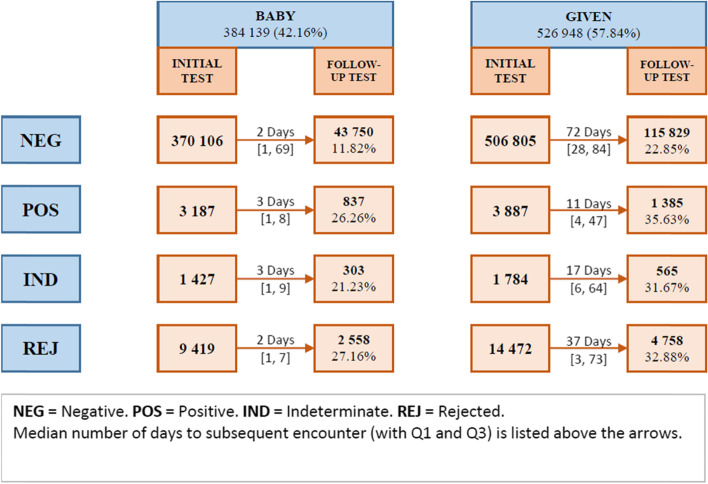
Methods: Retrospective descriptive analysis of NHLS data from 1st January 2017-1st September 2020 was performed. A validated probabilistic record-linking algorithm linked multiple results to individual patients in lieu of a unique patient identifier. Paediatric HIV PCR data was used to illustrate the effect on monitoring and evaluating a public health programme. Descriptive statistics including medians, proportions and inter quartile ranges are reported, with Chi-square univariate tests for independence used to determine association between variables.
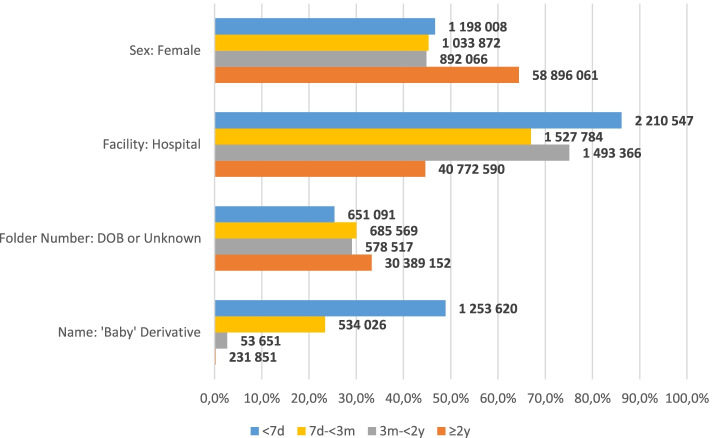
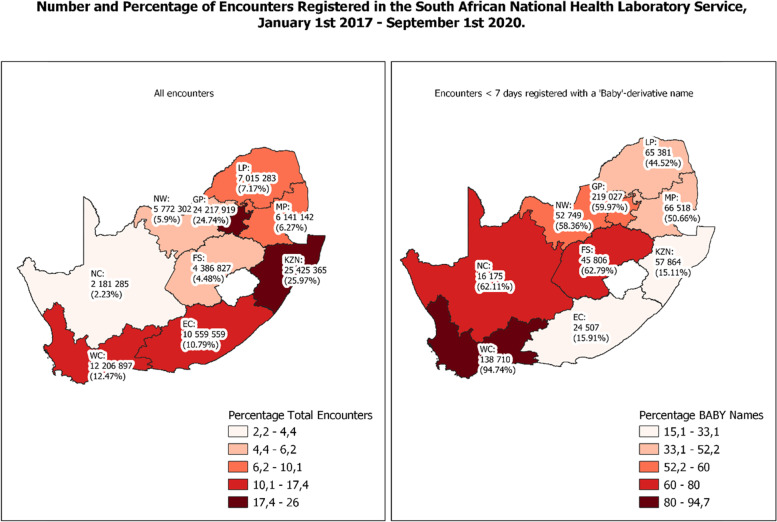
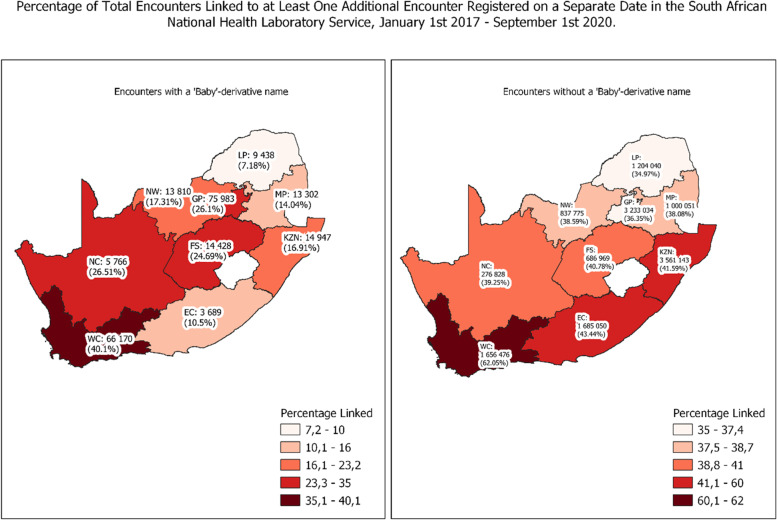
Results: During the period analysed, 485 300 007 tests, 98 217 642 encounters and 35 771 846 patients met criteria for analysis. Overall, 15.80% (n = 15 515 380) of all encounters had a registered national identity (ID) number, 2.11% (n = 2 069 785) were registered without a given name, 63.15% (n = 62 020 107) were registered to women and 32.89% (n = 32 304 329) of all folder numbers were listed as either the patient's date of birth or unknown. For infants tested at < 7 days of age (n = 2 565 329), 0.099% (n = 2 534) had an associated ID number and 48.87% (n = 1 253 620) were registered without a given name. Encounters with a given name were linked to a subsequent encounter 40.78% (n = 14 180 409 of 34 775 617) of the time, significantly more often than the 21.85% (n = 217 660 of 996 229) of encounters registered with a baby-derivative name (p-value < 0.001).
Conclusion: Unavailability and poor capturing of patient demographics, especially among infants and children, affects the ability to accurately monitor routine health programmes. A unique national patient identifier, other than the national ID number, is urgently required and must be available at birth if South Africa is to accurately monitor programmes such as the Prevention of Mother-to-Child Transmission of HIV.
Keywords: Data quality; Early infant HIV diagnosis; Monitoring and evaluation; Public health programmes; Unique patient identifier.
© 2022. The Author(s).
Conflict of interest statement
The authors declare that they have no competing interests.
Figures
Similar articles
-
Leveraging the Road to Health booklet as a unique patient identifier to monitor the prevention of mother-to-child transmission programme.S Afr Med J. 2018 Aug 30;108(9):729-733. doi: 10.7196/SAMJ.2018.v108i9.13093. S Afr Med J. 2018. PMID: 30182897
-
Indeterminate HIV PCR results within South Africa's early infant diagnosis programme, 2010-2019.Clin Microbiol Infect. 2022 Apr;28(4):609.e7-609.e13. doi: 10.1016/j.cmi.2021.08.002. Epub 2021 Aug 13. Clin Microbiol Infect. 2022. PMID: 34400341
-
Attrition Rates in HIV Viral Load Monitoring and Factors Associated With Overdue Testing Among Children Within South Africa's Antiretroviral Treatment Program: Retrospective Descriptive Analysis.JMIR Public Health Surveill. 2024 May 14;10:e40796. doi: 10.2196/40796. JMIR Public Health Surveill. 2024. PMID: 38743934 Free PMC article.
-
National program for preventing mother-child HIV transmission in Thailand: successful implementation and lessons learned.AIDS. 2002 May 3;16(7):953-9. doi: 10.1097/00002030-200205030-00001. AIDS. 2002. PMID: 11953461 Review.
-
Taking therapeutic apheresis services to patients in South Africa: An eight year review of SANBS mobile therapeutic apheresis service, 2013-2020.Transfus Apher Sci. 2021 Jun;60(3):103167. doi: 10.1016/j.transci.2021.103167. Epub 2021 May 21. Transfus Apher Sci. 2021. PMID: 34116933 Review.
Cited by
-
Retrospective review of maternal HIV viral load electronic gatekeeping codes in South Africa.South Afr J HIV Med. 2024 Feb 20;25(1):1539. doi: 10.4102/sajhivmed.v25i1.1539. eCollection 2024. South Afr J HIV Med. 2024. PMID: 38444836 Free PMC article.
-
An audit of completeness of Road to Health Booklet at a community health centre in South Africa.Afr J Prim Health Care Fam Med. 2024 Dec 18;16(1):e1-e8. doi: 10.4102/phcfm.v16i1.4654. Afr J Prim Health Care Fam Med. 2024. PMID: 39846111 Free PMC article.
-
Eliminating Vertical Transmission of HIV in South Africa: Establishing a Baseline for the Global Alliance to End AIDS in Children.Diagnostics (Basel). 2023 Aug 1;13(15):2563. doi: 10.3390/diagnostics13152563. Diagnostics (Basel). 2023. PMID: 37568928 Free PMC article.
-
Effects of the COVID-19 pandemic on early infant diagnosis of HIV in Cape Town, South Africa.South Afr J HIV Med. 2024 Mar 18;25(1):1542. doi: 10.4102/sajhivmed.v25i1.1542. eCollection 2024. South Afr J HIV Med. 2024. PMID: 38628908 Free PMC article.
-
How paediatric HIV services weathered the COVID-19 storm in Tshwane District, South Africa.South Afr J HIV Med. 2024 May 20;25(1):1557. doi: 10.4102/sajhivmed.v25i1.1557. eCollection 2024. South Afr J HIV Med. 2024. PMID: 38840712 Free PMC article.
References
-
- NHLS Admin. About Us. https://www.nhls.ac.za/about-us/. Accessed 25 Jan 2021.
-
- Ballah NJ, Kuonza LR, De Gita G, Musekiwa A, Williams S, Takuva S. Decline in syphilis seroprevalence among females of reproductive age in Northern Cape Province, South Africa, 2003–2012: utility of laboratory-based information. Int J STD AIDS. 2017;28:564–572. doi: 10.1177/0956462416636727. - DOI - PMC - PubMed
Publication types
MeSH terms
LinkOut - more resources
Full Text Sources
Medical
Miscellaneous
