


Red cell distribution width is associated with short-term mortality in critically ill patients with heart failure
- PMID: 35768950
- PMCID: PMC9715821
- DOI: 10.1002/ehf2.14023
Red cell distribution width is associated with short-term mortality in critically ill patients with heart failure
Abstract
Aims: There is limited evidence for the correlation between short-term mortality and red cell distribution width (RDW) in critical patients with heart failure. Herein, a retrospective cohort study was conducted to investigate whether RDW was independently associated with short-term mortality in critically ill patients with heart failure.
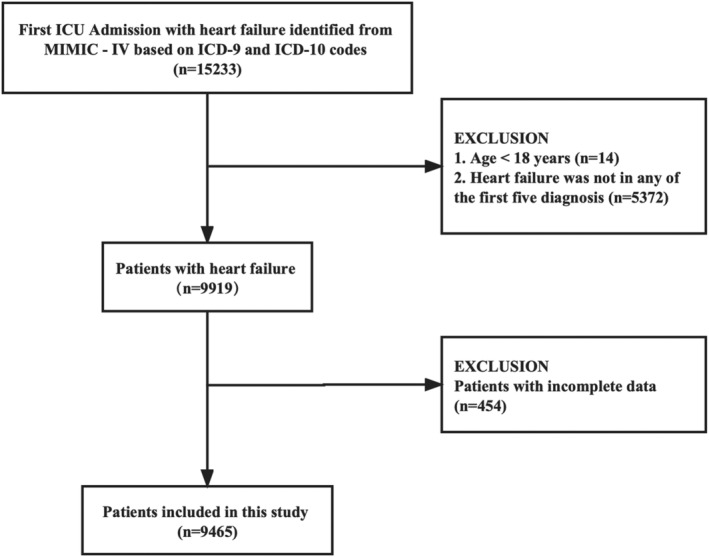
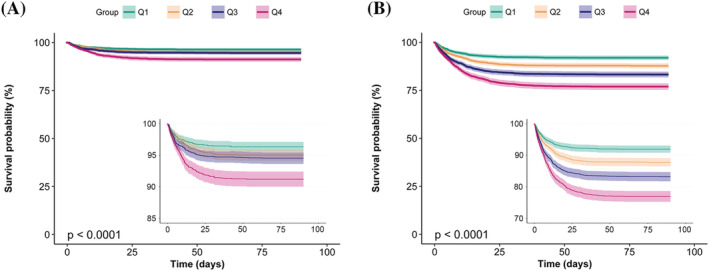
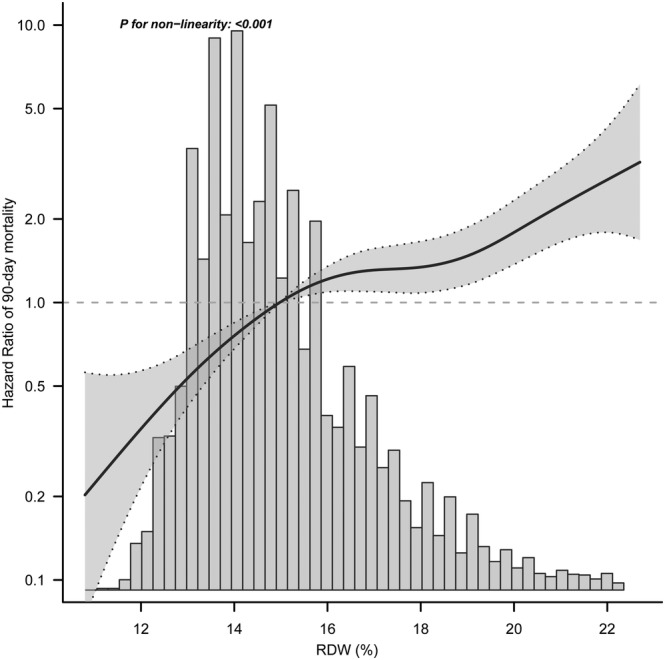
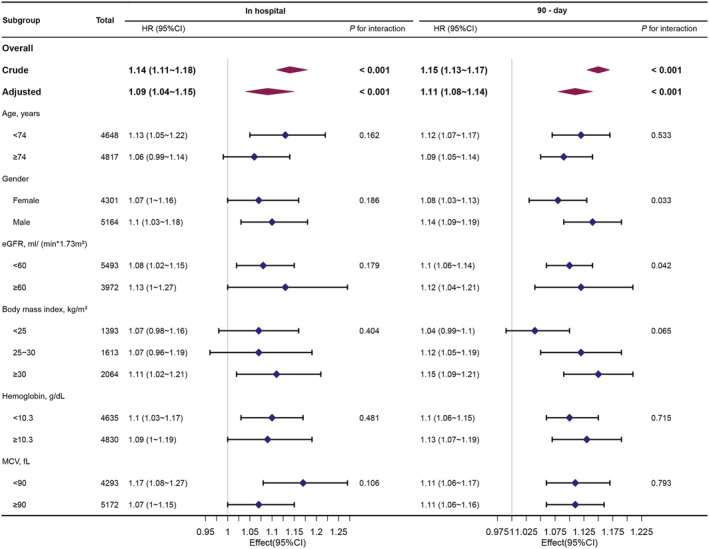
Methods and results: As a retrospective cohort study, it involved a total of 9465 patients with heart failure from the MIMIC-IV database. The target-dependent and independent variables were in-hospital mortality, 90 day mortality and RDW measured at baseline, respectively. The relationship between all-cause death and baseline RDW in hospital and after 90 days of admission to ICU was evaluated by using the Kaplan-Meier plot and Cox proportional hazard analysis. The average age of participants was 74.4 (64.2, 83.5) years old, among whom about 54.6% were male. Results of the adjusted Cox proportional hazard model revealed that RDW had a positive association with both in-hospital and 90 day mortality risk after the adjustment of confounders (HR = 1.09, 95% CI: 1.04-1.15, P < 0.001; HR = 1.11, 95% CI: 1.08-1.14, P < 0.001, respectively). A non-linear relationship was found between RDW and 90 day mortality, which had a threshold of 14.96%. The effect sizes and confidence intervals below and above the threshold were 1.36 (1.14 to 1.62) and 1.09 (1.04 to 1.15), respectively. It was also found by subgroup analysis that there were stronger correlations in male and patients with normal renal function.
Conclusions: Our data suggest that the short-term mortality of critically ill patients with HF is independently predicted by RDW. At the same time, large prospective research and longer follow-up time are required to further validate the findings of this study.
Keywords: Critically ill patients with heart failure; Prognosis; Red cell distribution width.
© 2022 The Authors. ESC Heart Failure published by John Wiley & Sons Ltd on behalf of European Society of Cardiology.
Conflict of interest statement
None declared.
Figures
References
-
- Poz D, de Falco E, Pisano C, Madonna R, Ferdinandy P, Balistreri CR. Diagnostic and prognostic relevance of red blood cell distribution width for vascular aging and cardiovascular diseases. Rejuvenation Res. 2019; 22: 146–162. - PubMed
-
- Salvagno GL, Sanchis‐Gomar F, Picanza A, Lippi G. Red blood cell distribution width: A simple parameter with multiple clinical applications. Crit Rev Clin Lab Sci. 2015; 52: 86–105. - PubMed
-
- Al‐Najjar Y, Goode KM, Zhang J, Cleland JGF, Clark AL. Red cell distribution width: An inexpensive and powerful prognostic marker in heart failure. Eur J Heart Fail. 2009; 11: 1155–1162. - PubMed
-
- Felker GM, Allen LA, Pocock SJ, Shaw LK, McMurray J, Pfeffer MA, Swedberg K, Wang D, Yusuf S, Michelson EL, Granger CB, CHARM Investigators . Red cell distribution width as a novel prognostic marker in heart failure: Data from the CHARM program and the Duke databank. J Am Coll Cardiol. 2007; 50: 40–47. - PubMed
-
- Melchio R, Rinaldi G, Testa E, Giraudo A, Serraino C, Bracco C, Spadafora L, Falcetta A, Leccardi S, Silvestri A, Fenoglio L. Red cell distribution width predicts mid‐term prognosis in patients hospitalized with acute heart failure: The RDW in acute heart failure (RE‐AHF) study. Intern Emerg Med. 2019; 14: 239–247. - PubMed
Publication types
MeSH terms
LinkOut - more resources
Full Text Sources
Medical
Research Materials
Miscellaneous
