. 2022 Jun 4;4(1):vdac075.
doi: 10.1093/noajnl/vdac075. eCollection 2022 Jan-Dec.

Rapid early progression (REP) of glioblastoma is an independent negative prognostic factor: Results from a systematic review and meta-analysis

Affiliations

Rapid early progression (REP) of glioblastoma is an independent negative prognostic factor: Results from a systematic review and meta-analysis

Mueez Waqar et al. Neurooncol Adv. .

Erratum in

Abstract

Background: In patients with newly diagnosed glioblastoma, rapid early progression (REP) refers to tumor regrowth between surgery and postoperative chemoradiotherapy. This systematic review and meta-analysis appraised previously published data on REP to better characterize and understand it.

Methods: Systematic searches of MEDLINE, EMBASE and the Cochrane database from inception to October 21, 2021. Studies describing the incidence of REP-tumor growth between the postoperative MRI scan and pre-radiotherapy MRI scan in newly diagnosed glioblastoma were included. The primary outcome was REP incidence.

Results: From 1590 search results, 9 studies were included with 716 patients. The median age was 56.9 years (IQR 54.0-58.8 y). There was a male predominance with a median male-to-female ratio of 1.4 (IQR 1.1-1.5). The median number of days between MRI scans was 34 days (IQR 18-45 days). The mean incidence rate of REP was 45.9% (range 19.3%-72.0%) and significantly lower in studies employing functional imaging to define REP (P < .001). REP/non-REP groups were comparable with respect to age (P = .99), gender (P = .33) and time between scans (P = .81). REP was associated with shortened overall survival (HR 1.78, 95% CI 1.30-2.43, P < .001), shortened progression-free survival (HR 1.78, 95% CI 1.30-2.43, P < .001), subtotal resection (OR 6.96, 95% CI 4.51-10.73, P < .001) and IDH wild-type versus mutant tumors (OR 0.20, 95% CI 0.02-0.38, P = .03). MGMT promoter methylation was not associated with REP (OR 1.29, 95% CI 0.72-2.28, P = .39).

Conclusions: REP occurs in almost half of patients with newly diagnosed glioblastoma and has a strongly negative prognostic effect. Future studies should investigate its biology and effective treatment strategies.

Keywords: IDH; MGMT; REP; extent of resection; glioblastoma; prognosis; progression; recurrence; survival.


Figures

Figure 1.
Figure 1.
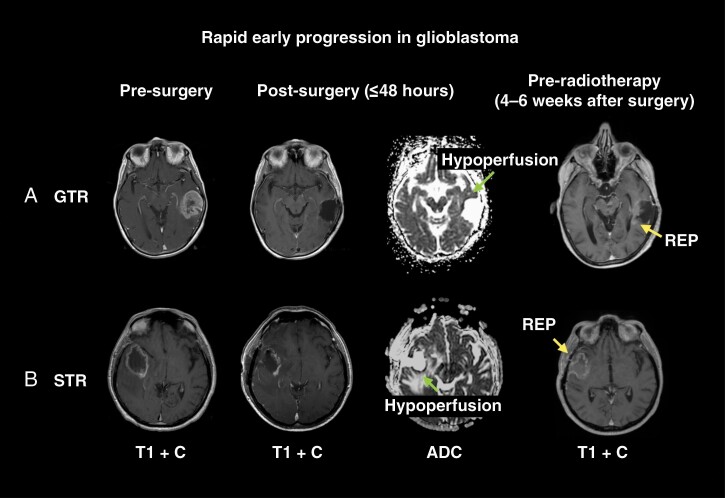
Example of rapid early progression (REP) in newly diagnosed glioblastoma. This figure shows serial MRI scans during various treatment time points of 2 patients with newly diagnosed glioblastoma to highlight the occurrence of REP after both gross-total resection (GTR) and subtotal resection (STR). (A) A 76-year-old female who was normally fit and well presented with dysphasia and was found to have a large left temporal tumor. She underwent a craniotomy and GTR of the tumor. Histology was consistent with an IDH wild-type glioblastoma. The pre-radiotherapy MRI scan demonstrated a modest volume of REP (white arrow) that was separate to the areas of restricted diffusion indicative of surgical cavity hypoperfusion (black arrow on the apparent diffusion coefficient [ADC] scan) on the post-operative MRI scan. (B) A 47-year-old female presented with 3 weeks of progressively worsening headaches and an MRI scan revealed a right posterior temporal tumor. She underwent a craniotomy and subtotal resection of the tumor. Histology was consistent with an IDH-wild-type glioblastoma. The pre-radiotherapy MRI scan demonstrated a large volume of REP (white arrow) that was distinct to the areas of restricted diffusion indicative of surgical cavity hypoperfusion (black arrow on ADC scan) on the post-operative MRI scan. Abbreviations: T1 + C = T1 with contrast; ADC = apparent diffusion coefficient. Pre-op = Preoperative; Post-op = Postoperative.
Figure 2.
Figure 2.
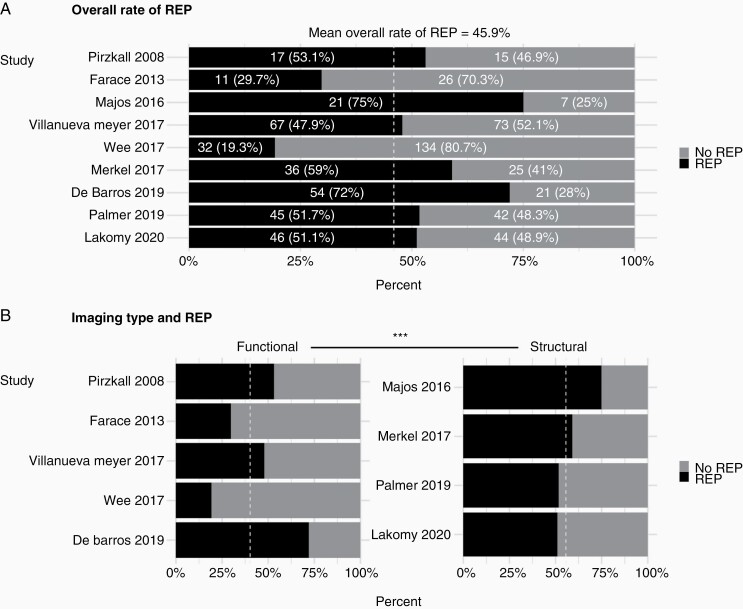
Incidence rate of REP in glioblastoma. (A) This figure shows proportions and percentages of patients with/without REP across studies to demonstrate the overall mean rate of REP (45.9%). (B) This figure divides studies into 2 groups based on the use of functional MRI to define REP. Studies employing functional imaging reported a significantly lower mean incidence rate of REP (55.6% vs. 40.2%, Fisher’s exact, P < .001).
Figure 3.
Figure 3.
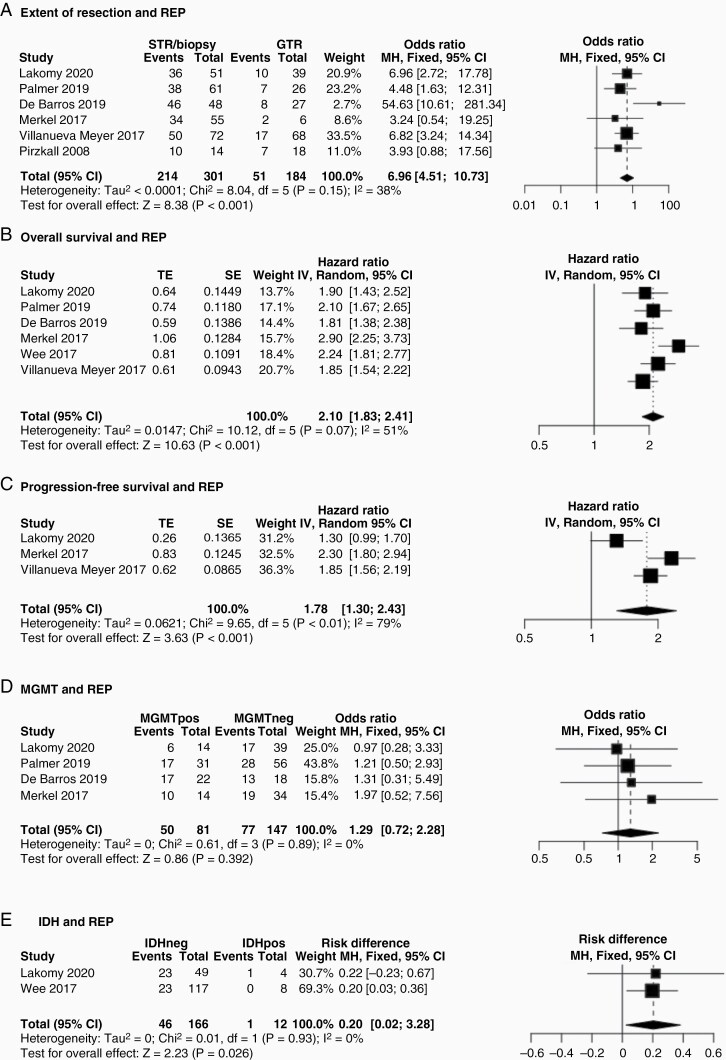
Associations of REP. (A) Comparison of patients with gross total versus subtotal resection/biopsy (combined as the biopsy group was relatively small). Subtotal resection/biopsy were predictive of REP using a fixed-effects model (OR 6.96, 95% CI 4-51-10.73, P < .001). (B) Patients with REP had a higher hazard ratio of death (HR 2.10, 95% CI 1.83–2.41, P < .001) using a random-effects model. (C) Patients with REP had a higher hazard ratio of disease progression (HR 1.78, 95% CI 1.30–2.43, P < .001) using a random-effects model. (D) MGMT promoter methylation (denoted as “MGMTpos” versus “MGMTneg” to denote its absence) was not associated with REP incidence (OR 1.29, 95% CI 0.72–2.28, P = .39) using a fixed-effects model. (E) Only 2 studies presented data on the interrelations between REP and IDH. IDH wild-type tumors (IDHneg) had a significantly higher incidence of REP versus IDH mutant (IDHpos) tumors (OR 0.20, 95% CI 0.02–0.38, P = .03) using a fixed-effects model.
Figure 4.
Figure 4.
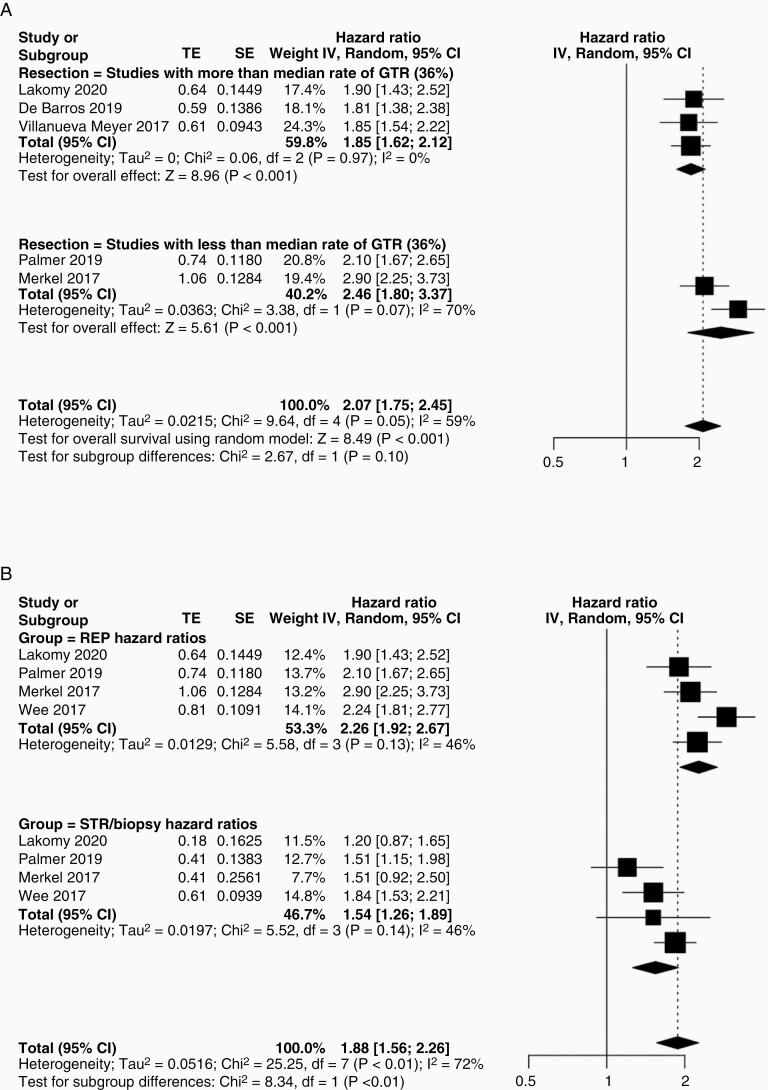
Subtotal resection and REP—subgroup analyses. (A) Studies were stratified into 2 groups based on the median rate of GTR and the group with a lower rate of GTR had a tendency toward a higher incidence rate of REP, although differences were not statistically significant (OR 2.07, 95% CI 1.75–2.45, χ 2 = 2.67, P = .10). (B) To determine which factor may have a bigger effect on prognosis, we pooled and compared hazard ratios for STR/biopsy versus REP in 4 studies that presented this comparative data. REP was associated with a significantly higher overall hazard ratio of death (χ 2 = 8.34, P < .01).

References

    1. Stupp R, Mason WP, van den Bent MJ, et al. . Radiotherapy plus concomitant and adjuvant temozolomide for glioblastoma. N Engl J Med. 2005;352(10):987–996. - PubMed
    1. Stupp R, Taillibert S, Kanner A, et al. . Effect of tumor-treating fields plus maintenance temozolomide vs maintenance temozolomide alone on survival in patients with glioblastoma: a randomized clinical trial. JAMA 2017;318(23):2306–2316. - PMC - PubMed
    1. Cantrell JN, Waddle MR, Rotman M, et al. . Progress toward long-term survivors of glioblastoma. Mayo Clin Proc. 2019;94(7):1278–1286. - PubMed
    1. Poon MTC, Sudlow CLM, Figueroa JD, Brennan PM. Longer-term (>/= 2 years) survival in patients with glioblastoma in population-based studies pre- and post-2005: a systematic review and meta-analysis. Sci Rep. 2020;10(1):11622. - PMC - PubMed
    1. Pirzkall A, McGue C, Saraswathy S, et al. . Tumor regrowth between surgery and initiation of adjuvant therapy in patients with newly diagnosed glioblastoma. Neuro-oncology 2009;11(6):842–852. - PMC - PubMed