


Rituximab, Omalizumab, and Dupilumab Treatment Outcomes in Bullous Pemphigoid: A Systematic Review
- PMID: 35769474
- PMCID: PMC9235912
- DOI: 10.3389/fimmu.2022.928621
Rituximab, Omalizumab, and Dupilumab Treatment Outcomes in Bullous Pemphigoid: A Systematic Review
Abstract
Background: Bullous pemphigoid (BP) is the most common autoimmune subepidermal bullous disease of the skin. First-line treatment of systemic corticosteroids may cause serious adverse events. Rituximab, omalizumab, and dupilumab should be explored as alternative treatment options to improve outcomes.
Objective: To systematically review the rituximab, omalizumab, and dupilumab treatment outcomes in bullous pemphigoid.
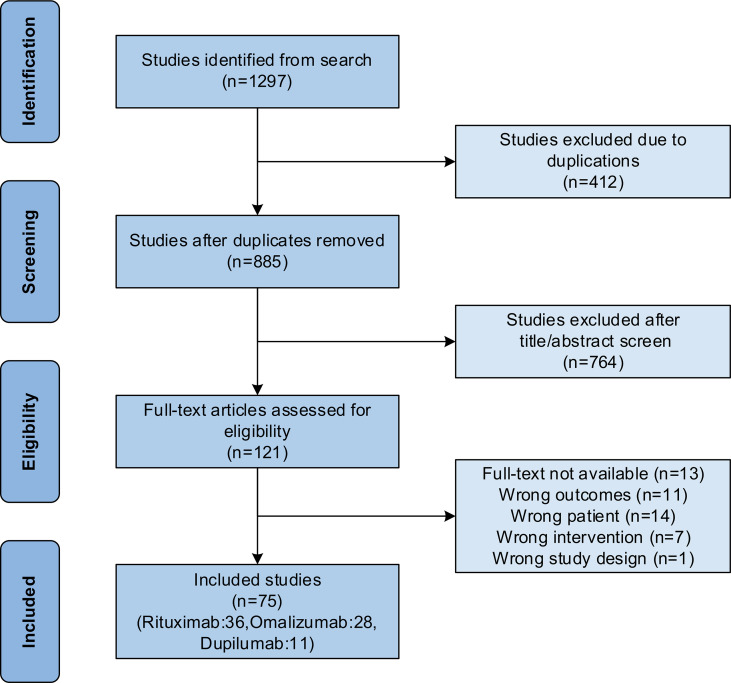
Methods: A PubMed, Embase, Web of Science, and Cochrane library search were conducted on March 10, 2022. A total of 75 studies were included using Preferred Reporting Items for Systematic Reviews and Meta-analyses guidelines.
Results: Use of rituximab (n=122), omalizumab (n=53) and dupilumab (n=36) were reported in 211 patients with BP. Rituximab led to complete remission in 70.5% (n=86/122) and partial remission in 23.8% (n=29/122) of patients within 5.7 months, with a recurrence rate of 20.5% (n=25/122). 9.0% (n=11/122) of patients died and infection (6.6%, n=8/122) was the most common adverse event. Omalizumab led to complete remission in 67.9% (n=36/53) and partial remission in 20.8% (n=11/53) of patients within 6.6 months, with a recurrence rate of 5.7% (n=3/53). 1.9% (n=1/53) of patients died and thrombocytopenia (1.9%, n=1/53) was observed as the most common adverse event. Dupilumab led to complete remission in 66.7% (n=24/36) and partial remission in 19.4% (n=7/36) of patients within 4.5 months of treatment without any reported adverse events, with a recurrence rate of 5.6% (n=2/36).
Conclusions: Rituximab, omalizumab, and dupilumab have similar clinical benefits for BP patients. However, rituximab resulted in higher recurrence rates, adverse events, and mortality rates.
Systematic review registration: https://www.crd.york.ac.uk/PROSPERO/, identifier CRD42022316454.
Keywords: biologics; bullous pemphigoid; dupilumab; omalizumab; rituximab.
Copyright © 2022 Cao, Xu and Zhang.
Conflict of interest statement
The authors declare that the research was conducted in the absence of any commercial or financial relationships that could be construed as a potential conflict of interest.
Figures
References
-
- Feliciani C, Joly P, Jonkman MF, Zambruno G, Zillikens D, Ioannides D, et al. Management of Bullous Pemphigoid: The European Dermatology Forum Consensus in Collaboration With the European Academy of Dermatology and Venereology. Br J Dermatol (2015) 172(4):867–77. doi: 10.1111/bjd.13717 - DOI - PubMed
Publication types
MeSH terms
Substances
LinkOut - more resources
Full Text Sources
Medical
