


Level dependent alterations in human facet cartilage mechanics and bone morphometry with spine degeneration
- PMID: 35770853
- PMCID: PMC9800647
- DOI: 10.1002/jor.25407
Level dependent alterations in human facet cartilage mechanics and bone morphometry with spine degeneration
Abstract
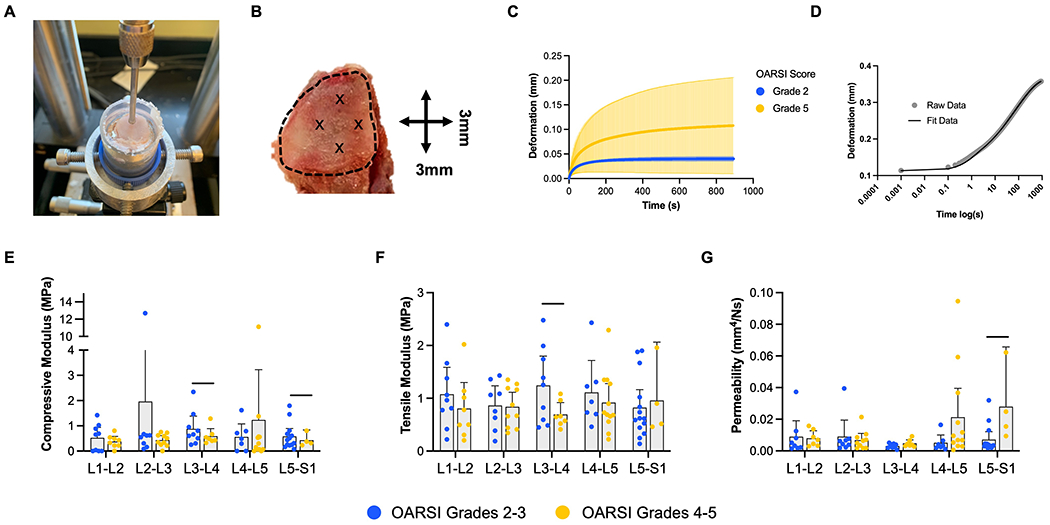
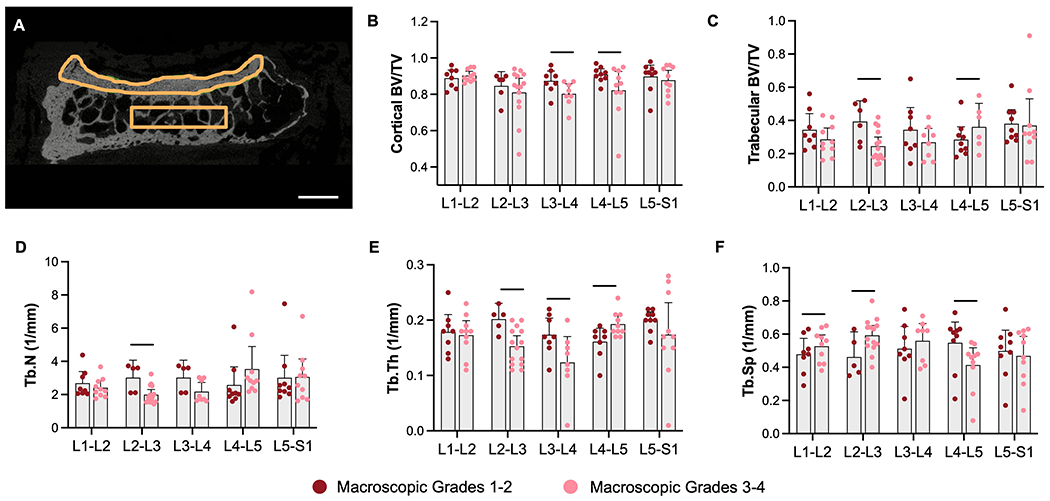
The zygapophyseal joints of the spine, also known as the facet joints, are paired diarthrodial joints posterior to the intervertebral disc and neural elements. The pathophysiology of facet osteoarthritis (OA), as well as crosstalk between the disc and facets, remains largely understudied compared to disc degeneration. The purpose of this study was to characterize alterations to human facet cartilage and subchondral bone across a spectrum of degeneration and to investigate correlations between disc and facet degeneration. Human lumbar facet articular surfaces from six independent donors were subject to creep indentation mechanical testing to quantify cartilage mechanical properties, followed by microcomputed tomography (µCT) analyses for subchondral bone morphometry. The degenerative state of each articular surface was assessed via macroscopic scoring and via Osteoarthritis Research Society International histopathology scoring. Our data suggest reduced facet cartilage compressive and tensile moduli and increased permeability with increasing degenerative grade, particularly at the lower levels of the spine. µCT analyses revealed spinal level-dependent alterations to the subchondral bone, with an increase in trabecular bone at the L4-L5 level, but a decrease at the upper levels of the lumbar spine with increasing degenerative grade. Cortical bone volume fraction was generally decreased with increasing degenerative grade across spinal levels. Correlation analysis revealed several associations between quantitative measures of disc degeneration and facet OA. This study showed that alterations in the mechanical properties of facet cartilage and in the structural properties of facet subchondral bone correlated with aspects of disc degeneration and were highly dependent on spinal level.
Keywords: biomechanics; indentation; intervertebral disc degeneration; osteoarthritis; zygapophyseal joint.
© 2022 Orthopaedic Research Society. Published by Wiley Periodicals LLC.
Conflict of interest statement
Conflict of Interest
Robert L. Mauck is a Co-Editor in Chief of JOR Spine.
Figures
References
-
- Casiano VE, Dydyk AM, Varacallo M. 2021. Back Pain. In: StatPearls. Treasure Island (FL): StatPearls Publishing; [cited 2021 Dec 10] Available from: http://www.ncbi.nlm.nih.gov/books/NBK538173/.
-
- Humzah MD, Soames RW. 1988. Human intervertebral disc: structure and function. The Anatomical record 220(4):337–56. - PubMed
-
- Varlotta GP, Lefkowitz TR, Schweitzer M, et al. 2011. The lumbar facet joint: a review of current knowledge: part 1: anatomy, biomechanics, and grading. Skeletal radiology 40(1):13–23. - PubMed
Publication types
MeSH terms
Grants and funding
LinkOut - more resources
Full Text Sources
Medical
