Review
. 2022 Jul 18;51(14):6065-6086.
doi: 10.1039/d0cs01414a.

The uptake of metal-organic frameworks: a journey into the cell

Affiliations
Review

The uptake of metal-organic frameworks: a journey into the cell

Emily Linnane et al. Chem Soc Rev. .

Abstract

The application of metal-organic frameworks (MOFs) in drug delivery has advanced rapidly over the past decade, showing huge progress in the development of novel systems. Although a large number of versatile MOFs that can carry and release multiple compounds have been designed and tested, one of the main limitations to their translation to the clinic is the limited biological understanding of their interaction with cells and the way they penetrate them. This is a crucial aspect of drug delivery, as MOFs need to be able not only to enter into cells but also to release their cargo in the correct intracellular location. While small molecules can enter cells by passive diffusion, nanoparticles (NPs) usually require an energy-dependent process known as endocytosis. Importantly, the fate of NPs after being taken up by cells is dependent on the endocytic pathways they enter through. However, no general guidelines for MOF particle internalization have been established due to the inherent complexity of endocytosis as a mechanism, with several factors affecting cellular uptake, namely NP size and surface chemistry. In this review, we cover recent advances regarding the understanding of the mechanisms of uptake of nano-sized MOFs (nanoMOFs)s, their journey inside the cell, and the importance of biological context in their final fate. We examine critically the impact of MOF physicochemical properties on intracellular trafficking and successful cargo delivery. Finally, we highlight key unanswered questions on the topic and discuss the future of the field and the next steps for nanoMOFs as drug delivery systems.


Conflict of interest statement

D. F.-J. has a financial interest in the start-up company Vector Bioscience Cambridge, which is seeking to commercialize metal–organic frameworks.

Figures
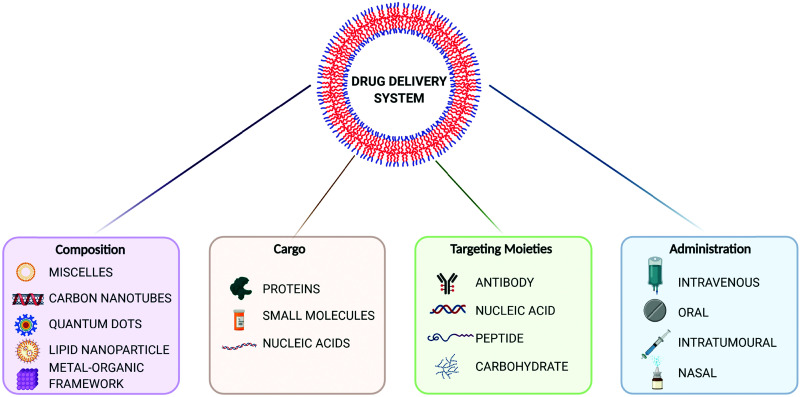
Fig. 1
Fig. 1. Overview of drug delivery systems (DDS) for precision medicine. Created with BioRender.com.
Fig. 2
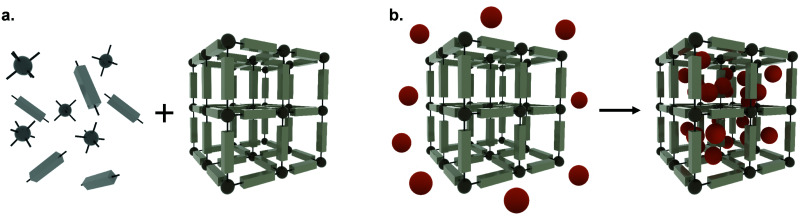
Fig. 2. The self-assembly process of metal–organic frameworks (a) The synthesis of metal–organic frameworks composed of metal clusters or ions (dark grey spheres) and organic linkers (light grey units), and (b) the encapsulation of APIs (orange spheres) adsorbed within the porosity.
Fig. 3
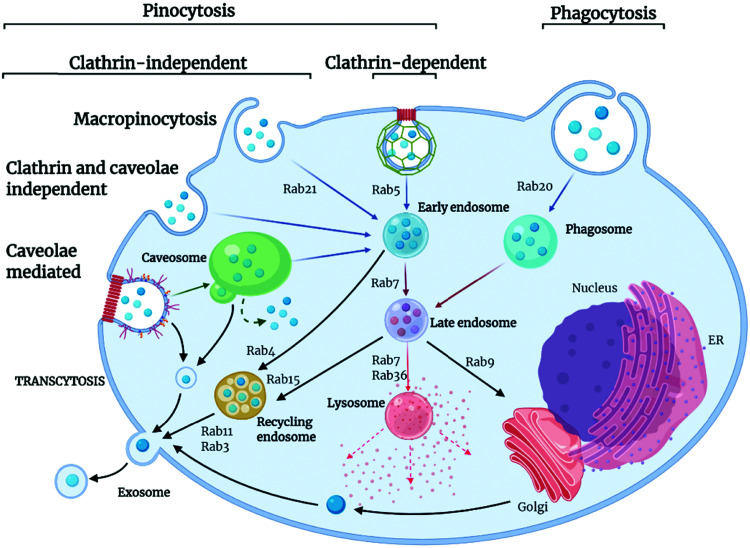
Fig. 3. Pathways and routes of endocytosis reported for nanoMOFs. There are several key routes which nanoMOFs may utilise to enter cells; clathrin- and caveolae-mediated endocytosis, macropinocytosis, clathrin and caveolin independent pathways and phagocytosis. These are mediated by the Rab protein family, small guanine triphosphatases (GTPases) that act to regulate pathways of endocytic trafficking. The final fate of the MOF is dependent on many factors including mechanism of uptake, cell type, MOF composition and API. The MOF may travel to the cytoplasm, undergo degradation in the lysosome, be trafficked out of the cell via the recycling pathway in exosomes or traffic to the cell nucleus. Created with BioRender.com.
Fig. 4
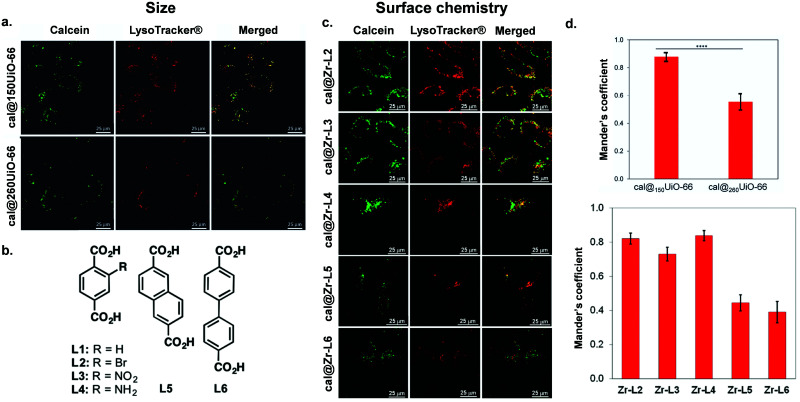
Fig. 4. Impact of size and surface chemistry on MOFs internalisation. (a) Confocal microscopy images of HeLa cells incubated with cal@150UiO-66 or cal@260UiO-66 (green fluorescence, calcein; red fluorescence, LysoTracker-Deep red) for 2 h, reproduced from Orellana-Tavra et al. with permission from Advanced Healthcare Materials, copyright 2016. (b) Organic linkers used to synthesize Zr-based MOFs. (c) Confocal microscopy images of HeLa cells incubated with Zr-based MOFs loaded with calcein (green fluorescence, calcein; red fluorescence, LysoTracker-Deep red) for 2 h. (d) Both figures show Manders’ overlapping coefficient for all the MOF samples and the lysosome marker (a and b). Image reproduced and adapted from Orellana-Tavra et al. with permission from American Chemical Society, copyright 2017.
Fig. 5
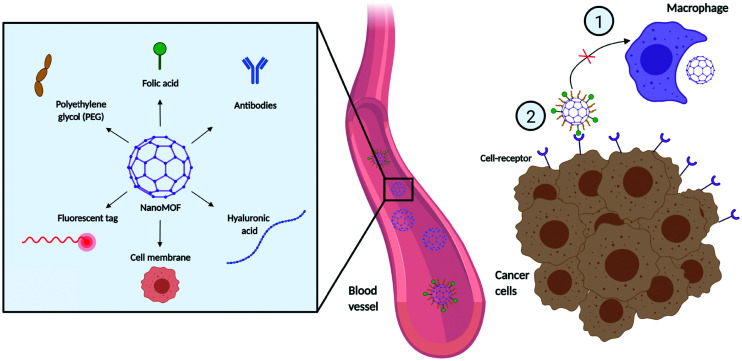
Fig. 5. Examples of external surface functionalization techniques in nanoMOF delivery and distribution. Different types of surface modifications can (i) prevent the macrophagocytic clearance: and (ii) improve cell selectivity and targeting. Created with BioRender.com.
Fig. 6
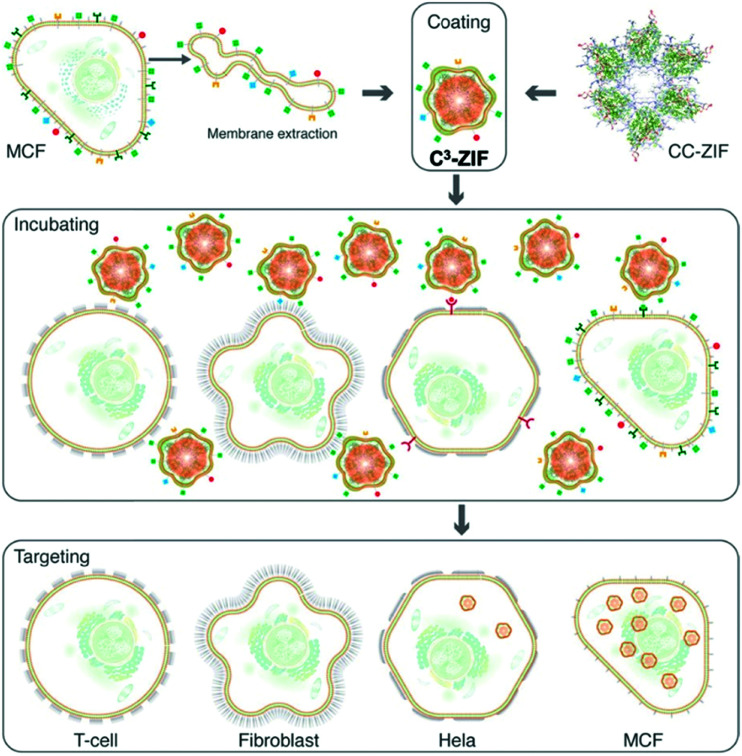
Fig. 6. Schematic illustration of the preparation and cell-type selectivity of C3-ZIF. Human breast adenocarcinoma cells (MCF-7) were used as a model cancer cell line to coat CC-ZIF. The membrane-coated MOFs were then incubated with MCF-7, HeLa, fibroblast, and TC cell lines to study selective uptake. Reproduced from Alyami et al. with permission from American Chemical Society, copyright 2020.
None
Emily Linnane
None
Salame Haddad
None
Francesca Melle
None
Zihan Mei
None
David Fairen-Jimenez

References

    1. Helfand W. H. Cowen D. L. Pharm. Hist. 1983;25:3–18. - PubMed
    1. Park K. J. Controlled Release. 2014;190:3–8. doi: 10.1016/j.jconrel.2014.03.054. - DOI - PMC - PubMed
    1. Tran S. DeGiovanni P. J. Piel B. Rai P. Clin. Transl. Med. 2017;6:44. - PMC - PubMed
    1. Luo Z. Fan S. Gu C. Liu W. Chen J. Li B. Liu J. Curr. Med. Chem. 2019;26:3341–3369. doi: 10.2174/0929867325666180214123500. - DOI - PubMed
    1. Yaghi O. M. O'Keeffe M. Ockwig N. W. Chae H. K. Eddaoudi M. Kim J. Nature. 2003;423:705–714. doi: 10.1038/nature01650. - DOI - PubMed

Substances