


Interpreting Within-Patient Changes on the EORTC QLQ-C30 and EORTC QLQ-LC13
- PMID: 35771392
- PMCID: PMC9585005
- DOI: 10.1007/s40271-022-00584-w
Interpreting Within-Patient Changes on the EORTC QLQ-C30 and EORTC QLQ-LC13
Abstract
Introduction: When determining if changes on patient-reported outcome (PRO) scores in clinical trials convey a meaningful treatment benefit, statistical significance tests alone may not communicate the patient perspective. Appraising within-patient changes on PRO scores against established thresholds can determine if improvements or deteriorations experienced by individuals are meaningful. To evaluate the appropriateness of thresholds for interpreting meaningful improvements and deterioration within individuals on the European Organisation for Research and Treatment of Cancer (EORTC) 30-item core instrument (QLQ-C30) and 13-item lung cancer module (QLQ-LC13), a series of psychometric methods were applied to data from a phase III randomized controlled clinical trial in non-small cell lung cancer.
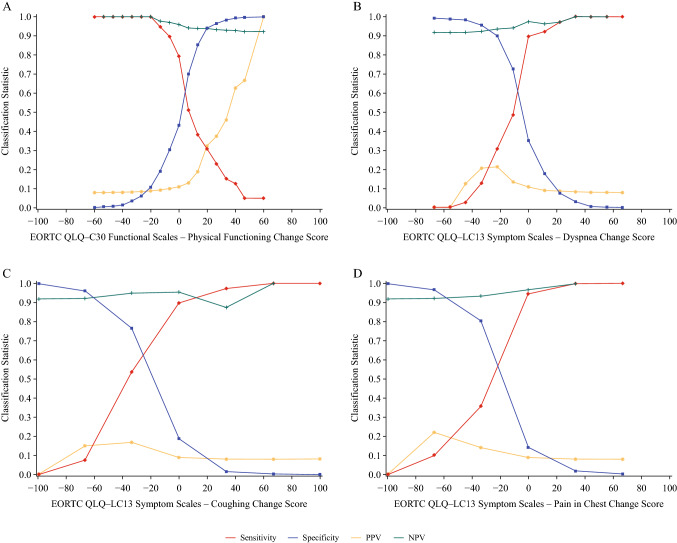
Methods: Anchor-based methods of empirical cumulative distribution functions and classification statistics were employed using change scores from Baseline to Week 7 using changes on the QLQ-C30 Global Health Status item as an anchor. Distribution-based methods of one-half standard deviation and standard error of measurement identified the minimum amount of change each domain score can reliably measure.
Results: While the correlations between the domain scores and the anchor item were modest in size (i.e., r ≥ 0.30 for only 5 of 24 domains), consideration of multiple methods along with the magnitude of possible step changes on the score allowed for patterns to emerge. The triangulation process planned a priori resulted in different methods being the source for different domain scores. Absolute values of the proposed thresholds ranged from 11.11 to 33.33, and all resulted in the same classifications for all EORTC domains, except QLQ-C30 Fatigue, as would the 10-point threshold that is traditionally used.
Conclusion: This study confirms the appropriateness of the 10-point EORTC score threshold generally used by the field for interpreting within-patient changes, but the thresholds proposed from this study enhance interpretability by corresponding to only observable locations along the domain score scale.
Trial registration: ClinicalTrials.gov NCT02395172.
© 2022. The Author(s).
Conflict of interest statement
Cheryl D. Coon is an employee of Outcometrix and received funding for this psychometric analysis from EMD Serono Research & Development Institute, Inc., Billerica, MA, USA, an affiliate of Merck KGaA (CrossRef Funder ID: 10.13039/100004755). Michael Schlichting is an employee of Merck Healthcare KGaA, Darmstadt, Germany. Xinke Zhang is an employee of EMD Serono Research & Development Institute, Inc., Billerica, MA, USA, an affiliate of Merck KGaA.
Figures


References
-
- Fiero MH, Roydhouse JK, Vallejo J, King-Kallimanis BL, Kluetz PG, Sridhara R. US Food and Drug Administration review of statistical analysis of patient-reported outcomes in lung cancer clinical trials approved between January, 2008, and December, 2017. Lancet Oncol. 2019;20(10):e582–e589. doi: 10.1016/S1470-2045(19)30335-3. - DOI - PubMed
-
- Xalkori [package insert]. New York, NY: Pfizer, Inc.; 2021.
-
- Aaronson NK, Ahmedzai S, Bergman B, Bullinger M, Cull A, Duez NJ, et al. The European Organisation for Research and Treatment of Cancer QLQ-C30: a quality-of-life instrument for use in international clinical trials in oncology. J Natl Cancer Inst. 1993;85:365–376. doi: 10.1093/jnci/85.5.365. - DOI - PubMed
Publication types
MeSH terms
Associated data
LinkOut - more resources
Full Text Sources
Other Literature Sources
Medical
