


Associations between long-term drought and diarrhea among children under five in low- and middle-income countries
- PMID: 35773263
- PMCID: PMC9247069
- DOI: 10.1038/s41467-022-31291-7
Associations between long-term drought and diarrhea among children under five in low- and middle-income countries
Abstract
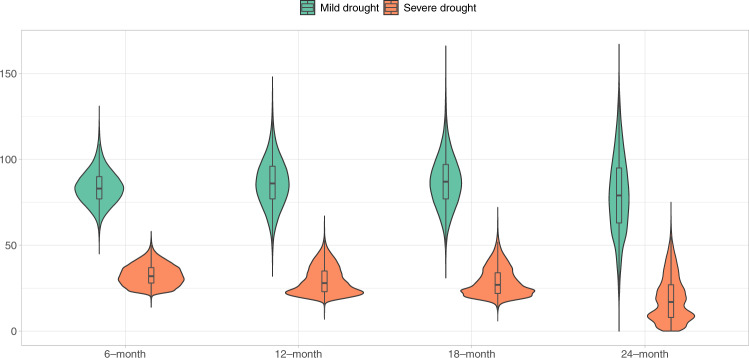
Climate change is projected to intensify drought conditions, which may increase the risk of diarrheal diseases in children. We constructed log-binomial generalized linear mixed models to examine the association between diarrhea risk, ascertained from global-scale nationally representative Demographic and Health Surveys, and drought, represented by the standardized precipitation evapotranspiration index, among children under five in 51 low- and middle-income countries (LMICs). Exposure to 6-month mild or severe drought was associated with an increased diarrhea risk of 5% (95% confidence interval 3-7%) or 8% (5-11%), respectively. The association was stronger among children living in a household that needed longer time to collect water or had no access to water or soap/detergent for handwashing. The association for 24-month drought was strong in dry zones but weak or null in tropical or temperate zones, whereas that for 6-month drought was only observed in tropical or temperate zones. In this work we quantify the associations between exposure to long-term drought and elevated diarrhea risk among children under five in LMICs and suggest that the risk could be reduced through improved water, sanitation, and hygiene practices, made more urgent by the likely increase in drought due to climate change.
© 2022. The Author(s).
Conflict of interest statement
V.E.P. has received reimbursement from Merck and Pfizer for travel to Scientific Input Engagements unrelated to the topic of this study and is a member of the WHO Immunization and Vaccine-related Implementation Research Advisory Committee (IVIR-AC). The remaining authors declare no competing interests.
Figures



References
-
- Intergovernmental Panel on Climate Change. Summary for policymakers. In Climate change 2021: the Physical Science Basis. Contribution of Working Group I to the Sixth Assessment Report of the Intergovernmental Panel on Climate Change (eds Seneviratne S. I. et al.) (Cambridge Univ. Press, 2021).
-
- Levy K, Woster AP, Goldstein RS, Carlton EJ. Untangling the impacts of climate change on waterborne diseases: a systematic review of relationships between diarrheal diseases and temperature, rainfall, flooding, and drought. Environ. Sci. Technol. 2016;50:4905–4922. doi: 10.1021/acs.est.5b06186. - DOI - PMC - PubMed
-
- Alexander KA, Heaney AK, Shaman J. Hydrometeorology and flood pulse dynamics drive diarrheal disease outbreaks and increase vulnerability to climate change in surface-water-dependent populations: a retrospective analysis. PLos Med. 2018;15:e1002688. doi: 10.1371/journal.pmed.1002688. - DOI - PMC - PubMed
-
- G. B. D. Diarrhoeal Disease Collaborators. Estimates of the global, regional, and national morbidity, mortality, and aetiologies of diarrhoea in 195 countries: a systematic analysis for the Global Burden of Disease Study 2016. Lancet Infect. Dis. 2018;18:1211–1228. doi: 10.1016/S1473-3099(18)30362-1. - DOI - PMC - PubMed
Publication types
MeSH terms
Substances
Grants and funding
LinkOut - more resources
Full Text Sources
