


Identification of risk factors for delirium, cognitive decline, and dementia after cardiac surgery (FINDERI-find delirium risk factors): a study protocol of a prospective observational study
- PMID: 35773648
- PMCID: PMC9245863
- DOI: 10.1186/s12872-022-02732-4
Identification of risk factors for delirium, cognitive decline, and dementia after cardiac surgery (FINDERI-find delirium risk factors): a study protocol of a prospective observational study
Abstract
Background: Postoperative delirium is a common complication of cardiac surgery associated with higher morbidity, longer hospital stay, risk of cognitive decline, dementia, and mortality. Geriatric patients, patients undergoing cardiac surgery, and intensive care patients are at a high risk of developing postoperative delirium. Gold standard assessments or biomarkers to predict risk factors for delirium, cognitive decline, and dementia in patients undergoing cardiac surgery are not yet available.
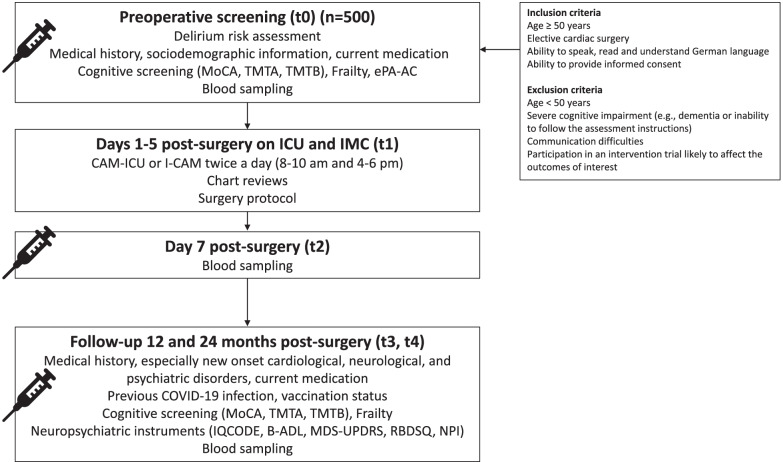
Methods: The FINDERI trial (FINd DElirium RIsk factors) is a prospective, single-center, observational study. In total, 500 patients aged ≥ 50 years undergoing cardiac surgery at the Department of Cardiovascular and Thoracic Surgery of the University of Göttingen Medical Center will be recruited. Our primary aim is to validate a delirium risk assessment in context of cardiac surgery. Our secondary aims are to identify specific preoperative and perioperative factors associated with delirium, cognitive decline, and accelerated dementia after cardiac surgery, and to identify blood-based biomarkers that predict the incidence of postoperative delirium, cognitive decline, or dementia in patients undergoing cardiac surgery.
Discussion: This prospective, observational study might help to identify patients at high risk for delirium prior to cardiac surgery, and to identify important biological mechanisms by which cardiac surgery is associated with delirium. The predictive value of a delirium screening questionnaire in cardiac surgery might be revealed. Finally, the identification of specific blood biomarkers might help to predict delirium, cognitive decline, and dementia in patients undergoing cardiac surgery.
Trial registration: Ethics approval for this study was obtained from the IRB of the University of Göttingen Medical Center. The investigators registered this study in the German Clinical Trials Register (DRKS; https://www.drks.de ) (DRKS00025095) on April 19th, 2021.
Keywords: Biomarkers; Cardiac surgery; Cognitive decline; Delirium; Delirium risk assessment; Dementia.
© 2022. The Author(s).
Conflict of interest statement
MS, IG, AW, CE, JE, JV, NH, and HE report no competing interest. JW has served at scientific advisory boards for Abbot, Biogen, Boehringer-Ingelheim, Eli Lilly, F. Hoffmann-La Roche, Immunogenetics, MSD SHARP & DOHME, has received honorarium for lectures sponsored by Eli Lilly, Pfizer, Janssen, MSD SHARP & DOHME, Amgen, Roche Pharma, Actelion Pharmaceuticals, Guangzhou Glorylen Medical Technology Co. (China), Beijing Yibai Science and Technology Ltd. CAFvA received honoraria from serving on the scientific advisory board of Biogen, Roche, and Dr. Willmar Schwabe GmbH &Co. KG and has received funding for travel and speaker honoraria from Biogen, Roche diagnostics AG and Dr. Willmar Schwabe GmbH &Co. KG and has received research support from Roche diagnostics AG. CC has received salary support from BioXcel Pharmaceuticals and honoraria for talks to Sunovion Pharmaceuticals on topics unrelated to this research. CC have received stipends from Elsevier for editorial work for General Hospital Psychiatry. Others declared no potential conflicts of interest with respect to the research, authorship, and/or publication of this article.
Figures
References
-
- Kotfis K, Szylińska A, Listewnik M, Strzelbicka M, Brykczyński M, Rotter I, Żukowski M. Early delirium after cardiac surgery: an analysis of incidence and risk factors in elderly (≥65 years) and very elderly (≥80 years) patients. Clin Interv Aging. 2018;13:1061–1070. doi: 10.2147/CIA.S166909. - DOI - PMC - PubMed
Publication types
MeSH terms
LinkOut - more resources
Full Text Sources
Medical
Miscellaneous
