


Assessing perceived effectiveness of career development efforts led by the women in American Medical Informatics Association Initiative
- PMID: 35773963
- PMCID: PMC9382400
- DOI: 10.1093/jamia/ocac101
Assessing perceived effectiveness of career development efforts led by the women in American Medical Informatics Association Initiative
Abstract
Objective: We sought to ascertain perceived factors affecting women's career development efforts in the American Medical Informatics Association (AMIA) and to provide recommendations for improvements.
Materials and methods: Data were collected using a 27-item survey administered via the AMIA newsletter and other social channels. Survey questions comprised 3 demographics, 15 Likert-scale, and 9 open-ended items. Likert-scale responses were summarized across respondent ages, career stages, and career domains, and open-ended responses were thematically analyzed.
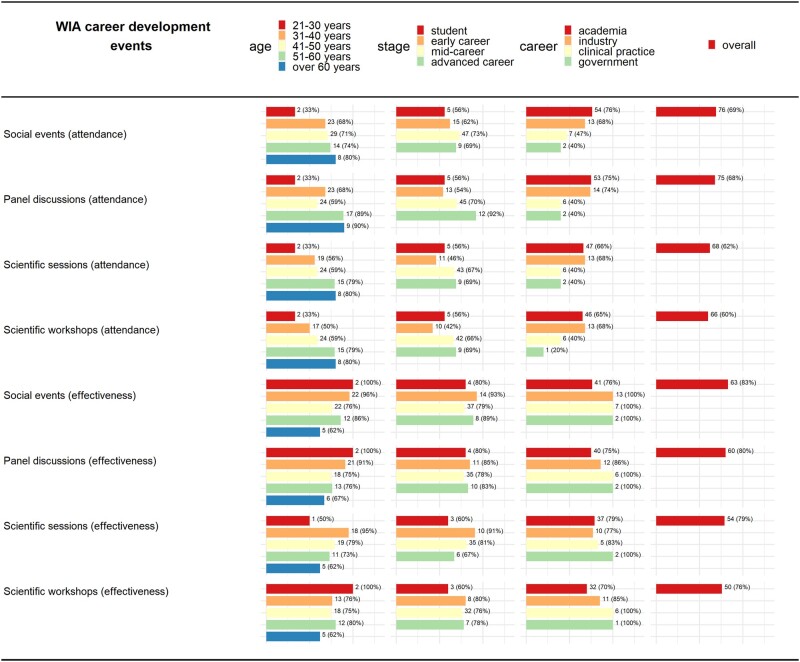
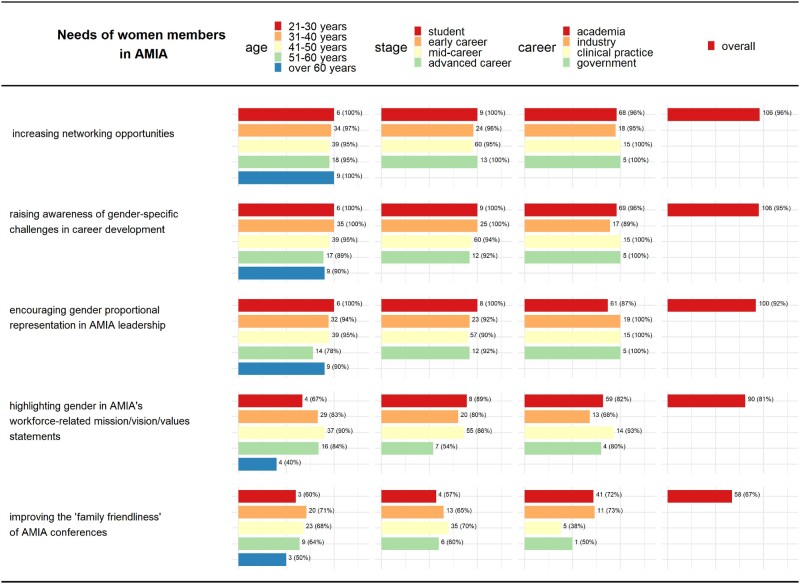
Results: We received survey responses from 109 AMIA women members. Our findings demonstrate that AMIA had made strides in promoting career development, and the most effective AMIA efforts included social events (83%), panel discussions (80%), and scientific sessions (79%). However, despite these efforts, women members perceived that gender-specific challenges persisted within AMIA, and recognized the need for increased networking opportunities (96%), raising awareness of gender-specific challenges (95%), and encouraging gender proportional representation in leadership (92%).
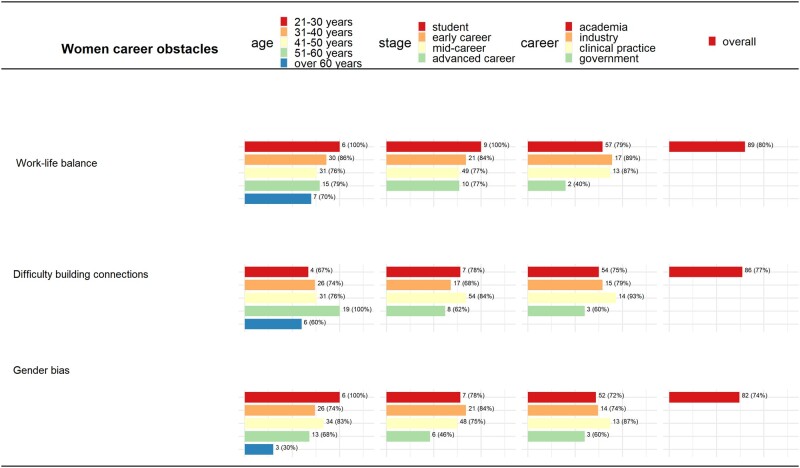
Discussion: International and national biomedical informatics professional communities have put forth efforts to address gender-specific issues in career development. Yet, our study identified that some of these, including the deep-rooted gender power hierarchy and bias, are still perceived as profound in AMIA.
Conclusion: Even though existing career development efforts for women are highly effective, important perceived gender-specific career development issues require further attention and investigation to improve existing AMIA activities.
Keywords: AMIA; biomedical informatics; career development; equity; gender; professional organization; women.
© The Author(s) 2022. Published by Oxford University Press on behalf of the American Medical Informatics Association. All rights reserved. For permissions, please email: journals.permissions@oup.com.
Figures
References
-
- Women in the Labor Force: A Databook. U.S. Bureau of Labor Statistics 2021. https://www.bls.gov/opub/reports/womens-databook/2020/home.htm. Accessed January 27, 2022.
-
- Desilver D. Women Scarce at Top of U.S. Business – and in the Jobs That Lead There. Washington, DC: Pew Research Center; 2018. https://www.pewresearch.org/fact-tank/2018/04/30/women-scarce-at-top-of-...
-
- Richter KP, Clark L, Wick JA, et al. Women physicians and promotion in academic medicine. N Engl J Med 2020; 383 (22): 2148–57. - PubMed
-
- Nonnemaker L. Women physicians in academic medicine – new insights from cohort studies. N Engl J Med 2000; 342 (6): 399–405. - PubMed
-
- AAUW. The Simple Truth about the Gender Pay Gap. Washington (DC: ): The American Association of University Women; 2018. https://www.aauw.org/app/uploads/2020/02/AAUW-2018-SimpleTruth-nsa.pdf. ...
