


Environmental Factors Shaping the Diversity and Spatial-Temporal Distribution of Indoor and Outdoor Culturable Airborne Fungal Communities in Tianjin University Campus, Tianjin, China
- PMID: 35774467
- PMCID: PMC9237511
- DOI: 10.3389/fmicb.2022.928921
Environmental Factors Shaping the Diversity and Spatial-Temporal Distribution of Indoor and Outdoor Culturable Airborne Fungal Communities in Tianjin University Campus, Tianjin, China
Abstract
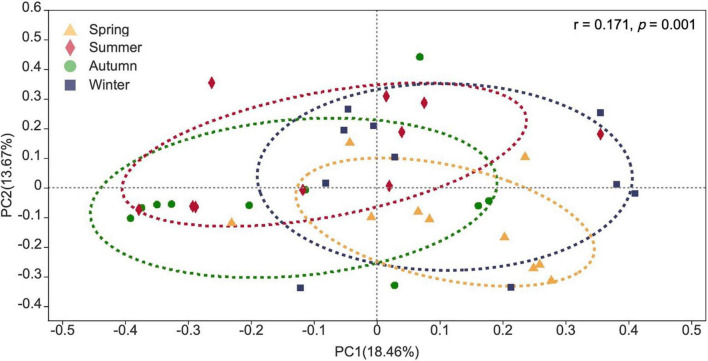
Airborne fungi have significant influence on air quality and may pose adverse effects on human health due to their allergenic and pathogenic effect. We carried out a 1-year survey on the airborne fungal diversity and concentration of indoor and outdoor environments, within the Tianjin University campus. Airborne fungi were sampled using an HAS-100B air sampler. Isolated fungal strains were identified based on morphological and molecular analysis. A total of 641 fungal strains belonging to 173 species and 74 genera were identified in this study. The dominant fungal genera were Cladosporium (29.49%), Alternaria (25.9%), and Epicoccum (6.24%), while the most frequently occurring species were A. alternata (15.44%), C. cladosporioides (11.86%), and E. nigrum (5.77%). The mean fungal concentration at different sites ranged from 0 to 420 CFU/m3, which is lower than the permissive standard level. There was a seasonal variation in the airborne fungal community, while temperature and relative humidity were positively correlated with the fungal concentration and diversity at almost all the sites. Higher fungal diversity was recorded in peak period of human traffic at the two canteens, whereas the two dormitories showed higher fungal diversity in off-peak period. Our study provides the first report on the diversity and concentration of airborne fungal species within different Tianjin University campus environments and clarifies the role played by environmental factors on the analyzed fungal community. Our results may represent valuable information for air quality monitoring and microbial pollution control in densely populated human living environments.
Keywords: ITS sequencing; airborne fungi; concentration; environmental factors; fungal diversity and community structure; indoor; morphology; outdoor.
Copyright © 2022 Yuan, Wang and Pecoraro.
Conflict of interest statement
The authors declare that the research was conducted in the absence of any commercial or financial relationships that could be construed as a potential conflict of interest.
Figures




References
-
- Abdel Hameed A. A., Khoder M. I., Yuosra S., Osman A. M., Ghanem S. (2009). Diurnal distribution of airborne bacteria and fungi in the atmosphere of Helwan area. Egypt. Sci. Total Environ. 407 6217–6222. - PubMed
-
- Banerjee U. C., Weber P., Ruffin J., Banerjee S. (1987). Airborne Fungi Survey of Some Residences in Durham. North Carolina U. S. A. Grana. 26 103–108. 10.1080/00173138709428910 - DOI
LinkOut - more resources
Full Text Sources
