


Chiropractic Clinical Outcomes Among Older Adult Male Veterans With Chronic Lower Back Pain: A Retrospective Review of Quality-Assurance Data
- PMID: 35774630
- PMCID: PMC9237589
- DOI: 10.1016/j.jcm.2022.02.004
Chiropractic Clinical Outcomes Among Older Adult Male Veterans With Chronic Lower Back Pain: A Retrospective Review of Quality-Assurance Data
Abstract
Objective: The purpose of this study was to determine whether a sample of older adult male U.S. veterans demonstrated clinically and statistically significant improvement in chronic lower back pain on validated outcome measures after a short course of chiropractic care.
Methods: We performed a retrospective review of a quality-assurance data set of outcome metrics for male veterans, aged 65 to 89 years, who had chronic low back pain, defined as pain in the lower back region present for at least 3 months before evaluation. We included those who received chiropractic management from January 1, 2010, to December 31, 2018. Paired t tests were used to compare outcomes after 4 treatments on both a numeric rating scale (NRS) and the Back Bournemouth Questionnaire (BBQ). The minimum clinically important difference (MCID) was set at 30% change from baseline.
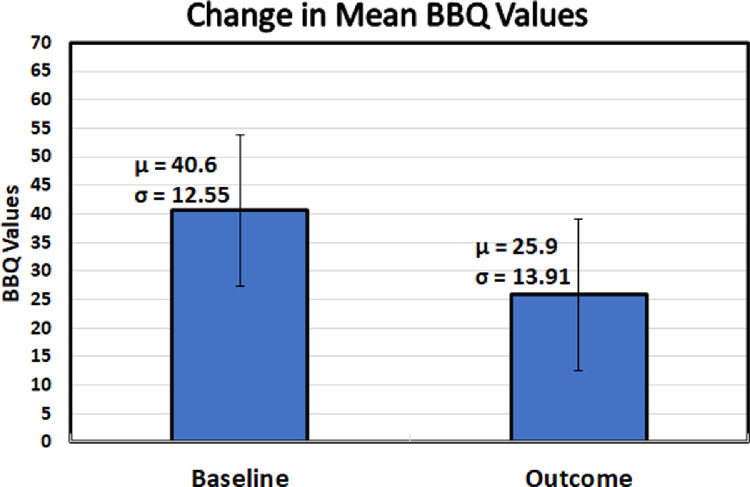
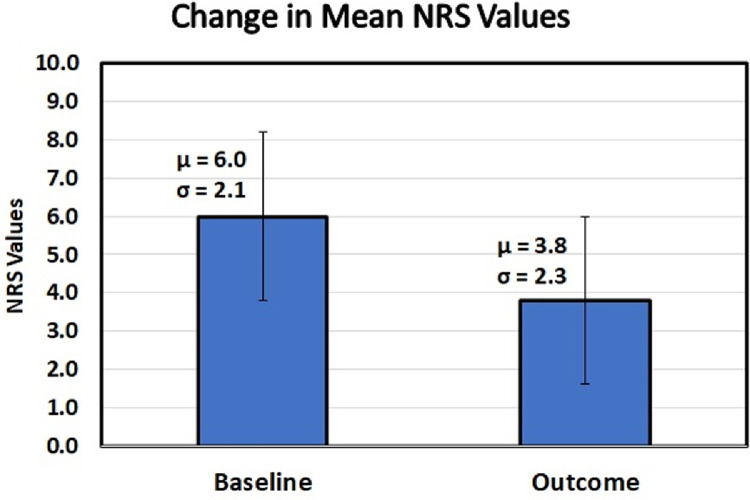
Results: There were 217 individuals who met the inclusion criteria. The mean NRS score change from baseline was 2.2 points, representing a 34.1% reduction (t = 13.5, P < .001). The mean score change for BBQ was 14.7 points, representing a 35.9% reduction (t = 16.7, P < .001). The percentage of participants reaching the MCID for the NRS was 57% (n = 124) and for the BBQ was 59% (n = 126), with 41% (n = 90) of the sample reaching the MCID for both the NRS and BBQ.
Conclusion: This retrospective review revealed clinically and statistically significant improvement in NRS and BBQ scores for this sample of older male U.S. veterans treated with chiropractic management for chronic low back pain.
Keywords: Adult; Chiropractic; Low Back Pain; Manipulation, Spinal; Veterans.
© 2022 by National University of Health Sciences.
Figures

References
-
- Public health and aging: trends in aging—United States and worldwide. JAMA. 2003;289(11):1371–1373. - PubMed
-
- Colby SL, Ortman JM. Projections of the size and composition of the U.S. population: 2014 to 2060. Current Population Reports, P25-1143. Washington, DC: US Census Bureau; 2014.
-
- Selim AJ, Berlowitz DR, Fincke G, et al. The health status of elderly veteran enrollees in the Veterans Health Administration. J Am Geriatr Soc. 2004;52(8):1271–1276. - PubMed
-
- Dionne CE, Dunn KM, Croft PR. Does back pain prevalence really decrease with increasing age? a systematic review. Age Ageing. 2006;35(3):229–234. - PubMed
-
- Docking RE, Fleming J, Brayne C, et al. Epidemiology of back pain in older adults: prevalence and risk factors for back pain onset. Rheumatology (Oxford) 2011;50(9):1645–1653. - PubMed
LinkOut - more resources
Full Text Sources
Miscellaneous
