Review
. 2022 Jun 14:13:913178.
doi: 10.3389/fimmu.2022.913178. eCollection 2022.

Intestinal Microbiota - An Unmissable Bridge to Severe Acute Pancreatitis-Associated Acute Lung Injury

Affiliations
Review

Intestinal Microbiota - An Unmissable Bridge to Severe Acute Pancreatitis-Associated Acute Lung Injury

Zhengjian Wang et al. Front Immunol. .

Abstract

Severe acute pancreatitis (SAP), one of the most serious abdominal emergencies in general surgery, is characterized by acute and rapid onset as well as high mortality, which often leads to multiple organ failure (MOF). Acute lung injury (ALI), the earliest accompanied organ dysfunction, is the most common cause of death in patients following the SAP onset. The exact pathogenesis of ALI during SAP, however, remains unclear. In recent years, advances in the microbiota-gut-lung axis have led to a better understanding of SAP-associated lung injury (PALI). In addition, the bidirectional communications between intestinal microbes and the lung are becoming more apparent. This paper aims to review the mechanisms of an imbalanced intestinal microbiota contributing to the development of PALI, which is mediated by the disruption of physical, chemical, and immune barriers in the intestine, promotes bacterial translocation, and results in the activation of abnormal immune responses in severe pancreatitis. The pathogen-associated molecular patterns (PAMPs) mediated immunol mechanisms in the occurrence of PALI via binding with pattern recognition receptors (PRRs) through the microbiota-gut-lung axis are focused in this study. Moreover, the potential therapeutic strategies for alleviating PALI by regulating the composition or the function of the intestinal microbiota are discussed in this review. The aim of this study is to provide new ideas and therapeutic tools for PALI patients.

Keywords: bacterial translocation; immune imbalance; intestinal microbiota; microbiota-gut-lung axis; pathogen-associated molecular patterns; severe acute pancreatitis-associated lung injury.


Conflict of interest statement

The authors declare that the research was conducted in the absence of any commercial or financial relationships that could be construed as a potential conflict of interest.

Figures
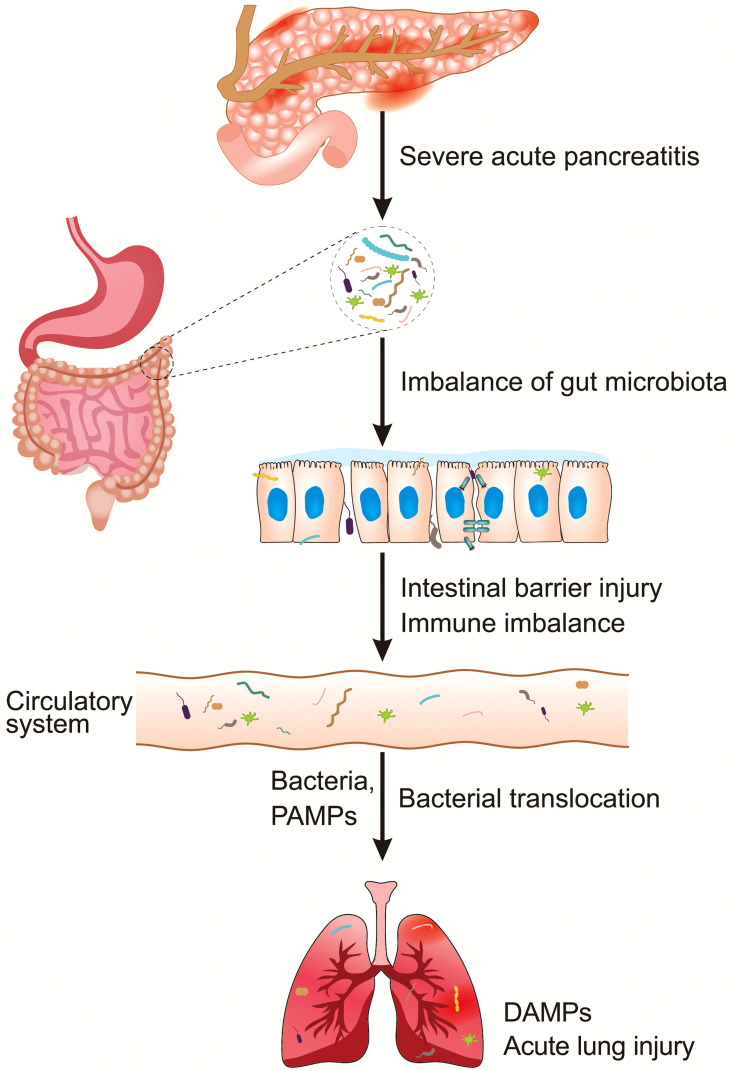
Figure 1
Figure 1
An overview of intestinal microbiota dysbiosis in PALI. DAMPs, damage-associated molecular patterns; PALI, severe acute pancreatitis-associated acute lung injury; PAMPs, pathogen-associated molecular patterns.
Figure 2
Figure 2
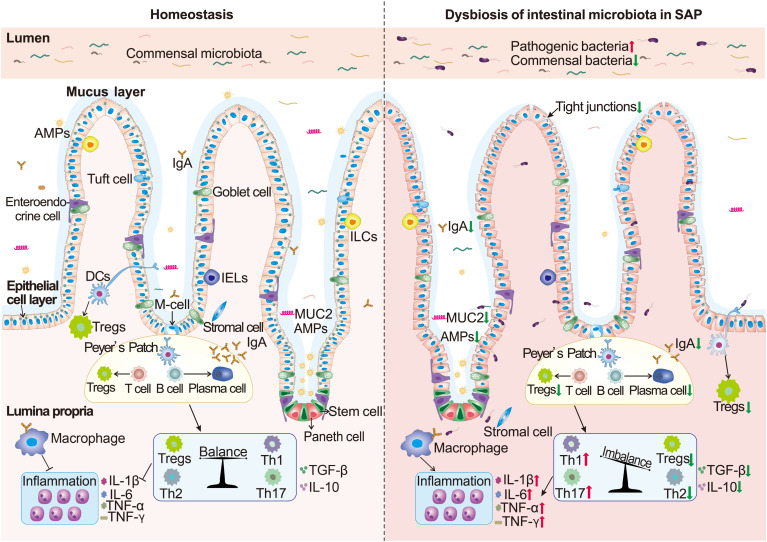
The mechanisms of intestinal barrier disruption mediated by intestinal bacterial dysbiosis. The increase of intestinal pathogenic bacteria and the decrease of commensal metabolites in severe acute pancreatitis (SAP) jointly lead to the thinning of the intestinal mucus layer and the decrease of antimicrobial peptides (AMPs), mucin2 (MUC2), and IgA (SIgA) secretion, resulting in direct contact of pathogenic bacteria with the intestinal epithelial cells (IECs) and an “inflammatory storm”. The abnormal immune responses further lead to IEC damage, slow renewal, and disruption of the tight junctions (TJs) in epithelial cells, further stimulating excessive pro-inflammatory factors on the intestinal mucosal immune system. Finally, the integrity of the intestinal barrier is destroyed, bacteria and products translocate to the lungs, and then PALI ensues.
Figure 3
Figure 3
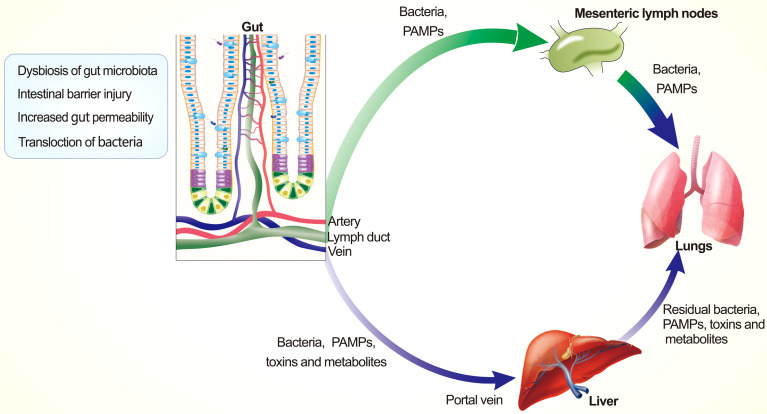
Pathways of intestinal bacterial translocation. Intestinal pathogenic bacteria, PAMPs, and metabolites translocate to the lung via lymphatic route and blood circulatory system.
Figure 4
Figure 4
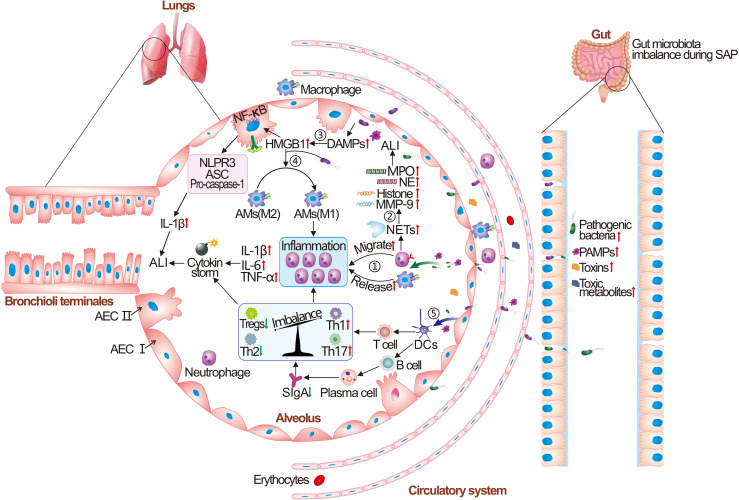
The pathogenesis of intestinal microbiota dysbiosis caused acute lung injury (ALI). Briefly, the intestinal pathogenic bacteria and harmful metabolites are translocated to the lung and recognized by pulmonary innate immune cells (AECs, AMs, DCs, and NK cells). Then, the release of persistent pro-inflammatory cytokines is induced by binding to their pattern recognition receptors (PRRs) on the cell surface, causing an “inflammatory storm”. A large number of neutrophil cells aggregate in the alveoli and neutrophil extracellular trap network (NETs) lead to increased release of neutrophil elastase (NE), myeloperoxidase (MPO), and histone. The inflammatory factors, granulins, and infiltrated red blood cells from vascular cause the damage and hemorrhage of lung tissue. Subsequently, the lung tissue initiates the immune responses of damage-associated molecular patterns (DAMPs), causing increased release of high mobility group protein B1 (HMGB1), the abnormal polarization of M1-type macrophages, and release of NOD-like receptor thermal protein domain associated protein 3 (NLRP3). Finally, lung tissue initiates an adaptive immune response, and increased production of pro-inflammatory Th1 and Th17 immune cells and suppression of Tregs cells could be observed, resulting in the paralysis of the immune system and irreversible ALI. AECs, alveolar epithelial cells; AMs, alveolar macrophages; DCs, dendritic cells; ASC, Apoptosis-associated speck-like protein containing a caspase recruit domain; SIgA, secretory IgA.
Figure 5
Figure 5
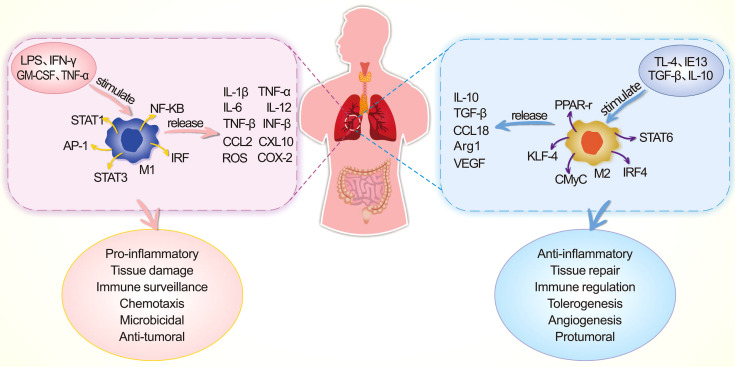
Comparison of M1-type macrophages and M2-type macrophages, in terms of stimulatory factors, transcription factors, released mediators, and functional properties during the process of PALI. AP-1, activating protein-1; ARG1, arginase 1; CMyC, transcription factor CMyC; GM-CSF, granulocyte-macrophage colony-stimulating factor; IFN-γ, interferon γ; IRF, interferon regulatory factor; KLF-4, krüppel-like factor 4; LPS, lipopolysaccharide; NF-κB, nuclear transcription factor κB; ROS, reactive oxygen species; STAT, signal transduction and activation of transcription factor; TGF-β, transforming growth factor ß; VEGF, vascular endothelial growth factor.
Figure 6
Figure 6
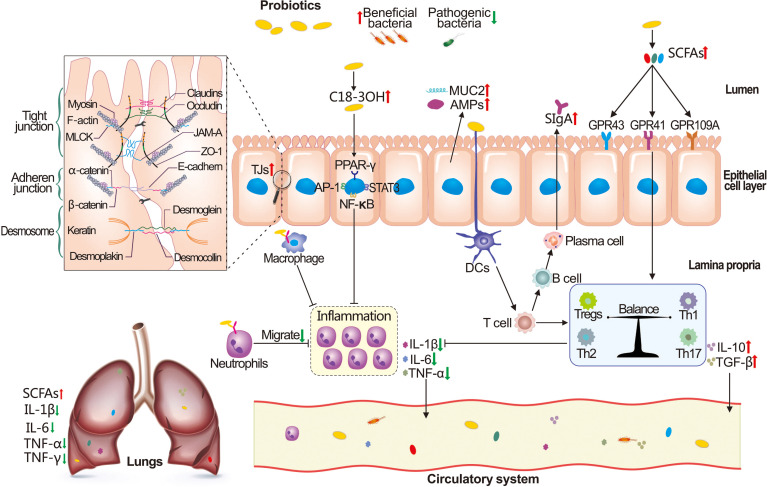
Possible mechanisms of probiotics supplementation on PALI recovery. Probiotics can restore the function of the intestinal barrier by inhibiting the proliferation of pathogenic bacteria, increasing the production of 3-hydroxyoctadecenoic acid (C18-3OH), short-chain fatty acids (SCFAs), antimicrobial peptides (AMPs), mucin2 (MUC2), and secretory IgA (SIgA), and regulating the expression of tight junction (TJ) proteins. In addition, probiotics have the capacity to reduce the neutrophil infiltration and release of inflammatory cytokines, maintain the balance of the intestinal immune system, and reduce the translocation of bacteria, inflammatory factors, etc., resulting in the alleviation of PALI.

References

    1. Kong L, Deng J, Zhou X, Cai B, Zhang B, Chen X, et al. Sitagliptin Activates the P62-Keap1-Nrf2 Signalling Pathway to Alleviate Oxidative Stress and Excessive Autophagy in Severe Acute Pancreatitis-Related Acute Lung Injury. Cell Death Dis (2021) 12(10):928. doi: 10.1038/s41419-021-04227-0 - DOI - PMC - PubMed
    1. Jin M, Zhang H, Wu M, Wang Z, Chen X, Guo M, et al. Colonic Interleukin-22 Protects Intestinal Mucosal Barrier and Microbiota Abundance in Severe Acute Pancreatitis. FASEB J (2022) 36(3):e22174. doi: 10.1096/fj.202101371R - DOI - PubMed
    1. Wu J, Zhang J, Zhao J, Chen S, Zhou T, Xu J. Treatment of Severe Acute Pancreatitis and Related Lung Injury by Targeting Gasdermin D-Mediated Pyroptosis. Front Cell Dev Biol (2021) 9:780142. doi: 10.3389/fcell.2021.780142 - DOI - PMC - PubMed
    1. Zhou J, Zhou P, Zhang Y, Wang G, Fan Z. Signal Pathways and Markers Involved in Acute Lung Injury Induced by Acute Pancreatitis. Dis Markers (2021) 2021:9947047. doi: 10.1155/2021/9947047 - DOI - PMC - PubMed
    1. Xu C, Zhang J, Liu J, Li Z, Liu Z, Luo Y, et al. Proteomic Analysis Reveals the Protective Effects of Emodin on Severe Acute Pancreatitis Induced Lung Injury by Inhibiting Neutrophil Proteases Activity. J Proteomics (2020) 220:103760. doi: 10.1016/j.jprot.2020.103760 - DOI - PubMed

Publication types