Review
. 2022 Jul;179(7):458-469.
doi: 10.1176/appi.ajp.20220423.

Toward a Better Understanding of the Mechanisms and Pathophysiology of Anhedonia: Are We Ready for Translation?

Affiliations
Review

Toward a Better Understanding of the Mechanisms and Pathophysiology of Anhedonia: Are We Ready for Translation?

Diego A Pizzagalli. Am J Psychiatry. 2022 Jul.

Abstract

Anhedonia-the loss of pleasure or lack of reactivity to pleasurable stimuli-remains a formidable treatment challenge across neuropsychiatric disorders. In major depressive disorder, anhedonia has been linked to poor disease course, worse response to psychological, pharmacological, and neurostimulation treatments, and increased suicide risk. Moreover, although some neural abnormalities linked to anhedonia normalize after successful treatment, several persist-for example, blunted activation of the ventral striatum to reward-related cues and reduced functional connectivity involving the ventral striatum. Critically, some of these abnormalities have also been identified in unaffected, never-depressed children of parents with major depressive disorder and have been found to prospectively predict the first onset of major depression. Thus, neural abnormalities linked to anhedonia may be promising targets for prevention. Despite increased appreciation of the clinical importance of anhedonia and its underlying neural mechanisms, important gaps remain. In this overview, the author first summarizes the extant knowledge about the pathophysiology of anhedonia, which may provide a road map toward novel treatment and prevention strategies, and then highlights several priorities to facilitate clinically meaningful breakthroughs. These include a need for 1) appropriately controlled clinical trials, especially those embracing an experimental therapeutics approach to probe target engagement; 2) novel preclinical models relevant to anhedonia, with stronger translational value; and 3) clinical scales that incorporate neuroscientific advances in our understanding of anhedonia. The author concludes by highlighting important future directions, emphasizing the need for an integrated, collaborative, cross-species, and multilevel approach to tackling anhedonic phenotypes.

Keywords: Brain Imaging Techniques; Cognitive Neuroscience; Depressive Disorders; Major Depressive Disorder; Neurocircuitry.


Figures
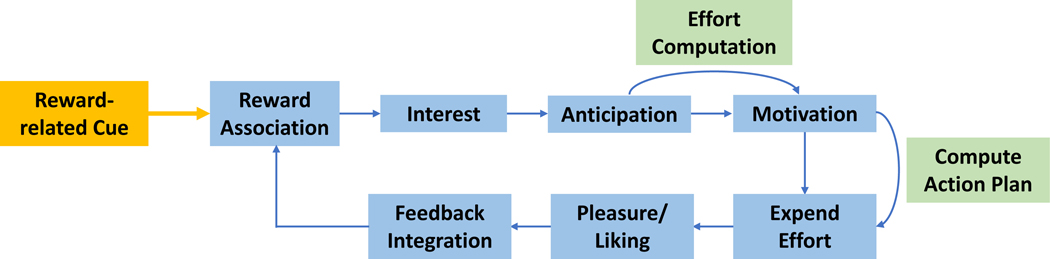
Figure 1:
Figure 1:
Subprocesses and subdomains implicated in reward processing (modified after (19) and (18)). Specific anhedonic behaviors might be chiefly associated with disruption in one or several of these subdomains.
Figure 2:
Figure 2:
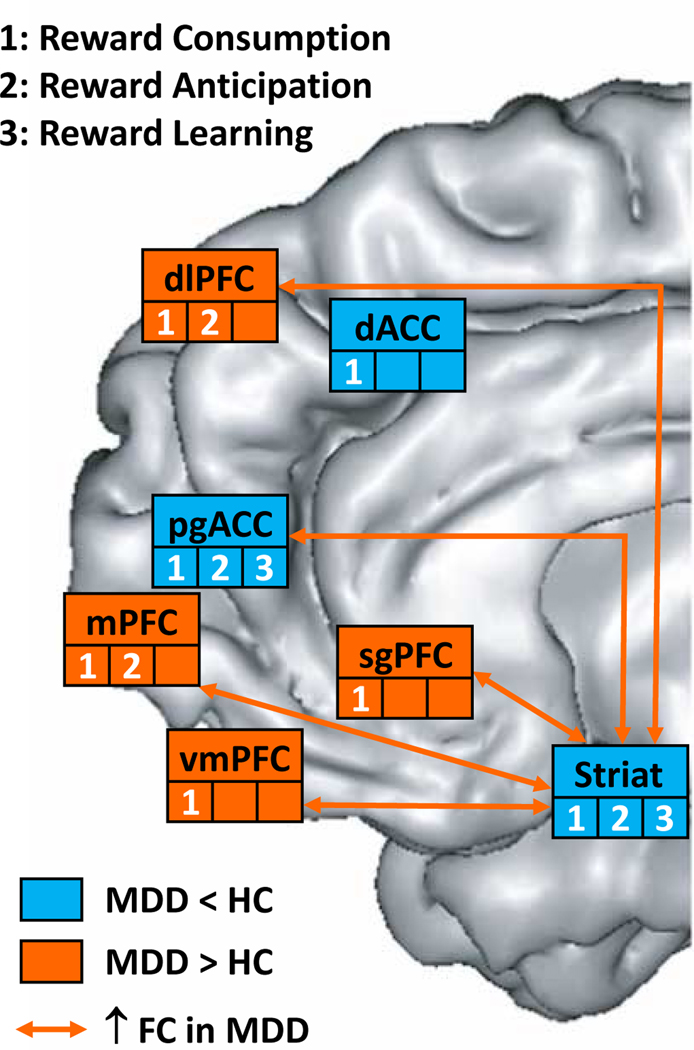
Summary of abnormalities emerging from functional magnetic resonance imaging (fMRI) in individuals with major depressive disorder (MDD) or at risk for MDD using tasks probing reward-related processes or evaluating resting state functional connectivity within the brain reward system. Regions highlighted in orange and blue show higher activation and lower activation, respectively, in MDD samples than healthy controls (HC). Orange arrows denote higher functional connectivity in MDD samples than healthy controls. dACC: dorsal anterior cingulate cortex, dlPFC: dorsolateral prefrontal cortex, mPFC: medial prefrontal cortex, pgACC; perigenual anterior cingulate cortex, sgACC: subgenual anterior cingulate cortex, Striat: striatum vmPFC: ventromedial prefrontal cortex. Modified after (34).
Figure 3:
Figure 3:
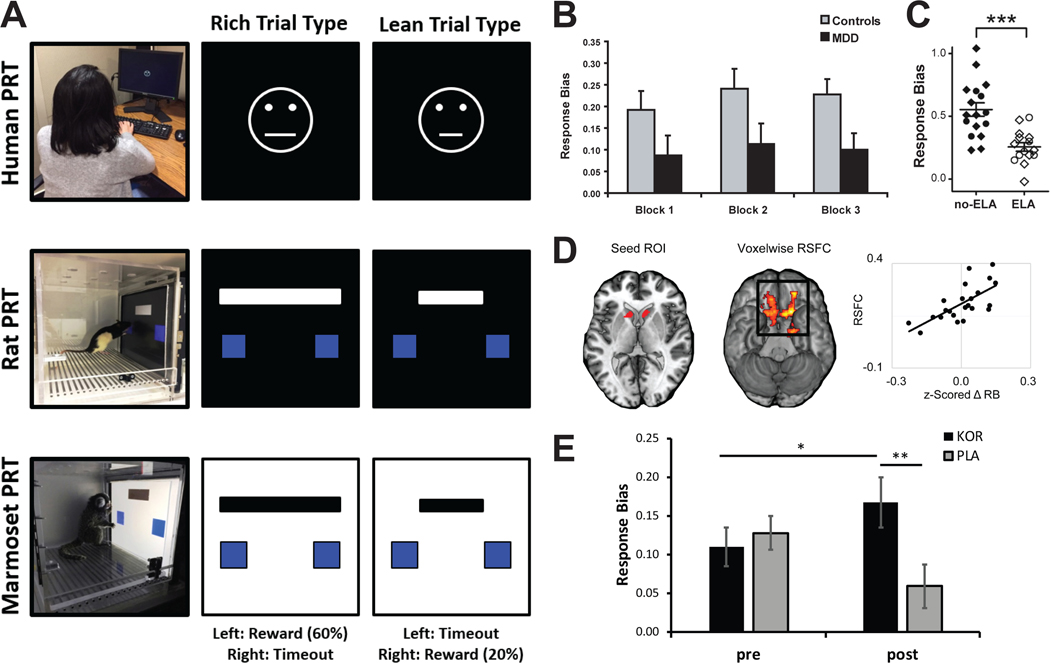
Cross-species Reward Learning Assay. (A) Task schematics for the human (top; (108)), rat (middle; (110)), and marmoset (bottom; (109)) Probabilistic Reward Task (PRT). Using a signal-detection approach involving an asymmetric reinforcement schedule and two difficult-to-discriminate stimuli, the PRT objectively assesses subjects’ ability to develop a response bias toward a more frequently rewarded stimulus, which is taken as a measure of reward learning. (B) Relative to healthy controls, unmedicated individuals with major depressive disorder (MDD) have significantly lower response bias (117). (C) Relative to a no-stress (control) group, rats exposed to early life stress (limited bedding and nesting paradigm) between P2 and P9 were characterized by signiciantly blunted response bias (118). (D) Among healthy controls, individual differences in response bias are positively associated with resting state functional connectivity between the ventral striatum and the ventromedial prefrontal cortex (as assessed with fMRI) and negatively associated with dopamine transporter binding potential (not shown; as assessed using positron emission tomography). The latter finding suggests that low dopamine transporter availability, and thus higher dopamine availability in the synaptic cleft, is associated with better reward learning abilities (119). (E) In a placebo-controlled clinical trial, a kappa opioid antagonist was associated with better response bias among a transdiagnostic sample with elevated anhedonia (87). Figures reproduced with permissions from the publishers.

References

    1. Klein DF: Endogenomorphic depression. A conceptual and terminological revision. Arch Gen Psychiatry 1974; 31:447–54 - PubMed
    1. Treadway MT, Zald DH: Reconsidering anhedonia in depression: lessons from translational neuroscience. Neurosci Biobehav Rev 2011; 35:537–55 - PMC - PubMed
    1. Pizzagalli DA: Depression, stress, and anhedonia: toward a synthesis and integrated model. Annu Rev Clin Psychol 2014; 10:393–423 - PMC - PubMed
    1. Pelizza L, Ferrari A: Anhedonia in schizophrenia and major depression: state or trait? Ann Gen Psychiatry 2009; 8:145–155 - PMC - PubMed
    1. Cao B, Park C, Subramaniapillai M, et al.: The Efficacy of Vortioxetine on Anhedonia in Patients With Major Depressive Disorder. Front psychiatry 2019; 10 - PMC - PubMed

Publication types

LinkOut - more resources