


Advancing Lung Immunology Research: An Official American Thoracic Society Workshop Report
- PMID: 35776495
- PMCID: PMC9273224
- DOI: 10.1165/rcmb.2022-0167ST
Advancing Lung Immunology Research: An Official American Thoracic Society Workshop Report
Abstract
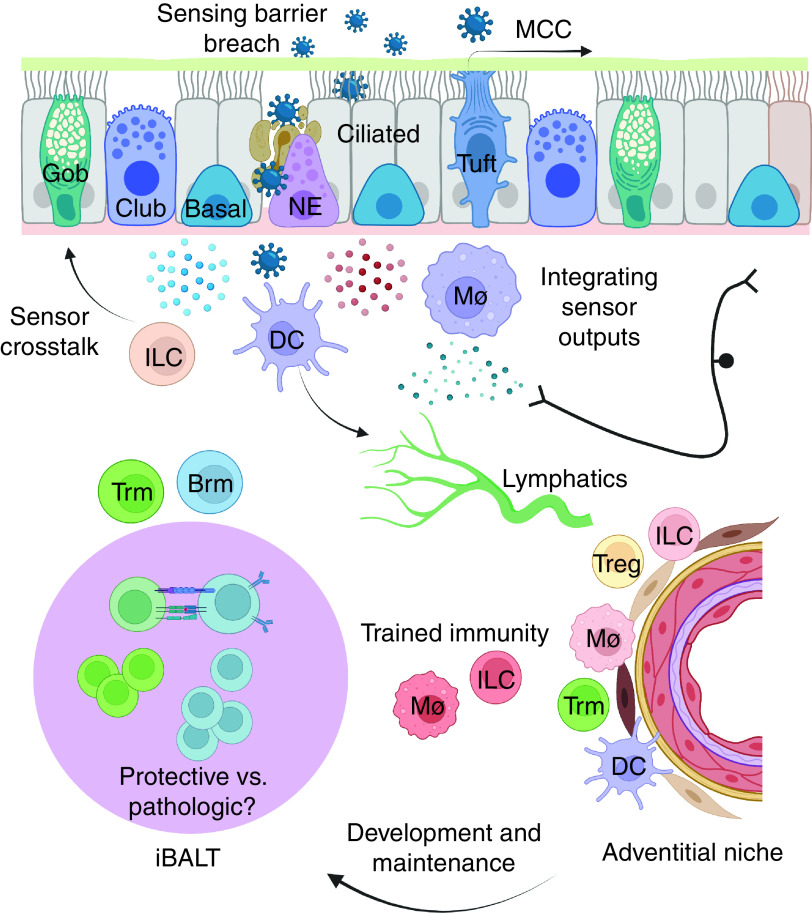
The mammalian airways and lungs are exposed to a myriad of inhaled particulate matter, allergens, and pathogens. The immune system plays an essential role in protecting the host from respiratory pathogens, but a dysregulated immune response during respiratory infection can impair pathogen clearance and lead to immunopathology. Furthermore, inappropriate immunity to inhaled antigens can lead to pulmonary diseases. A complex network of epithelial, neural, stromal, and immune cells has evolved to sense and respond to inhaled antigens, including the decision to promote tolerance versus a rapid, robust, and targeted immune response. Although there has been great progress in understanding the mechanisms governing immunity to respiratory pathogens and aeroantigens, we are only beginning to develop an integrated understanding of the cellular networks governing tissue immunity within the lungs and how it changes after inflammation and over the human life course. An integrated model of airway and lung immunity will be necessary to improve mucosal vaccine design as well as prevent and treat acute and chronic inflammatory pulmonary diseases. Given the importance of immunology in pulmonary research, the American Thoracic Society convened a working group to highlight central areas of investigation to advance the science of lung immunology and improve human health.
Keywords: allergy and immunology; lung diseases; mucosal immunity.
Figures
References
-
- Harker JA, Lloyd CM. Overlapping and distinct features of viral and allergen immunity in the human lung. Immunity . 2021;54:617–631. - PubMed
Publication types
MeSH terms
Substances
Grants and funding
- R21 AI149416/AI/NIAID NIH HHS/United States
- R01 AI134236/AI/NIAID NIH HHS/United States
- R01 HL148758/HL/NHLBI NIH HHS/United States
- R01 AI111914/AI/NIAID NIH HHS/United States
- 789384/ERC_/European Research Council/International
- U19 AI135964/AI/NIAID NIH HHS/United States
- UL1 TR001422/TR/NCATS NIH HHS/United States
- P01 HL154998/HL/NHLBI NIH HHS/United States
- K08 HL140173/HL/NHLBI NIH HHS/United States
- P30 DK054759/DK/NIDDK NIH HHS/United States
- WT_/Wellcome Trust/United Kingdom
- R01 HL149883/HL/NHLBI NIH HHS/United States
- R35 HL155458/HL/NHLBI NIH HHS/United States
- R01 AI125644/AI/NIAID NIH HHS/United States
- R01 AI123780/AI/NIAID NIH HHS/United States
- R01 HL142701/HL/NHLBI NIH HHS/United States
- R01 HL153122/HL/NHLBI NIH HHS/United States
- 107059/Z/15/Z/WT_/Wellcome Trust/United Kingdom
- P30 DK043351/DK/NIDDK NIH HHS/United States
- R01 AI155024/AI/NIAID NIH HHS/United States
- R01 AI150043/AI/NIAID NIH HHS/United States
- K23 HL143135/HL/NHLBI NIH HHS/United States
- P01 AG049665/AG/NIA NIH HHS/United States
- K24 HL127301/HL/NHLBI NIH HHS/United States
- U19 AI162310/AI/NIAID NIH HHS/United States
