Review
. 2022 Jul;8(26):eabn0929.
doi: 10.1126/sciadv.abn0929. Epub 2022 Jul 1.

Risks of mining to salmonid-bearing watersheds

Affiliations
Review

Risks of mining to salmonid-bearing watersheds

Christopher J Sergeant et al. Sci Adv. 2022 Jul.

Abstract

Mining provides resources for people but can pose risks to ecosystems that support cultural keystone species. Our synthesis reviews relevant aspects of mining operations, describes the ecology of salmonid-bearing watersheds in northwestern North America, and compiles the impacts of metal and coal extraction on salmonids and their habitat. We conservatively estimate that this region encompasses nearly 4000 past producing mines, with present-day operations ranging from small placer sites to massive open-pit projects that annually mine more than 118 million metric tons of earth. Despite impact assessments that are intended to evaluate risk and inform mitigation, mines continue to harm salmonid-bearing watersheds via pathways such as toxic contaminants, stream channel burial, and flow regime alteration. To better maintain watershed processes that benefit salmonids, we highlight key windows during the mining governance life cycle for science to guide policy by more accurately accounting for stressor complexity, cumulative effects, and future environmental change.


Figures
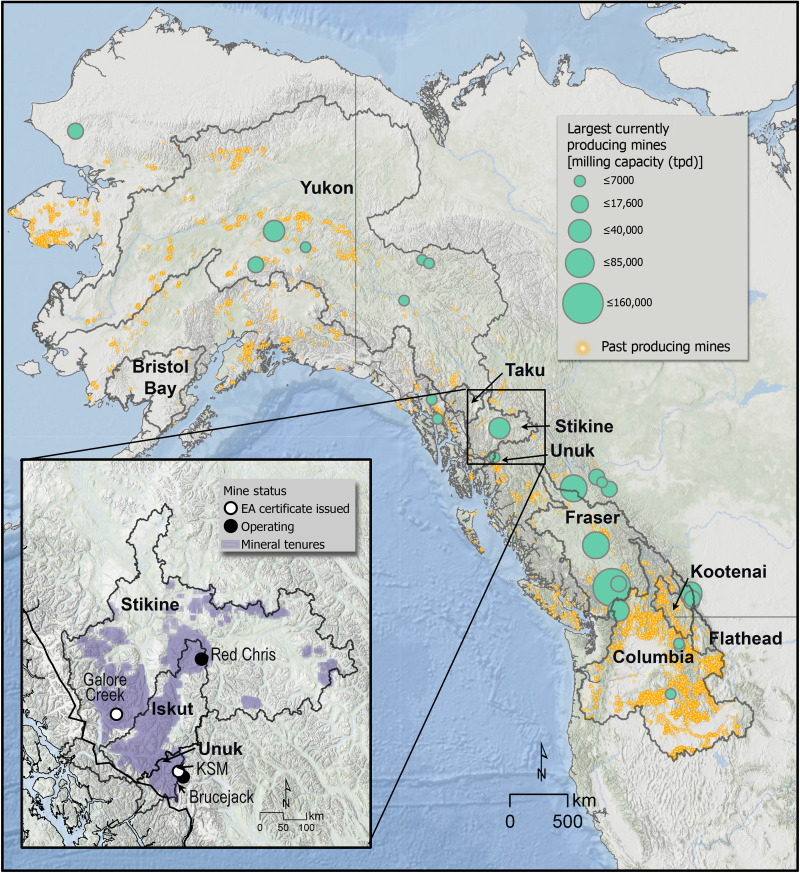
Fig. 1.
Fig. 1.. Current and past producing metal and coal mining locations in northwestern North America.
Outlined watersheds are referenced in the text. Teal circles represent the largest currently operating mines in the region (n = 26), where sizes are proportional to daily milling rate in metric tons per day (tpd). The inset illustrates the high density of mineral tenures (purple polygons) in the BC extent of the Stikine, Iskut, and Unuk Rivers. Data sources and definitions of “producer” and “past producer” are found in Supplementary Text.
Fig. 2.
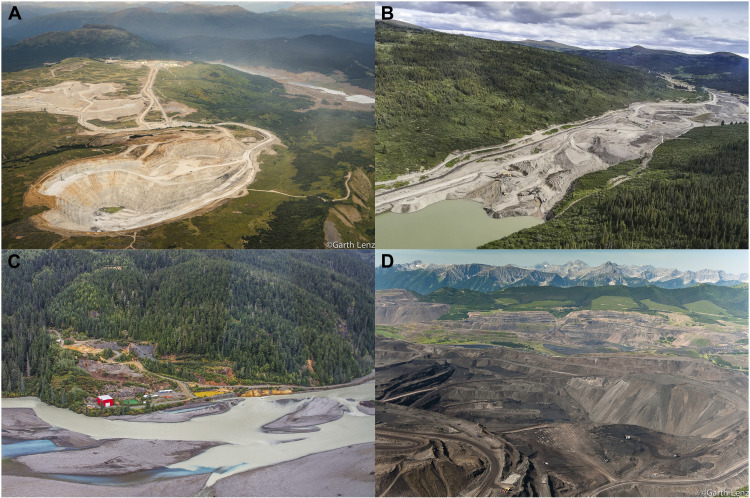
Fig. 2.. Representative mining operations in northwestern North America.
(A) Open-pit operations with a wet tailings impoundment facility beginning to take shape in the background (Red Chris Mine, BC; Garth Lenz). (B) Open-pit placer operations with a pit lake used for recirculating sluicing water (Atlin, BC; Jackie Caldwell). (C) Legacy underground operations adjacent to a glacial river (Tulsequah Chief Mine, BC; Christopher Sergeant). (D) Mountaintop removal coal mining (Elk Valley, BC; Garth Lenz).
Fig. 3.
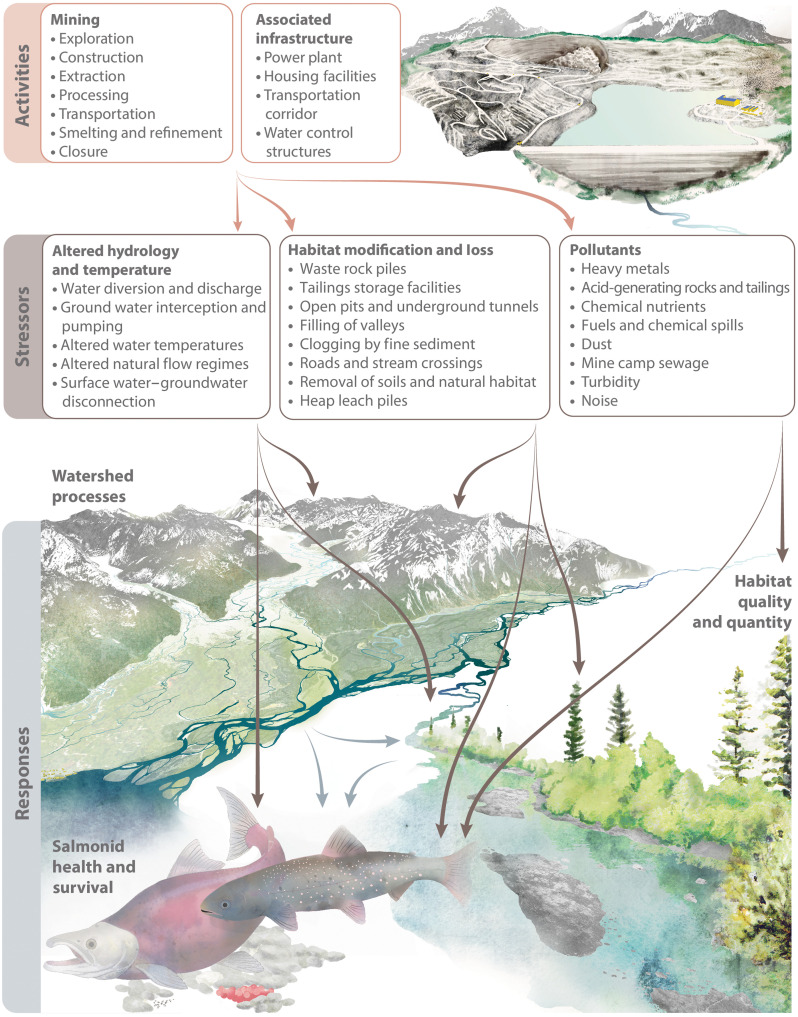
Fig. 3.. Mining activities and pathways of impacts to salmonid-bearing watersheds.
The different stages of mining activities and associated infrastructure can result in combinations of stressors that, in turn, influence the watershed processes that shape and define salmonid-bearing watersheds from headwaters to outlet, alter habitat quality and quantity, and directly influence salmonid health and survival (brown arrows). These pathways of impacts can have internal feedbacks and connections (gray arrows). Illustration by Cecil Howell.
Fig. 4.
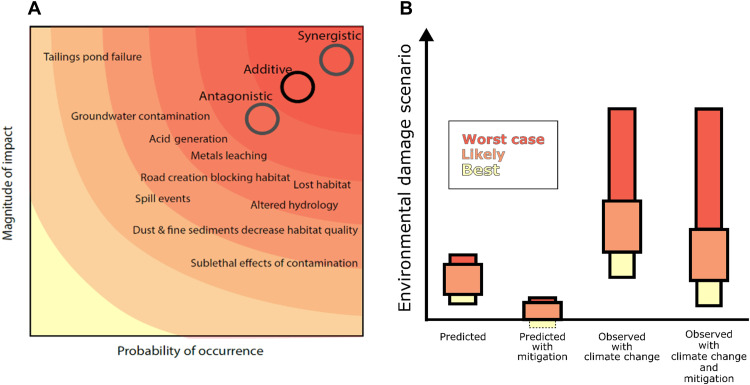
Fig. 4.. Conceptual diagrams of cumulative and assessed risks resulting from mining activities.
(A) Mining activities pose risks that vary in magnitude of impact × probability of occurrence. Yellow, lower risk; red, higher risk. Activities are placed for illustration purposes only, and the actual placement of individual activities relies on specific project details. As reviewed in (150), combined risks, which are represented by circles, can be antagonistic (combined effect of multiple stressors is less than the sum of individual effects), additive (combined effect is the sum of individual effects), or synergistic (combined effect is greater than the sum of individual effects). (B) Scenarios of environmental damage predicted during the impact assessment process and the proposed mitigation strategies can have unacknowledged uncertainty introduced by poorly quantified cumulative effects and climate change. In some cases, project proponents may assert that the proposed mitigation will improve environmental conditions (light yellow bar below the horizontal axis).

References

    1. Moore J. N., Luoma S. N., Hazardous wastes from large-scale metal extraction: A case study. Environ. Sci. Technol. 24, 1278–1285 (1990).
    1. Farag A. M., Woodward D. F., Goldstein J. N., Brumbaugh W., Meyer J. S., Concentrations of metals associated with mining waste in sediments, biofilm, benthic macroinvertebrates, and fish from the Coeur d’Alene River Basin, Idaho. Arch. Environ. Contam. Toxicol. 34, 119–127 (1998). - PubMed
    1. Barry K. L., Grout J. A., Levings C. D., Nidle B. H., Piercey G. E., Impacts of acid mine drainage on juvenile salmonids in an estuary near Britannia Beach in Howe Sound, British Columbia. Can. J. Fish. Aquat. Sci. 57, 2032–2043 (2000).
    1. K. Spitz, J. Trudinger, Mining and the Environment: From Ore to Metal (CRC Press, 2019).
    1. Simonin M., Rocca J. D., Gerson J. R., Moore E., Brooks A. C., Czaplicki L., Ross M. R. V., Fierer N., Craine J. M., Bernhardt E. S., Consistent declines in aquatic biodiversity across diverse domains of life in rivers impacted by surface coal mining. Ecol. Appl. 31, e02389 (2021). - PubMed