


Interrelationship among thigh intermuscular adipose tissue, cross-sectional area, muscle strength, and functional mobility in older subjects
- PMID: 35777009
- PMCID: PMC9239645
- DOI: 10.1097/MD.0000000000029744
Interrelationship among thigh intermuscular adipose tissue, cross-sectional area, muscle strength, and functional mobility in older subjects
Abstract
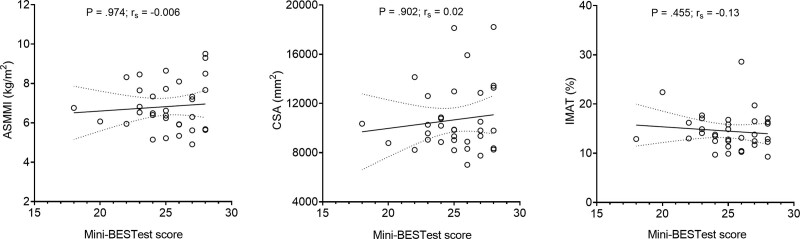
The aim of this cross-sectional study was to investigate the association between lower limb strength, muscle mass and composition, and balance ability in elders. Thirthy-four older participants (Age: 65.6 ± 4.73 years; male = 10 and female = 24) were assessed for muscle strength (maximal isometric strength of knee extensors and one repetition maximum by leg press, the one repetition maximum [1RM]), balance and gait capacity (Mini-BESTest), body composition by whole-body dual energy x-ray absorptiometry (obtaining Appendicular Skeletal Muscle Mass Index, ASMMI), and magnetic resonance imaging of thigh to evaluate Intermuscular Adipose Tissue (IMAT) and muscle Cross Sectional Area (CSA). Positive correlations between 1RM and ASMMI (rs = 0.64, P < .0001) and thigh CSA (rs = 0.52, P = .0017), but not with thigh IMAT, were found. In addition, significant correlations between knee extensors strength and ASMMI (rs = 0.48, P = .004) and thigh CSA (rs = 0.49, P = .0033) and IMAT (rs = -0.35, P = .043) were observed, whereas no significant correlations between the Mini-BESTest with ASMMI, thigh CSA, and IMAT were observed. Lower limb strength positively correlated with appendicular muscle mass. Further, the maximal isometric strength of knee extensors negatively correlated with thigh IMAT in elderly patients, whereas the dynamic balance ability did not correlate with any of the morphological variables of the muscle (i.e., ASMMI, CSA, and IMAT). A reduced muscle size and strength could affect movement and reduce physical function in older patients. Improving the composition and size of muscle in elder subjects could reduce frailty and risk of falls.
Copyright © 2022 the Author(s). Published by Wolters Kluwer Health, Inc.
Conflict of interest statement
The authors have no conflicts of interest to disclose.
Figures


References
-
- Salazar-Barajas ME, Crespo ML, Cortez PLH, et al. . Factors contributing to active aging in older adults, from the framework of Roy’s adaptation model. Investig y Educ en Enferm. 2018;36:2. doi:10.17533/udea.iee.v36n2e08 - PubMed
-
- Owusu-Addo E, Ofori-Asenso R, Batchelor F, et al. . Effective implementation approaches for healthy ageing interventions for older people: a rapid review. Arch Gerontol Geriatr. 2021;92:104263. doi:10.1016/j.archger.2020.104263 - PubMed
