


A systematic review and meta-analysis of treatments for rapid cycling bipolar disorder
- PMID: 35778967
- PMCID: PMC9796364
- DOI: 10.1111/acps.13471
A systematic review and meta-analysis of treatments for rapid cycling bipolar disorder
Abstract
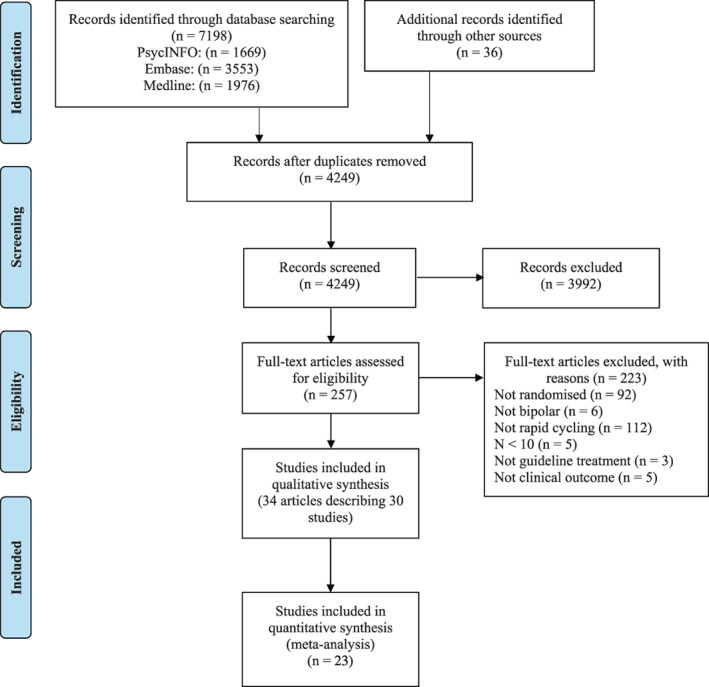
Objectives: Rapid cycling is a common and disabling phenomenon in individuals with bipolar disorders. In the absence of a recent literature examination, this systematic review and meta-analysis aimed to synthesise the evidence of efficacy, acceptability and tolerability of treatments for individuals with rapid cycling bipolar disorder (RCBD).
Method: A systematic search was conducted to identify randomised controlled trials assigning participants with RCBD to pharmacological and/or non-pharmacological interventions. Study inclusion and data extraction were undertaken by two reviewers independently. The primary outcome was continuous within-subject RCBD illness severity before and after treatment. Pre-post random effects meta-analyses were conducted for each outcome/intervention arm studied, generating a standardised effect size (hedge's g) and 95% confidence interval (CI).
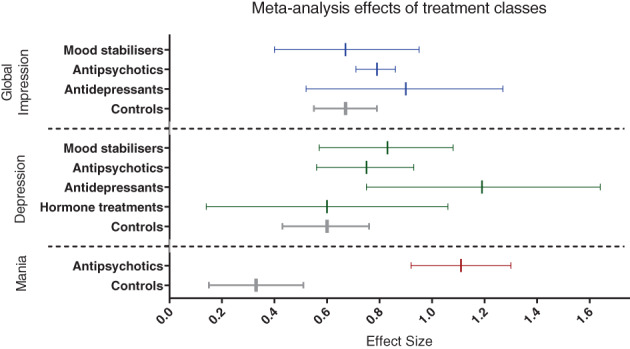
Results: A total of 34 articles describing 30 studies were included. A total of 16 separate pharmacological treatments were examined in contrast to 1 psychological therapy study. Only quetiapine and lamotrigine were assessed in >5 studies. By assessing 95% CI overlap of within-subject efficacy effects compared to placebo, the only interventions suggesting significant depression benefits (placebo g = 0.60) were olanzapine (with/without fluoxetine; g = 1.01), citalopram (g = 1.10) and venlafaxine (g = 2.48). For mania, benefits were indicated for quetiapine (g = 1.01), olanzapine (g = 1.19) and aripiprazole (g = 1.09), versus placebo (g = 0.33). Most of these effect sizes were from only one trial per treatment. Heterogeneity between studies was variable, and 20% were rated to have a high risk of bias.
Conclusions: While many interventions appeared efficacious, there was a lack of robust evidence for most treatments. Given the limited and heterogeneous evidence base, the optimal treatment strategies for people with RCBD are yet to be established.
Keywords: bipolar disorders; meta-analysis; rapid cycling; systematic review; treatment.
© 2022 The Authors. Acta Psychiatrica Scandinavica published by John Wiley & Sons Ltd.
Conflict of interest statement
In the last 3 years: Rebecca Strawbridge declares an honorarium from Lundbeck; Allan H. Young declares honoraria for speaking from Astra Zeneca, Lundbeck, Eli Lilly, Sunovion, honoraria for consulting from Allergan, Livanova and Lundbeck, Sunovion, Janssen, and research grant support from Janssen; Sameer Jauhar has received honoraria for educational talks given for Lundbeck, Sunovian and Janssen, on antipsychotics; Nefize Yalin has worked on studies conducted together with Janssen Cliag, Corcept Therapeutics and COMPASS Pathways. No other conflicts of interest are declared.
Figures
References
-
- Diagnostic and Statistical Manual of Mental Disorders: DSM‐5. 5th ed. American Psychiatric Association; 2013. doi‐org.db29.linccweb.org/10.1176/appi.
