. 2022 Aug;298(8):102214.
doi: 10.1016/j.jbc.2022.102214. Epub 2022 Jun 30.

Overexpression of MRX9 impairs processing of RNAs encoding mitochondrial oxidative phosphorylation factors COB and COX1 in yeast

Affiliations

Overexpression of MRX9 impairs processing of RNAs encoding mitochondrial oxidative phosphorylation factors COB and COX1 in yeast

Jhulia Almeida Clarck Chagas et al. J Biol Chem. 2022 Aug.

Abstract

Mitochondrial translation is a highly regulated process, and newly synthesized mitochondrial products must first associate with several nuclear-encoded auxiliary factors to form oxidative phosphorylation complexes. The output of mitochondrial products should therefore be in stoichiometric equilibrium with the nuclear-encoded products to prevent unnecessary energy expense or the accumulation of pro-oxidant assembly modules. In the mitochondrial DNA of Saccharomyces cerevisiae, COX1 encodes subunit 1 of the cytochrome c oxidase and COB the central core of the cytochrome bc1 electron transfer complex; however, factors regulating the expression of these mitochondrial products are not completely described. Here, we identified Mrx9p as a new factor that controls COX1 and COB expression. We isolated MRX9 in a screen for mitochondrial factors that cause poor accumulation of newly synthesized Cox1p and compromised transition to the respiratory metabolism. Northern analyses indicated lower levels of COX1 and COB mature mRNAs accompanied by an accumulation of unprocessed transcripts in the presence of excess Mrx9p. In a strain devoid of mitochondrial introns, MRX9 overexpression did not affect COX1 and COB translation or respiratory adaptation, implying Mrx9p regulates processing of COX1 and COB RNAs. In addition, we found Mrx9p was localized in the mitochondrial inner membrane, facing the matrix, as a portion of it cosedimented with mitoribosome subunits and its removal or overexpression altered Mss51p sedimentation. Finally, we showed accumulation of newly synthesized Cox1p in the absence of Mrx9p was diminished in cox14 null mutants. Taken together, these data indicate a regulatory role of Mrx9p in COX1 RNA processing.

Keywords: Saccharomyces cerevisiae; intron processing; mitochondrial translation.


Conflict of interest statement

Conflicts of interest The authors declare that they have no conflicts of interest with the contents of this article.

Figures

Figure 1
Figure 1
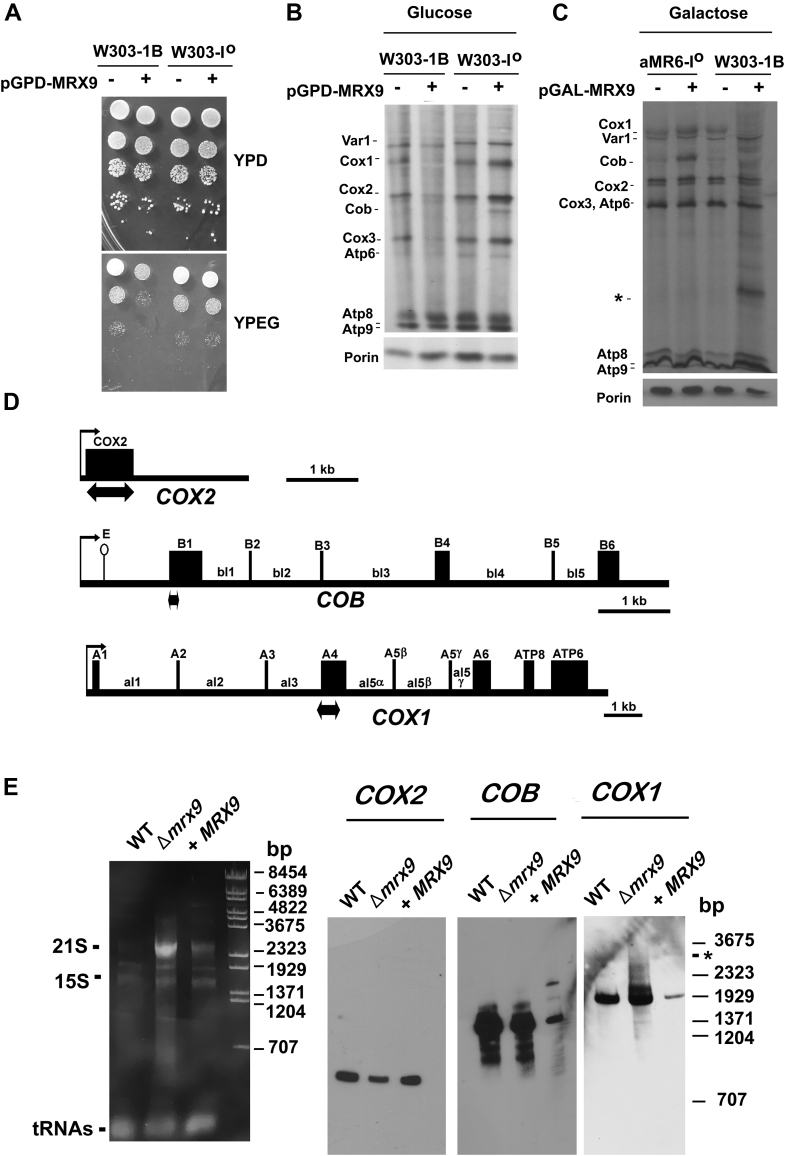
Overexpression of MIOREX components and analyses of mitochondrial translation properties.A and B, newly synthesized mitochondrial translation products were analyzed from the indicated strains as described in the Exprimental procedures section. The radiolabeled bands corresponding to the mitochondrial gene products are marked in the margins as indicated: subunits 1 (Cox1), subunit 2 (Cox2), subunit 3 (Cox3) of cytochrome c oxidase; subunit 6 (Atp6), subunit 8 (Atp8), and subunit 9 (Atp9) of ATP synthase; cytochrome b subunit (Cyt b) of ubiquinol cytochrome c reductase; the mitoribosome Var1 protein. Membranes were also probed against antiporin antibodies for loading control. The number of petites that arose in the experiments is indicated in the bottom of the panels.
Figure 2
Figure 2
MRX9 mutants phenotypes.A, growth properties of mrx9Δ mutant spotted on rich glucose (YPD) and rich nonfermentable ethanol–glycerol (YPEG) media; plates were photographed after 2 days of growth. B, mitochondrial newly synthesized products from the WT and mrx9Δ mutant were identified as in Figure1. C, steady-state level of the indicated mitochondrial proteins in the WT were compared to the strain overexpressing MRX9 (+MRX9) and the mrx9Δ null mutant, Coq3p and Coq4p are components of the CoQ synthome (90), Cob and Rip1p of the respiratory complex III (CIII), Cox1p and Cox2p—complex IV (CIV), Atp6—complex V (CV), uL24 is a component of the 54S subunit of the mitoribosome (LSU), Prx1 is a soluble mitochondrial protein, and Porin is a component of the mitochondrial outer membrane. Bands intensities were evaluated and compared using the histogram for pixels densitometry of the Adobe Photoshop program. D, enzymatic activity of the ubiquinol cytochrome c reductase (CIII) measured by the rate of cytochrome c reduction, and the activity of the cytochrome c oxidase (CIV) measured by the rate of reduced cytochrome c oxidation. Data points were obtained from three independent experiments ∗p< 0.05 versus WT.
Figure 3
Figure 3
Comparison of mitochondrial protein synthesis in COX mutants harboring or not mrx9 deletion and overexpressing MRX9.A, the indicated strains containing the mrx9Δ deletion (+) and the original strains (−) were grown in rich galactose media and cells labeled for the analyses of mitochondrially encoded newly synthesized products as indicated in the methods sections. B, newly synthesized mitochondrial products from COX mutants transformants harboring the pMRX9-GAL (+) were also analyzed from cells grown in galactose-rich media The respective mitochondrial products were identified as in Figure 1. Growth of mam33 mutant transformed or not with MRX9 was also compared to the WT strains. Membranes were also probed against antiporin antibodies for loading control.
Figure 4
Figure 4
Evaluation of MRX9 overexpression and adaptation to the respiratory metabolism.A, Mrx9p-HA content obtained from mitochondria isolated from the indicated strains grown in galactose media. Mitochondrial protein extracts were separated on SDS-PAGE for membrane transfer and immunodecoration with anti-HA. Ponceau staining is shown below. B, growth properties of the indicated strains spotted on rich glucose (YPD) and rich nonfermentable ethanol–glycerol (EG) media from cells at exponential fermentative growth. The EG plates were photographed after 1 day and 2 days as indicated; the YPD plate was photographed after 2 days of growth. C, mitochondrial newly synthesized products of the indicated strains were labeled from glucose-grown cells at exponential phase. The indicated products on the left are the same described in Figure 1. D, growth of GPD-MRX9 transformants were also assessed from culture cells pregrown on glucose or galactose and spotted on YPD and YPEG at exponential logarithmic phase. Plates were photographed after 1 day at 30 °C. E, mitochondrial translation properties from glucose or galactose grown cells as indicated. The signals “−” and “+” indicate the presence of the correspondent plasmid in the strain. The respective mitochondrial products were identified as in Figure 1.
Figure 5
Figure 5
Mrx9p is in the mitochondrial inner membrane facing the matrix side.A, mitochondrial proteins isolated from cells expressing the Mrx9p-HA constructs (Mit) were sonicated and centrifuged, obtaining supernatant (S) and pellet (SMP). The pellet was suspended in carbonate salt and centrifuged again, with a new super (CS) and pellet (CP). The distribution of Mrx9p-HA in the different fractions was assessed using an anti-HA antibody; the solubilization was also checked using an antibody against the matrix soluble Kgd2p and the inner membrane protein Sco1p. B, mitochondria containing the Mrx9-HA (Mit) were osmotically challenged with Hepes buffer generating mitoplasts devoid of the outer membrane and the intermembrane compartment (Mp). Mitochondria and mitoplasts were digested (+) or not (−) with proteinase K to test the availability of the indicated tested proteins to digestion.
Figure 6
Figure 6
The Mrx9-HA sedimentation pattern and the assembly of the mitoribosome 54S and 37S subunits were assessed from the strain expressing MRX9-HA construct with its endogenous promoter (WT/MRX9-HA) and with the GAL10 promoter (+GAL/MRX9-HA) and in the mrx9 null mutant (mrx9Δ). Mitochondrial proteins were obtained from galactose grown cells and extracted in the presence of 0.5 mM MgCl2 and the indicated detergent (0.8% Triton – A, 0.8% digitonin B). The extracts were sedimented in a linear sucrose gradient (1M to 0.3 M as represented by the gray bar). Fractions were collected from the bottom (1) to top (14). The Western blots were assayed for anti-HA, anti-bL31 (54S component), anti-mS37 (37S component), anti-Mss51p, and anti-Prx1p (soluble—sedimentation control). Prx1p is shown in two bands U (unprocessed) and P (processed), which are dependent on Oct1p/Imp processing state (65). The structure of the mitoribosome (74S), its large (54S), and small subunit (37S) are represented on the bottom of panels (A and B), based on the sedimentation properties of bL31 and mS37.
Figure 7
Figure 7
MRX9 excess toxicity is dependent on the presence of mitochondrial introns.A, glucose-grown cells of the indicated strains were spotted on rich glucose media (YPD) and rich ethanol–glycerol media (YPEG) and photographed after 2 days at 30 °C. B and C, mitochondrial newly synthesized products were labeled from the indicated strains harboring (+) or not (-) the indicated MRX9 plasmid. Cells at exponential logarithmic growth (B in glucose, C in galactose) were incubated in the presence of methionine-cysteine 35S mixture and the mitochondrial products identified as in Figure 1. D, schematic representation of the W303-1B yeast strain mitochondrial primary RNA transcripts. COB and COX1 exons are represented with capital letters and the introns with lowercases letters, double arrows positioned the probes employed in the Northern blots as follows: COX2 entire coding sequence, COB a 23 nucleotide primer positioned just after the first ATG (Table S2, (95)); COX1 exon a4 entire sequence. Scale and graphics were based on a previous review (77). E, mitochondrial RNAs from the indicated strains were extracted and separated in a 1% agarose gels with a BsteII digest of λ phage serving as a size standard. The ethidium-bromide stained gel on the left is representative of one extraction, the base pairs sizes of the standard fragments are indicated on the right. RNAs were transferred to a nylon membrane, hybridized to 3′end biotin-conjugated probes for COB, COX1, and COX2 depicted in (D). The asterisk ∗ between 3675 and 2323 indicates a faint band of a partially processed COX1.
Figure 8
Figure 8
MRX9 excess impairs proper activation of the reporter ARG8munder control of COB and COX1 5′ UTR. Mitochondrial mutants strains cox1Δ (cox1::ARG8), cox2Δ (cox2::ARG8), cobΔ (cob::ARG8), and atp9Δ (atp::ARG8) and the same strains transformed with the GAL-MRX9 fusion (+MRX9) were grown overnight in rich galactose media. Cells were spotted on minimal galactose (GAL) and minimal glucose without supplementation (GLU) and supplemented with arginine (GAL + Arg) (GLU + ARG). On the right, a depicted panel of the respective disrupted gene. Plates were photographed after 3 days of growth at 30 °C.
Figure 9
Figure 9
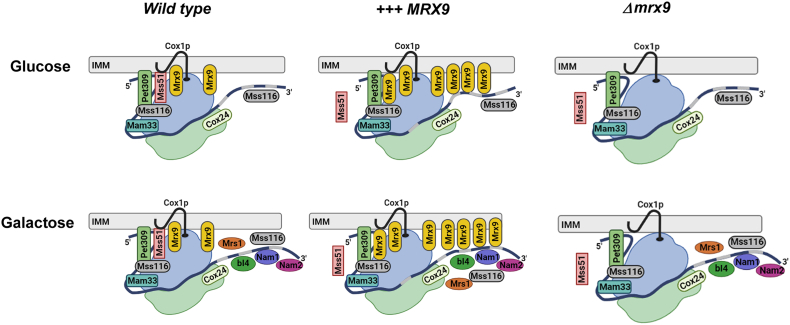
Model for Mrx9p function in COX1 processing and translation. In the WT, Mrx9p associated with the mitochondrial inner membrane (IMM) and the mitoribosome. COX1 mRNA starts its translation before all intervening sequences (in gray) are processed and concomitantly with the insertion of the nascent polypeptide (Cox1p) in the IMM (1, 4, 40). Optimal Cox1p translation requires Pet309p, Mss51p, Mss116p, Mam33p, Mrx8p, and Cox24p (4, 22, 25, 26, 27, 28, 29). In galactose, expression of nuclearly encoded mitochondrial proteins is not repressed and their steady-state level elevated inside the organelle, including those involved in intron processing (77). Some of them depicted in the panel: Mrs1p, Mss116p, Cox24p, Nam1p, Nam2p, and the mitochondrial bI4 maturase, which function depends on Cbs2p (68). The accumulation of these factors intensifies the mitochondrial protein synthesis. When MRX9 is overexpressed (+++MRX9) in glucose (GPD-MRX9 construct), our data show destitute mitochondrial protein synthesis; in galactose (GAL-MRX9 construct), its excess lead to dislocation of Mss51p from the activation complex, interference in the 5′ UTR sequence and impairment in intron processing. Finally, in the null mutant (Δmrx9), Mss51p is not optimally recruited to the 5′ UTR activation complex.

References

    1. Ott M., Amunts A., Brown A. Organization and regulation of mitochondrial protein synthesis. Annu. Rev. Biochem. 2016;85:77–101. - PubMed
    1. Dujon B. Mitochondrial genetics revisited. Yeast. 2020;37:191–205. - PubMed
    1. Derbikova K.S., Levitsky S.A., Chicherin I.V., Vinogradova E.N., Kamenski P.A. Activation of yeast mitochondrial translation: who is in charge? Biochemistry. 2018;83:87–97. - PubMed
    1. Fox T.D. Mitochondrial protein synthesis, import, and assembly. Genetics. 2012;192:1203–1234. - PMC - PubMed
    1. Khalimonchuk O., Bird A., Winge D.R. Evidence for a pro-oxidant intermediate in the assembly of cytochrome oxidase. J. Biol. Chem. 2007;282:17442–17449. - PubMed

Publication types

MeSH terms

LinkOut - more resources